Support

Château d'If

About

The Château d'If is a famous fortress and former prison located on a small island in the Frioul archipelago in the Mediterranean Sea, just a few kilometers off the coast of Marseille, France. It is one of the most recognizable and intriguing historical landmarks in the region, shrouded in mystery and literary legend.
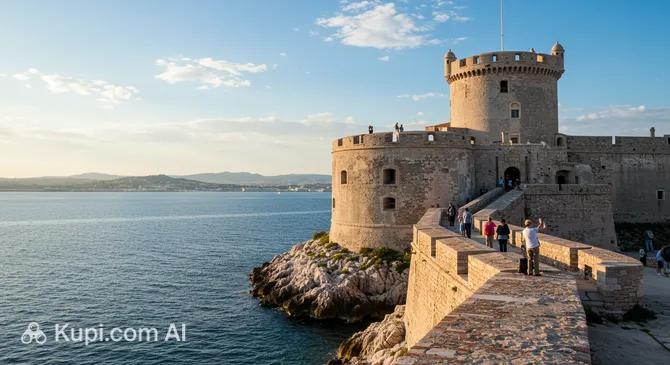
Château d'If. Illustration.
Source: Kupi.com AI

Traveler photos:

Constructed in the 16th century by order of King Francis I, the castle was originally intended to defend the city of Marseille from naval invasions. However, its impregnable walls and isolated island location soon led to its new, darker role as a state prison. For centuries, it held political prisoners, Huguenots, and others who opposed the regime.

The Château d'If gained international renown through Alexandre Dumas' immortal novel, "The Count of Monte Cristo." Although the protagonist, Edmond Dantès, is a fictional character, the castle's grim atmosphere and the stories of its actual prisoners inspired the writer. Many travelers visit this site to connect with the legend and imagine the trials of the famous count.

Today, the Château d'If is a major tourist attraction, drawing visitors from all over the world. Guests can explore the former prison cells, including the one attributed to Dantès, walk along the fortress ramparts to enjoy breathtaking panoramic views of Marseille and the vast sea, and learn more about the fascinating and sometimes eerie history of this unique structure.

Contacts

To plan your visit to the Château d'If, we recommend first checking the attraction's official website. There you can find the most up-to-date information on opening hours, ticket prices, and the ferry schedule for boats departing to the island from the Old Port of Marseille.

Since the Château d'If is located on an island and is accessible only by sea, be sure to confirm the maritime transport details in advance. Information can also be found at Marseille tourist offices or through companies that organize boat tours.

How to contactContact
AddressEmbarcadère Frioul If, 1 Quai de la Fraternité, 13001 Marseille, France
Phone number+33 6 03 06 25 26
Websitechateau-if.fr

What to Do

The primary activity at the Château d'If is, of course, exploring the fortress itself. Once on the island, you can immerse yourself in its centuries-old history by wandering through the courtyards, peeking into the grim casemates where prisoners once languished, and climbing narrow stone staircases to the watchtowers. Every corner of the castle holds its own secrets, allowing you to touch the harsh past of this legendary site located near Marseille.

A highlight of the visit is the literary heritage associated with Alexandre Dumas' novel. Many tourists come here specifically to see Edmond Dantès' "cell" and the hole supposedly dug by him and Abbé Faria. Although this is part of a legend designed to captivate visitors, touring these rooms provides a deeper immersion into the world of "The Count of Monte Cristo." Inside the castle, you will also find exhibits detailing both the true history of the Château d'If prison and its famous fictional inmate.

By climbing to the upper terraces and ramparts of the Château d'If, you will be rewarded with spectacular panoramic views. From here, you can enjoy a magnificent perspective of the city of Marseille, the other islands of the Frioul archipelago, and the endless horizon of the Mediterranean Sea. This is an excellent opportunity to take impressive photographs and feel the contrast between the castle's stern history and the natural beauty of France. A walk along the walls also allows you to appreciate the fortress's strategic location and imagine what it looked like during its years of active service.

Getting There

The Château d'If can only be reached by sea, as it is situated on an island in the Frioul archipelago, approximately 1.5 kilometers from the coast of Marseille. This makes the journey to the castle a small maritime adventure in its own right, offering picturesque views of the city and the sea.

The main departure point for ferries and excursion boats to the Château d'If is the Old Port (Vieux Port) of Marseille. This is a central and lively part of the city, easily accessible by public transport, including the metro (the nearest station is Vieux Port Hôtel de Ville), by bus, or even on foot if you are staying nearby. In the port, you will find several companies offering regular trips to If Island.

Boat tickets can be purchased directly at the ticket offices on the Old Port quayside or, in some cases, in advance via the transport companies' websites. It is recommended to check the schedule beforehand, as it can vary depending on the season and weather conditions. Usually, the boat trip to the island takes about 20-30 minutes. It is important to remember that the cost of the boat ticket typically does not include the admission fee to the castle itself—this will need to be purchased either upon arrival on the island or sometimes as part of a boat ticket package.

When planning your trip, especially during the height of the tourist season, it is worth arriving at the pier a bit early to avoid queues. Also, keep in mind that maritime transport is highly dependent on the weather: in cases of strong winds or rough seas, trips to the Château d'If may be cancelled or delayed. Therefore, before heading out, it is a good idea to check the weather forecast and, if possible, confirm the trip status with the carrier.

Nearest city: Marseille

History & Facts

Construction of the Château d'If began in 1524 by order of King Francis I and was completed in 1531. The primary objective was to bolster the defenses of Marseille, which had recently become part of France and required protection from naval attacks, particularly from Emperor Charles V. Interestingly, the residents of Marseille initially viewed the fortress's construction with suspicion, seeing it not so much as protection but as a tool for royal control over the city. Its location on a rocky island in the Frioul archipelago made the fortress virtually impregnable from the sea.

Although the Château d'If was built as a fortification, its massive walls and isolated position quickly dictated its new, darker fate as a state prison. From the mid-16th century, political prisoners, Huguenots during the Wars of Religion, and other figures who had fallen out of favor were exiled here. One famous real-life prisoner was Captain Jean-Baptiste Chataud, who was accused of bringing the plague to Marseille in 1720. Conditions varied greatly: wealthy prisoners could afford relatively comfortable "pistole" cells with windows and fireplaces, while the poor were cast into damp and dark underground dungeons known as "fosses."

The Château d'If achieved worldwide fame through Alexandre Dumas and his novel "The Count of Monte Cristo." While Edmond Dantès is a fictional character, the castle's grim reputation and the stories of its prisoners served as a powerful source of inspiration for the author. Curiously, the cells shown to tourists today as "Dantès' cell" and "Abbé Faria's cell"—complete with a supposed tunnel between them—were likely set up after the novel's publication to bolster the legend. Nevertheless, the fact remains: throughout the entire history of the Château d'If as a prison, there was never a recorded successful escape, only adding to its formidable reputation as an inescapable dungeon.

Time Needed

When planning a visit to the Château d'If, you should expect to spend approximately 2-3 hours for the entire trip, including the boat ride from Marseille and back. This time frame allows you to leisurely explore the island fortress, immerse yourself in its history, and enjoy the atmosphere of this legendary site.

The exploration of the castle itself usually takes from 1 to 1.5 hours. During this time, you can visit the main parts of the fortress: peek into the former prison cells, including those tied to the legend of the Count of Monte Cristo, stroll through the inner courtyards, and climb the ramparts. The upper tiers offer magnificent panoramic views of Marseille and the Mediterranean Sea, so be sure to leave some time for photography and contemplation.

Keep in mind that to the time spent at the Château d'If itself, you must add the boat travel time to and from the island (each leg takes about 20-30 minutes), as well as potential waiting time for the ferry, especially during peak tourist season. Consequently, the entire excursion to the famous fortress may take about half a day, which is worth considering when planning your Marseille itinerary.

Working Hours

The Château d'If is generally open to visitors year-round, though its operating hours vary by season. Typically, during the summer (roughly from April to September), the castle remains open longer, often from 10:00 to 18:00. In the winter (from October to March), the hours may be shorter, such as 10:00 to 17:00. It is also important to note that the castle may be closed on certain public holidays (e.g., January 1, May 1, December 25) or due to adverse weather conditions, as island access is dependent on sea travel. Last admission is usually 30-45 minutes before closing.

It is highly recommended to check for current information regarding opening hours and any potential changes just before your visit on the official Château d'If website or at Marseille tourist information centers. While pre-booking tickets for the castle itself is not always required, it can save time during the peak tourist season. Ferry tickets to the island are often purchased separately, and their schedule should also be confirmed in advance.

10:00 – 18:00

Nearby

A visit to the legendary Château d'If is undoubtedly one of the highlights of any trip to Marseille. However, to make your journey even more enriching and full of impressions, it is worth exploring other nearby attractions. Discovering the surrounding area will allow you to dive deeper into the history and culture of this unique region of France, perfectly complementing the experience of the stark walls of the famous island fortress.

Near the Château d'If, both on the Marseille mainland and on the neighboring islands of the Frioul archipelago, there are several points of interest that can enhance your itinerary. Below is a list of some of these sites, along with the approximate distance from the castle.

NameDistance
Saint-Estève Beach0.9 km
Fort Saint-Nicolas3.3 km
Fort Saint-Jean3.4 km
Place d'Armes3.4 km
Museum of European and Mediterranean Civilisations3.5 km
Cosquer Cave3.5 km
Notre-Dame de la Garde3.8 km

Have you reached the end of the page?

So the route has been studied inside and out