Support

Marseille Cathedral

About

Marseille Cathedral (Cathédrale Sainte-Marie-Majeure), also known as the Cathedral of Marseille, is one of the most majestic and recognizable landmarks in France. This grand Catholic church is striking for its unique architectural style, which harmoniously blends Byzantine, Romanesque, and Gothic motifs, making it unlike any other cathedral in the country. Located north of the Old Port, it is a true symbol of the city.
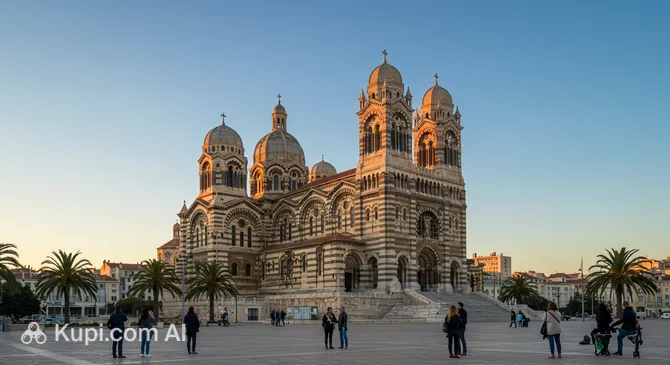
Marseille Cathedral. Illustration.
Source: Kupi.com AI

Traveler photos:

The scale of the cathedral is impressive: it reaches a length of 142 meters, and the height of its central dome is 70 meters, comparable in size to St. Peter's Basilica in Rome. The facade is adorned with two monumental 60-meter towers that give the building even more prominence. Thanks to its size, the cathedral can accommodate up to 3,000 people and is visible from afar, welcoming ships arriving at the port.

The interior of the church is just as monumental as its exterior. Visitors are greeted by a wealth of decorative elements: the walls and vaults are adorned with exquisite Venetian glass mosaics, while various types of marble and onyx brought from Italy and Tunisia were used in the finishing. Majestic arches, marble sculptures, and vibrant stained-glass windows create a special atmosphere of solemnity and spiritual uplift inside, making it a must-visit for anyone wanting to experience the history and culture of Marseille.

Contacts

To plan your visit to Marseille Cathedral (Cathédrale Sainte-Marie-Majeure) or to check the latest information such as opening hours and service schedules, you can use the official contact details. The cathedral is located in the heart of Marseille, and there are several ways to get in touch with its representatives.

How to contactContact
AddressPl. de la Major, 13002 Marseille, France
Phone number+33 7 72 15 60 10
Websitediocese-marseille.fr

What to Do

A visit to Marseille Cathedral offers many experiences both inside and out. Stepping inside, you can not only admire the majestic architecture but also explore its rich decor in detail. The interiors are decorated with exquisite mosaics, marble columns, and bright stained-glass windows, which together create a unique atmosphere of harmony and solemnity. Special attention should be paid to the main chapels, each with its unique design and historical significance: the Chapel of the Sacred Heart, the Chapel of Saint Lazarus, and the Chapel of the Virgin Mary.

In addition to touring the main space of the cathedral, visitors have other opportunities. From the outside, the church is a wonderful subject for photography due to its unusual striped masonry and monumental forms. The square in front of the cathedral offers picturesque panoramic views of the city and the port, which can be enjoyed at any time. It is also worth visiting the adjacent Old Cathedral ("La vieille Major"), the preserved part of the previous 12th-century church, which is an integral part of this unique historical ensemble.

Marseille Cathedral is not just an architectural monument but an active place of worship and an important cultural center for the city. Services are held regularly, open to believers and anyone wishing to connect with the spiritual life of Marseille. Additionally, organ music concerts and other cultural events are often held within its walls, allowing visitors to fully experience its magnificent acoustics and soulful atmosphere.

Getting There

Reaching Marseille Cathedral is quite easy thanks to its convenient location just north of the Old Port of Marseille. If you are in the city center, one of the most pleasant ways to get there is on foot. The walk from the famous Old Port (Vieux-Port) takes no more than 10–15 minutes and allows you to soak in the atmosphere of the coastal city, as the route passes through picturesque streets and is part of many popular walking trails.

For those who prefer public transport, the cathedral is also easily accessible. The nearest metro station is Joliette on line M2, just a few minutes' walk from the cathedral. Additionally, you can reach the site by taking tram line T2 to the same Joliette stop. Numerous city buses also stop nearby, including routes 49, 82, and 83, making it accessible from almost anywhere in the city.

If you are arriving in Marseille by train at the Marseille Saint-Charles main station, it is convenient to take the metro (line M2) to the aforementioned Joliette station. For those traveling by car, there are parking lots nearby, such as Parking Vieux-Port / La Major. Of course, taxis and ridesharing services are always available for maximum comfort, especially if you are traveling from the airport or more distant neighborhoods.

Nearest city: Marseille

History & Facts

The history of Marseille Cathedral dates back centuries, making it not just an architectural masterpiece but a true witness to the long history of Marseille. Christian churches have existed on this site since the 5th century. In the 12th century, a Romanesque predecessor was built here, serving as the city's main cathedral for several hundred years. Thus, the site where the cathedral stands was the city's spiritual heart long before its current grand appearance took shape.

The decision to build a new, larger cathedral was made in the mid-19th century at the initiative of Bishop Eugène de Mazenod, who wanted to give the city a temple worthy of its status. The project was so significant for France that on September 26, 1852, Emperor Napoleon III personally laid the foundation stone. This event marked the beginning of a massive construction project that lasted over 40 years and became one of the largest architectural undertakings of its time in the region.

Over the long years of construction, several prominent architects worked on the project. Initially led by Léon Vaudoyer, the work was continued by Henri-Jacques Espérandieu after Vaudoyer's death. Construction was completed in 1893, and the solemn consecration took place on May 6, 1897. One of the cathedral's most remarkable features is that part of the old Romanesque church, known as "La vieille Major," and its bell tower were preserved due to protests from local residents. Today, they stand beside the new building, creating a unique architectural ensemble where the past and present harmoniously coexist.

Time Needed

When planning a visit to Marseille Cathedral, you should expect to spend about 1–1.5 hours for a full tour. This time is usually sufficient to walk through the main halls without rushing, examine the impressive mosaics and architectural details, and take beautiful souvenir photos. During this period, you will have time not only to see the rich interior decor but also to fully enjoy the atmosphere of Marseille's historic center.

Of course, the duration of your visit may vary depending on your interests. If you are passionate about history, architecture, or religious art, you might need a bit more time to study the numerous chapels, sculptures, and unique marble and onyx finishes in detail. Additionally, it is worth spending a few minutes admiring the cathedral from the outside and enjoying the views from the square in front of it. Therefore, for a deeper immersion, you can easily plan for up to two hours.

Working Hours

Marseille Cathedral is open to visitors year-round, making it accessible to tourists in any season. As a rule, the cathedral is open daily, but hours may vary depending on the time of year. During the summer period (from April 1 to October 31), the church doors are open from 10:00 to 19:00. In the winter season (from November 1 to March 31), the opening hours are shorter, and the cathedral can be visited from 10:00 to 17:30.

It is important to keep in mind that on public holidays and during religious services (especially on Sundays), visiting hours may change, and access to certain parts of the cathedral may be restricted. Before your visit, it is highly recommended to check the current schedule on the cathedral's official website or at the Marseille tourism office. Admission to the cathedral is usually free, and no prior booking is required, although special conditions may apply for specific events.

10:00 – 19:00

Nearby

Visiting Marseille Cathedral is just the beginning of your journey through the rich historical heritage of Marseille. The area surrounding the cathedral is filled with other iconic sites just a few minutes' walk away, allowing you to dive deeper into the atmosphere of France's oldest city. Many of these attractions are located in the famous historic district of Le Panier, which is a living open-air museum in its own right.

Strolling through this neighborhood is a fascinating journey. You will find yourself in a labyrinth of narrow streets, ancient buildings, and cozy squares, where every corner holds its own story. To help you plan your route, we have compiled a list of interesting attractions located in the immediate vicinity of the cathedral.

NameDistance
Le Panier0.3 km
La Vieille Charité0.3 km
Cosquer Cave0.3 km
Museum of European and Mediterranean Civilisations0.4 km
Fort Saint-Jean0.5 km
Place d'Armes0.5 km
La Place des Canailles0.7 km

Have you reached the end of the page?

So the route has been studied inside and out