Support

Gallo-Roman Theatre

About

The Gallo-Roman Theatre in Lyon is one of the most impressive ancient landmarks in France, located on the scenic Fourvière Hill. This outstanding monument of Roman architecture is a silent witness to the rich history of a city that was one of the key centers of Gaul during the Roman Empire. Visiting the theatre allows you to literally touch the past and experience the greatness of an ancient civilization.
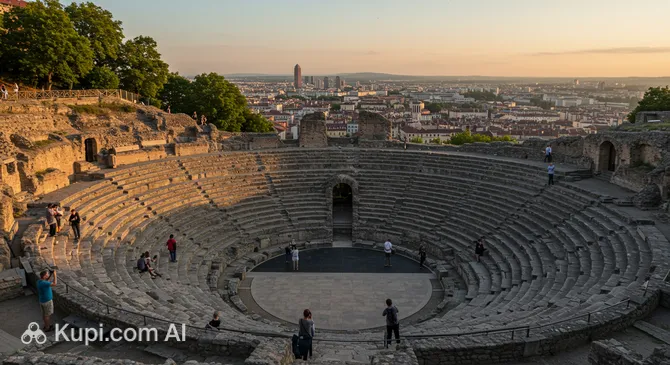
Gallo-Roman Theatre. Illustration.
Source: Kupi.com AI

Traveler photos:

The theatre is striking in its scale and atmosphere. Its classical amphitheater shape and well-preserved elements of stage architecture provide a vivid idea of how grand theatrical productions and other mass spectacles took place here thousands of years ago. Walking along its stone steps, it is easy to imagine the enthusiasm of the crowd and the skill of the ancient actors. This is not just a collection of ruins, but living history under the open sky.

The site is particularly valuable due to its location: the Gallo-Roman Theatre is situated in the immediate vicinity of the Museum of Gallo-Roman Civilization. This proximity allows you to combine a tour of ancient structures with an immersion into exhibits dedicated to the life, culture, and daily routines of the ancient Gauls and Romans. It is a unique opportunity to gain a comprehensive understanding of the ancient heritage of Lyon and all of France.

Contacts

The Gallo-Roman Theatre is part of the Lugdunum – Musée & Théâtres romains (Museum of Gallo-Roman Civilization) complex. For up-to-date visiting information, including opening hours, ticket prices, and the event schedule, you can contact them using the following details:

How to contactContact
Address17 Rue Cleberg, 69005 Lyon, France
Phone number+33 4 72 38 49 30
Websitewww.museegalloromain.grandlyon.com

What to Do

Visitors to the Gallo-Roman Theatre can freely walk across the well-preserved stone steps and climb to the upper tiers, which offer a magnificent panorama of modern-day Lyon. This is a unique opportunity not only to appreciate the scale of the ancient structure and feel its atmosphere but also to enjoy city views while feeling a connection across time. Imagine yourself as one of the thousands of spectators watching performances here over two millennia ago.

The theatre is open for free exploration, allowing every visitor to fully experience the spirit of antiquity. As you walk across its ancient stones, it is easy to imagine how exciting theatrical productions, gladiatorial battles, and important public meetings that defined the life of ancient Lugdunum — as Lyon was once called — unfolded in this arena.

Of particular interest is visiting the theatre during the summer, when it comes to life and becomes a venue for various cultural events. Concerts, festivals, and theatrical performances take place here under the open sky, reviving ancient traditions in a modern way. Additionally, do not miss the chance to visit the nearby Museum of Gallo-Roman Civilization (Lugdunum – Musée & Théâtres romains). Its collection will introduce you to unique archaeological finds that tell the story of Lyon and all of Gaul, the territory of modern-day France.

Getting There

The Gallo-Roman Theatre is conveniently situated on the picturesque Fourvière Hill overlooking Lyon, making it easily accessible for visitors. One of the most convenient and authentic ways to reach the theatre is by taking the F2 funicular. You will need to travel to the Vieux Lyon (Old Lyon) metro station and then transfer to the funicular heading towards the Minimes–Théâtres Romains stop. From this stop, it is just a few minutes' pleasant walk to the theatre, where you will find yourself at the gateway to ancient history.

For those who prefer to enjoy the city's views and atmosphere, there is a wonderful alternative — walking up. The route winds through the charming, narrow streets of Old Lyon, allowing you to fully experience the historical spirit of the area. This walk, while requiring some effort, will reward you with unforgettable impressions. Of course, you can always use a taxi, which will quickly take you from the city center or any other point directly to the foot of Fourvière Hill.

If you plan to travel by car, please note that there is parking available near the theatre. However, keep in mind that Fourvière Hill is a popular tourist spot, and during peak hours, especially during the tourist season, parking spaces may be limited and access roads can be congested. Therefore, to avoid unnecessary hassle and save time, it is recommended to prioritize public transport or taxis, which will provide a more comfortable and predictable journey to this outstanding landmark in France.

Nearest city: Lyon

History & Facts

The history of the Gallo-Roman Theatre dates back to the 1st century BC. Its construction began during a landmark period for Lyon, when the city, then known as Lugdunum, became the capital of the Three Gauls — the most important provinces of the Roman Empire in the lands of modern-day France. Most of the construction was completed around 19 BC. Later, in the 2nd century AD, the structure was significantly expanded; after this reconstruction, its stands could accommodate an impressive 20,000 spectators. This made it one of the largest theatres of its time.

Interestingly, the Gallo-Roman Theatre in Lugdunum was not just a place for spectacles and entertainment. It played a significant role as an important social and even political center. According to historical data, it was in this arena that representatives of various Gallic tribes gathered to discuss pressing political issues and public affairs. Some researchers see these gatherings as one of the early examples or prototypes of a parliamentary system, highlighting the theatre's unique significance far beyond its cultural function.

The fate of this grand structure was complex. In the Middle Ages, the Gallo-Roman Theatre, like many other ancient monuments, was partially destroyed and gradually covered with earth, remaining hidden from sight for many centuries. It was only in the 20th century, thanks to the efforts of archaeologists and restorers, that the theatre was thoroughly researched, carefully restored, and once again presented to the public in all its ancient splendor. Today, it is rightfully considered one of the main historical gems of Lyon and a vivid testament to the city's rich past.

Time Needed

To fully enjoy the atmosphere of the Gallo-Roman Theatre and the adjacent Museum of Gallo-Roman Civilization, it is recommended to set aside approximately 1.5 to 3 hours. This time is generally sufficient for a leisurely exploration of the majestic ruins, taking memorable photos, and immersing yourself in the museum's exhibits, which complement the experience of the theatre itself.

Of course, the duration of your visit may vary depending on personal interests. If you are passionate about history and archaeology, you might want to spend more time here, carefully studying every corner and exhibit. If you only plan a quick look at the theatre itself, an hour might be enough. However, to get a complete picture of this unique site, it is better to aim for the specified time range.

Keep in mind that this timeframe includes walking through the theatre itself, which is impressive in its scale, and visiting the museum. A relaxed pace will allow you not only to see but to feel the ancient spirit that lingers over this iconic Lyon landmark.

Working Hours

The grounds of the Gallo-Roman Theatre in Lyon are generally open to visitors daily and year-round. However, it is important to remember that specific opening hours may change depending on the season, as well as during special events or festivals held on its territory. Entry to the theatre grounds themselves is usually free, allowing you to enjoy its atmosphere without additional cost.

To get the most accurate and up-to-date information regarding access hours, as well as the need to purchase tickets for the adjacent Museum of Gallo-Roman Civilization or special events, it is highly recommended to check the official Lugdunum museum website or contact local tourist information centers directly before your visit. This will help you plan your visit in the best possible way and avoid any potential inconvenience.

DayOpening hours
MondayClosed
Tuesday11:00 – 18:00
Wednesday11:00 – 18:00
Thursday11:00 – 18:00
Friday11:00 – 18:00
Saturday10:00 – 18:00
Sunday10:00 – 18:00

Nearby

Visiting a place as significant as the Gallo-Roman Theatre in Lyon is a profound experience in itself. However, to make your journey even more rewarding and complete, it is worth paying attention to the attractions located nearby. Exploring the surrounding area will allow you to dive deeper into the city's atmosphere, discover new interesting corners, and gain a more holistic understanding of the rich history and culture of France.

After all, Lyon is a city where every stone breathes history, and often the most amazing discoveries await you just around the corner from famous tourist sites. Walking through the neighboring streets or visiting nearby museums and squares can offer just as many vivid emotions as your main visit to the Gallo-Roman Theatre. Below is a list of some interesting places located nearby.

NameDistance
Gallo-Roman Museum of Lyon-Fourvière0.1 km
Basilica of Notre-Dame de Fourvière0.4 km
Museum of Cinema and Miniature0.6 km
Traboules of Old Lyon0.7 km
Place Bellecour1 km
Hôtel-Dieu de Lyon1.3 km
Carmelo1.3 km

Have you reached the end of the page?

So the route has been studied inside and out