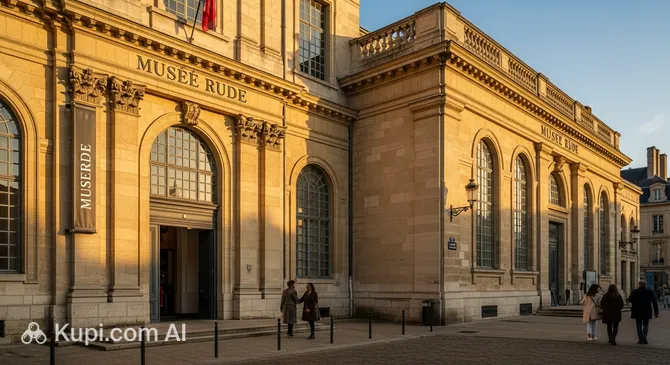
If you appreciate monumental art and history, be sure to visit the Musée Rude. Located in the heart of Dijon, this intimate museum is dedicated to the life and work of the outstanding French Romantic sculptor. France is rightfully proud of its native son, whose works have become symbols of national pride.
Rude Museum. Illustration.
Source: Kupi.com AI
Traveler photos:
The museum occupies an unusual space—the transept of the ancient Saint-Etienne Church, founded back in the 11th century. This combination of austere medieval architecture and expressive 19th-century plastic arts creates a unique atmosphere. Visitors can see life-size plaster casts and sketches of the master's most famous works here.
The main treasure of the collection is a cast of the legendary composition "La Marseillaise" (or "The Departure of the Volunteers of 1792"), the original of which adorns the Arc de Triomphe in Paris. Free admission makes this place accessible to every traveler wishing to experience fine art without unnecessary formalities.
Contacts
To clarify details of your visit or to organize a group tour, you can use the official contact information. We recommend checking for the latest updates on the museum's website before your trip.
In this cozy museum, you can closely examine the details of François Rude's grandiose works. Unlike in Parisian squares, here the massive figures are at eye level, allowing you to appreciate the expressive faces and the incredible dynamics of every muscle in his sculptures. A major highlight is studying the creation process of "La Marseillaise" through detailed casts.
In addition to viewing the exhibits, it is worth paying attention to the architecture of the Saint-Etienne Church itself. Walking through the hall where ancient Romanesque walls meet emotional 19th-century imagery gives a sense of a connection through time. After your visit, it's pleasant to relax in the adjacent Place François Rude, which is an ideal spot for photos and observing the city's slow-paced life.
Getting There
Finding the museum is easy, as it is located at 8 Rue Vaillant, just a few minutes' walk from the Palace of the Dukes of Burgundy. The entire historical center of the city is pedestrian-friendly and very compact, so a walk from the main squares to the museum will be a pleasant addition to your tour.
If you prefer public transport, take the tram to the "Place Darcy" stop or use bus routes 1, 3, and 5, which run through the center. From the railway station, the walk takes about 20 minutes, while the tram will get you there in just 5–7 minutes. For those who enjoy active travel, the city offers the Vélodi bike-sharing service.
Nearest city: Dijon
History & Facts
François Rude, born in Dijon in 1784, rose from being a blacksmith's son to becoming the greatest sculptor of his time. His work served as a bridge between Classicism and Romanticism, bringing life, emotion, and patriotic fervor to cold stone. It is thanks to his talent that the world saw one of the most recognizable reliefs on the Arc de Triomphe in Paris.
The museum itself was founded in 1947. The choice fell on the then-abandoned Saint-Etienne Church, which allowed for the preservation of an architectural monument while creating a worthy home for the legacy of the great Dijon native. This decision highlighted the continuity of generations in Burgundy's cultural capital.
Interestingly, the exhibition includes the plaster casts that the master used as benchmarks. They allow visitors to trace the evolution of his style from strict restraint to the unbridled energy characteristic of his later works. The museum remains an important testament to how the city carefully preserves the memory of its great sons.
Time Needed
Since the Musée Rude occupies only one hall, visiting it won't take much of your time. Usually, 30–45 minutes is enough for tourists to leisurely study all the displayed casts and read the information stands. It is a perfect option for a cultural break during a busy walk through the city center.
If you are a passionate fan of sculpture or architecture, you might spend a bit more than an hour here, immersing yourself in the sculptural details and studying the history of the ancient church. The compactness of the exhibition makes it easy to fit into any travel itinerary.
Working Hours
When planning your stroll through Dijon, keep in mind that the museum is open most of the week. The standard opening hours are from 09:30 to 18:00. Please note that Tuesday is a day off when the museum doors are closed to the public.
During the summer period, the schedule may change slightly with a lunch break, so we strongly recommend checking the current opening hours on the official website or at the city's tourist office before your visit to ensure your trip is as comfortable as possible.
Day
Working hours
Monday
09:30–18:00
Tuesday
Закрыто
Wednesday
09:30–18:00
Thursday
09:30–18:00
Friday
09:30–18:00
Saturday
09:30–18:00
Sunday
09:30–18:00
Nearby
Exploring the surroundings of this site will allow you to dive deeper into the atmosphere of the Burgundian capital. The city of Dijon is famous for its architectural ensemble, with a historical treasure hidden around literally every corner. The walking distance between key sites makes exploring easy and tireless.
Each of these locations complements the overall picture of the region's cultural wealth and is a must-visit for those who want to see Dijon in all its glory.