Support

Basilica of Notre-Dame de Fourvière

About

Standing majestically atop Fourvière Hill, overlooking Lyon, is one of the most recognizable landmarks in France — the Basilica of Notre-Dame de Fourvière. This Catholic church dedicated to the Virgin Mary is not just an important pilgrimage site, but also a true architectural dominant visible from many points in the city. Its snow-white towers and elegant silhouette have become an integral part of the cityscape and a symbol of Lyon.
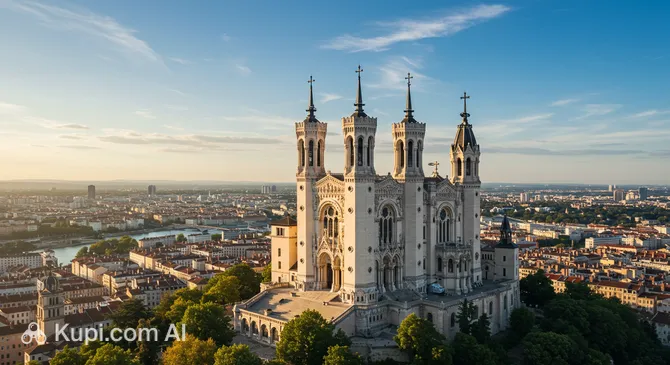
Basilica of Notre-Dame de Fourvière. Illustration.
Source: Kupi.com AI

Traveler photos:

The architecture of the basilica, designed by Pierre Bossan in the late 19th century, is striking for its eclectic style. It harmoniously combines elements of neo-Byzantine and neo-Gothic movements, making its appearance unusual for the country's religious buildings. The structure consists of two tiers: the upper, richly decorated church, and the lower, more austere crypt dedicated to Saint Joseph.

The interior of the temple leaves a lasting impression. The walls and vaults of the basilica are covered with magnificent mosaics telling biblical stories and the history of Lyon. Vibrant stained-glass windows fill the space with colored light, while numerous sculptures and columns made of marble and granite add solemnity and grandeur to the interior. A visit to Notre-Dame de Fourvière is an opportunity not only to touch the spiritual life of the city but also to enjoy stunning panoramic views that open from the hill across all of Lyon.

Contacts

If you are planning to visit the basilica and want to check current details, such as opening hours or event schedules, it is recommended to use the official contact information. All necessary information can be found on the website or by calling the provided phone number.

How to contactContact
Address8 Pl. de Fourvière, 69005 Lyon, France
Phone number+33 4 78 25 13 01
Websitewww.fourviere.org

What to Do

Visiting the Basilica of Notre-Dame de Fourvière is a true immersion into the world of art and spirituality. Inside, a magnificent interior awaits you, where every detail tells its own story. Visitors can spend hours examining the impressive mosaics decorating the walls and vaults, studying the themes in the vibrant stained-glass windows, and admiring the numerous sculptures. This is a place where you can stroll slowly, soaking in the atmosphere of grandeur and tranquility.

One of the main magnets for tourists is the panoramic terrace, which offers perhaps the best view of Lyon and its surroundings. From here, the entire city is visible as if in the palm of your hand. In addition to the main upper church, the lower, more modest crypt dedicated to Saint Joseph is also open to the public. Next to the temple is the chapel tower with its gilded statue of the Virgin Mary, which is also open for visitors.

The basilica is not just a museum but an active church. Services are held regularly and are open to anyone who wishes to experience the spiritual life of this site. Furthermore, Notre-Dame de Fourvière often hosts organ music concerts, filling the space with majestic sounds and creating an unforgettable experience.

Getting There

The Basilica of Notre-Dame de Fourvière is located at the top of the hill of the same name, which overlooks the historic part of Lyon. The most convenient and memorable way to reach the temple is by funicular. One of its lines (Funiculaire de Fourvière) starts right at the Vieux Lyon metro station and takes passengers directly to the entrance of the basilica. This short trip will not only save your energy but also serve as a mini-adventure.

If you enjoy walking, climbing the hill on foot is an excellent alternative. Picturesque paths and staircases lead from the Old Town to the basilica through the Rosary Gardens. Although the climb is quite steep, it rewards you with gradually unfolding, truly breathtaking views of the city's rooftops and the Saône River. This is a wonderful opportunity to enjoy the beauty of Lyon at a leisurely pace.

You can also reach Notre-Dame de Fourvière by public transport or car. City buses run to the landmark, which is convenient for those traveling from more distant districts. Taxi services are also an option. There is parking near the basilica, but keep in mind that it can be crowded during the peak tourist season.

Nearest city: Lyon

History & Facts

The history of the Basilica of Notre-Dame de Fourvière is rooted in the distant past. As early as the 12th century, in 1168, the first church in honor of the Virgin Mary was built on this hill. Although the temple was destroyed during religious wars in the 16th century, the site did not lose its spiritual significance. A turning point in the history of the sanctuary was 1643, when Lyon was struck by a plague epidemic. In desperation, the townspeople turned to the Virgin Mary in prayer, promising to pay her tribute if the city was saved. The disaster bypassed Lyon, and since then, a solemn procession has taken place here every September 8th as a sign of gratitude.

The modern basilica building we see today is the fulfillment of the promise made by the city's residents. Its construction began in the 19th century as a symbol of gratitude for saving Lyon from calamities. The temple was built using donations from citizens between 1872 and 1884. The first stone was laid on December 7, 1872, and the solemn consecration of the entire basilica took place on June 16, 1896. In the following year, 1897, the church was granted the honorary status of a minor basilica.

Work on the magnificent interior decoration continued for many decades after the main construction was finished. The interiors were finally completed only in 1964, revealing stunning mosaics, stained glass, and sculptures that continue to evoke admiration today. The significance of this site for world culture was officially recognized when the historic part of Lyon, including Fourvière Hill and its basilica, was added to the UNESCO World Heritage list. This highlights not only the religious but also the immense historical and architectural value of the basilica for all of France and the world.

Time Needed

To fully experience the Basilica of Notre-Dame de Fourvière and its surroundings, it is recommended to set aside 1.5 to 2.5 hours. This will be enough time to explore the two levels of the temple without rushing: the richly decorated upper church with its magnificent mosaics and stained glass, and the more austere lower crypt. Additionally, you will have time to enjoy the spectacular panoramic views of Lyon from the terrace in front of the basilica.

If you are short on time, a quick tour of the main hall and the view from the observation deck will take about 45–60 minutes. However, if you want to immerse yourself more deeply in the atmosphere, you should plan for more time. For instance, you could visit the small museum of religious art located on-site or climb one of the towers as part of a special guided tour for an even more impressive view. Remember that Notre-Dame de Fourvière is not only an architectural monument of France but also an active church, so if you wish to attend a service or an organ music concert, your visit may last longer.

Working Hours

The Basilica of Notre-Dame de Fourvière is open to visitors year-round, making it accessible for a visit at any time. As a rule, the temple is open daily from 7:00 to 19:00. Entry to the main part of the basilica, including the upper church and the lower crypt, is free of charge for everyone, and no prior booking is required for self-guided tours.

It is worth noting that on religious holidays or during services, the schedule may change, and access to some parts of the church may be temporarily restricted. Therefore, it is highly recommended to check the current opening hours on the official website of the landmark before your visit. Also, keep in mind that there may be a separate fee for visiting certain areas, such as the rooftop observation deck, or for participating in themed guided tours.

DayOpening hours
Monday7:00 – 20:00
Tuesday7:00 – 20:00
Wednesday7:00 – 20:00
Thursday7:00 – 20:00
Friday7:00 – 20:00
Saturday7:00 – 20:00
Sunday7:00 – 21:00

Nearby

A visit to the Basilica of Notre-Dame de Fourvière is just the beginning of your acquaintance with the rich historical heritage of Fourvière Hill and Old Lyon. To fully experience the atmosphere of this unique place, it is worth taking a stroll through its surroundings. Right next to the basilica are other iconic landmarks that will allow you to dive deeper into the city's history and culture.

Fourvière Hill, often referred to as "the praying hill," preserves traces of different eras — from antiquity to the present day. Exploring the nearby museums, ancient ruins, and picturesque streets will enrich your impressions and make your journey through Lyon truly unforgettable.

NameDistance
Gallo-Roman Museum of Lyon-Fourvière0.3 km
Gallo-Roman Theatre0.4 km
Traboules of Old Lyon0.4 km
Museum of Cinema and Miniature0.4 km
Place Bellecour0.9 km
Carmelo1 km
Palace of the Stock Exchange of Lyon1.1 km

Have you reached the end of the page?

So the route has been studied inside and out