Support

Grenoble-Isere Airport

About the Airport

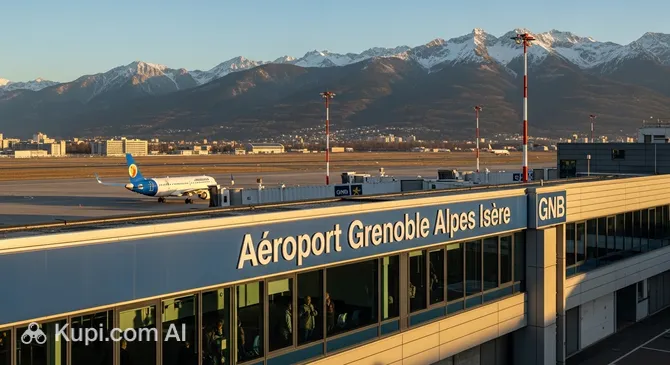
Grenoble-Isère Airport. Source: Kupi.com Binoculars

This airport is not merely a transport hub, but a true gateway to the winter fairytale of the Alps. Unlike the bustling and vast Saint-Exupéry, Grenoble-Isère (GNB) comes to life specifically when the mountain peaks are covered in snow, transforming into a cosy haven for thousands of skiers and snowboarders. Landing here is a unique pleasure in itself: the aircraft descends surrounded by majestic peaks, and as soon as you step onto the stairs, you breathe in the crystal-clear mountain air, knowing that your adventure has begun.

IATA CodeGNB
ICAO Code LFLS
City Saint-Étienne-de-Saint-Geoirs (serves Grenoble and Lyon)
Distance to City Centre ~45 km to Grenoble, ~85 km to Lyon
Status International (predominantly seasonal)
Passengers per Year ~250,000 (main traffic during the winter season)
ScheduleOnline board

Airport Features and Advantages:

Grenoble Alpes Isère Airport has a distinctly seasonal character. Life here is busiest from December to April, when charter and scheduled flights deliver tourists to France's best ski resorts. Thanks to its specialization in winter tourism, logistics are thought out to the smallest detail: counters for oversized baggage (skis and snowboards) operate quickly and efficiently.

The main advantage is its strategic location. It is much faster to reach legendary resorts such as Alpe d'Huez or Les Deux Alpes from here than from Lyon or Geneva. The terminal is compact, which eliminates long walks through endless corridors, and transfer buses often wait for passengers right outside the arrivals area exit.

Despite its modest size, the airport offers everything necessary for a comfortable wait: from cafes with local pastries to duty-free shops. It is the ideal choice for those who value their time and want to be on the slopes as soon as possible after landing.

Contact Information

  • Official Airport Website: www.grenoble-airport.com (information available in English and French)
  • Help Desk Phone: +33 4 76 65 48 48 (general inquiries, flight schedules)
  • Airport Address: Aéroport Grenoble Alpes Isère, 38590 Saint-Étienne-de-Saint-Geoirs, France (approximately 45 km from Grenoble and 85 km from Lyon)
  • Email: info@grenoble-airport.com (for general queries)
  • Airport Social Media: Current news and seasonal updates are available on the official pages on Facebook (Grenoble Alpes Isère Airport) and Instagram.
  • Lost Luggage Information: The baggage tracing service is located in the arrivals area. Phone: +33 4 76 65 55 34, email for inquiries: bags@grenoble-airport.com
  • Passenger Support Contacts: The information desk is located in the main terminal hall and operates during flight hours. A feedback form is also available on the website under the "Contact" section.

How to Get to the Airport

It is important to understand that although Grenoble Alpes Isère Airport (GNB) is often considered one of the hubs of the Auvergne-Rhône-Alpes region, it is not located in Lyon itself, but in the commune of Saint-Étienne-de-Saint-Geoirs. This is approximately 85 kilometres southeast of Lyon. Unlike the region's main air hub, Lyon-Saint Exupéry International Airport, getting here requires a little more time and planning, especially if you are not travelling by rental car.

Transfer Buses (Shuttles)
This is the most popular mode of transport for tourists arriving for a ski holiday. Dedicated shuttle buses (such as Ben’s Bus or Actibus) run between the airport and major resorts, as well as the Grenoble bus station.
If you are travelling from Lyon, there are practically no direct regular buses to GNB. The optimal route is to travel to the Grenoble Bus Station (Gare Routière), from where regular shuttles depart to the airport aligned with flight arrivals and departures.
Cost: A ticket from Grenoble to the airport costs about 15–20 Euros one way. Travel time from Grenoble station is about 45 minutes.

Train + Bus
Grenoble-Isère Airport does not have its own railway station. The nearest stations are in Grenoble and Voiron.
For travel from Lyon: 1. Take a TER train from Lyon Part-Dieu station towards Grenoble. 2. Get off at Grenoble station (travel time ~1 hour 25 minutes) or Voiron (~45 minutes). 3. From Grenoble station, transfer to a direct shuttle to the airport. From Voiron, you can take a taxi (about 15–20 minutes drive).
Total Cost: Train (15–25 Euros) + bus/taxi will amount to approximately 35–50 Euros per person.

Taxi and Private Transfer
The most comfortable, though more costly, option. Taxis can be found at the rank in front of the terminal or booked in advance via online services (highly recommended during high season). This is particularly convenient if you have a lot of luggage or ski equipment.
Cost: A trip from the centre of Lyon to Grenoble-Isère Airport will cost approximately 140–180 Euros during the day and more at night or on weekends. From Grenoble, the price will be around 60–80 Euros.
Travel Time: From Lyon — about 1 hour, from Grenoble — 40 minutes (traffic permitting).

Car Rental
Counters of international rental companies are located in the arrivals area. This is an excellent choice for those planning a trip around the Alps. The road from Lyon follows the A48 motorway (exit No. 9 Rives/Aéroport).
Recommendation: In winter, be sure to check for the availability of snow chains or winter tyres, as they may be mandatory on approach roads to mountain resorts. Economy class car rental starts from 40–50 Euros per day.

Parking at the Airport
There are several parking zones located within walking distance of the terminal:

  • P0 and P1: Short-term parking right at the entrance (ideal for dropping off passengers). The first 15–20 minutes are usually free.
  • P2: Long-term parking, more economical for those leaving their car for a week or more.
The cost of a week's parking here is significantly lower than in major hubs like Geneva Airport, amounting to approximately 45–60 Euros per week when booked in advance.

Alternative Airports
If the logistics to Grenoble seem too complex, or your flight has been rescheduled, it is worth considering neighbouring transport hubs. For skiers, Chambéry Airport (about 50 km) is often convenient, and for travellers from southern regions — Avignon-Caumont Airport, although it is significantly further away (about 165 km). Clermont-Ferrand Auvergne Airport also operates in the region but is used less frequently for Alpine destinations.

Terminals and Map

Grenoble Alpes Isère Airport (GNB) compares favourably with large European hubs due to its compactness and simplicity. There is no confusing system of multiple terminals requiring transfers by train or bus. The entire airport complex consists of a single passenger terminal, which is intuitively divided into departure and arrival zones. This makes navigation extremely clear even for those visiting for the first time.

Terminal Structure and Zoning

The airport building is designed to effectively handle peak loads during the winter season while maintaining a cosy atmosphere.

  • Check-in Zone: Located in the main hall on the ground floor. There is a row of check-in counters here that open for specific flights. A feature of this zone is the presence of special separate counters for dropping off oversized baggage (skis, snowboards, bicycles in summer).
  • Departures Zone: After checking in and dropping off luggage, passengers proceed to the security check. The Boarding Area is located in the "airside" zone. It is divided into several gates (usually designated by letters A, B, C, etc.), but all are located within walking distance of each other. The departures area has a small Duty Free shop, a café, and restrooms.
  • Arrivals Zone: Located in the same building but has a separate entrance for passengers from the airfield. The path from the aircraft to the baggage claim area is minimal. The hall is equipped with luggage belts and a separate area for collecting sports equipment.

Navigation and Transfer Features

Getting lost in Grenoble Airport is practically impossible. All navigation takes place on one level (mostly the ground floor), which is particularly convenient for travellers with heavy equipment.

Unlike giant airports, jet bridges ("sleeves") are practically not used here. Boarding and disembarking of passengers are carried out in the classic way — walking across the tarmac or using apron buses if the aircraft is parked at a remote stand. This is worth considering when choosing clothes: immediately after exiting the plane, you will find yourself in the fresh Alpine air.

Processing Time

The time required for formalities depends heavily on the day of the week and the season:

  • Weekdays and Low Season: The airport operates in a relaxed mode. Passing through all procedures (from entrance to gate) can take just 30–40 minutes.
  • Winter Saturdays and Sundays: These are "changeover" days at ski resorts. The airport operates at the limit of its capacity. Queues for check-in, ski drop-off, and security can be significant.

Recommendations for Passengers

If you are flying on weekends from January to March, it is strongly recommended to arrive at the airport at least 2.5–3 hours before departure. Additional time will be required for scanning and dropping off sports equipment. Also, note that passport control (for flights outside the Schengen zone, such as to the UK) may take longer due to the high flow of tourists.

Airport History

The history of Grenoble Alpes Isère Airport (GNB) is inextricably linked with one of the most vibrant sporting events of the 20th century — the X Winter Olympic Games of 1968. While many air hubs developed over decades, this airport was created practically from scratch to welcome the world to a great celebration of sport.

Olympic Birth (1960s)

Until the mid-60s, the region's main airfield was Grenoble-Mermoz, located too close to the city. Urban growth and ambitious plans for hosting the Olympics made its modernization impossible. The authorities decided to build a new modern airport in the commune of Saint-Étienne-de-Saint-Geoirs. The choice fell on the broad Bièvre plain, ideally suited for safe take-offs and landings away from complex mountain terrain.

The official opening took place in 1967. Already in February 1968, the airport underwent its "baptism of fire", welcoming thousands of athletes, journalists, and fans. This event gave it the unofficial status of the main "Gateway to the Alps".

Changing Eras and Competition with Trains

After the Olympics, the airport served regular domestic flights for many years, particularly the popular route to Paris. However, the launch of high-speed TGV trains connecting Grenoble with the capital radically changed the situation. Competing with the railway in terms of time and convenience became difficult, and passenger traffic began to fall. This forced the management to seek new paths for development.

In the early 2000s, a strategy focused on international tourism was adopted. The airport repurposed itself as a specialized hub for charter flights and low-cost carriers bringing skiers from all over Europe. It was then that its unique seasonal operating model was formed.

New Era under VINCI Management

A key moment in recent history was 2004, when management of the airport was transferred to the major international operator VINCI Airports. This partnership opened access to significant investment and world-class expertise. A large-scale modernization programme began: terminals were updated, the baggage handling system was improved (which is critical for oversized ski equipment), and the route network was expanded.

In 2016, the airport received its current marketing name — Grenoble Alpes Isère Airport. The rebranding was intended to further emphasize its geographical proximity to the region's best ski resorts and strengthen its tourism image.

Interesting Facts and Achievements:

  • School of Aces: One of the centres of the National School of Civil Aviation (ENAC) is based on the airport grounds. Future pilots of French civil aviation hone their skills here.
  • Phenomenal Seasonality: This is one of the rare international airports where winter traffic exceeds summer traffic by tens of times. In summer, silence reigns here, while in winter, the terminal turns into a bustling hive of activity.
  • Spirit of the 60s: Despite modern interiors, the external architecture of the building has preserved the strict lines of functionalism characteristic of the era of its construction for the Olympics.

Services and Facilities

Grenoble Alpes Isère Airport is a compact regional hub, so the range of services differs from giant international hubs. The infrastructure is optimized for the seasonal flow of tourists, offering all the essentials for a comfortable wait for a flight without excess. The cosy atmosphere and absence of huge crowds (on weekdays) allow for calm preparation for your flight.

Restaurants and Shops
The choice of dining establishments at the airport is modest but sufficient for a snack. In the public area (before security), there is a snack bar where you can have coffee, order sandwiches, pastries, or soft drinks. This is a convenient place to meet arrivals or wait for check-in to open.
In the departure zone ("airside"), there is another bar-restaurant with a view of the runway. A Duty Free shop is also located here. The assortment is traditional: perfumes, cosmetics, and confectionery. Particular attention should be paid to the section with regional products: here you can buy local specialities such as Grenoble walnuts or regional cheeses as a gastronomic souvenir.

Wi-Fi and Device Charging
Free unlimited Wi-Fi is available throughout the terminal. The network is usually named "VINCI Airports wifi". Connection is simple and does not require complex registration, allowing you to stay in touch or download boarding passes directly from your phone. Electrical sockets and USB ports are provided in the waiting halls for charging electronic devices, although during peak hours (winter weekends), there may not be enough for everyone.

VIP Lounges and Comfort
For those who prefer privacy and enhanced comfort, the airport offers a VIP lounge. It operates primarily during the winter season. Guests are offered hot and cold beverages, light snacks, fresh press, and a calmer environment away from the main flow of passengers. Access to the lounge can be paid for on the spot or accessed via loyalty programme cards (it is better to check conditions in advance at the information desk).

Financial Services
An ATM (usually Crédit Agricole network) is installed in the main terminal hall, where you can withdraw cash Euros. There may not be a full currency exchange office with a wide selection of currency pairs, or it may operate with limited hours. Travellers are strongly advised to take care of currency exchange in advance or use bank cards, which are accepted almost everywhere.

Services for Passengers with Children
The airport is friendly to family travellers. Baby changing tables are equipped in restrooms in both the public and departure zones. Thanks to the small size of the terminal, it is easy to keep an eye on children here — they won't get lost in endless corridors. There are no specialized playrooms, so it is recommended to bring entertainment for the child for the journey.

Passengers with Reduced Mobility
Grenoble Airport fully complies with European standards for a barrier-free environment. For passengers with reduced mobility (PRM), the following are provided:
- Dedicated parking spaces near the entrance. - Specialized restrooms. - Lifts and ramps. - Escort service from check-in to boarding the aircraft.
Important: A request for assistance must be submitted to your airline at least 48 hours before departure so that staff have time to prepare the necessary equipment.

Medical Assistance
There is no full clinic or pharmacy in the terminal. In case of feeling unwell, you should contact staff at the information desk or any security officer, who can call a duty medic to provide first aid. If you need specific medications (e.g., for motion sickness), it is better to purchase them in the city in advance.

Hotels and Accommodation
There are no hotels directly within the airport building. The nearest accommodation options are located in surrounding settlements, a 5–15 minute taxi ride away. These are small guest houses and B&B type hotels (for example, in the town of Saint-Étienne-de-Saint-Geoirs). For a more comfortable stay, passengers usually choose hotels in Grenoble or Voiron, from where they can reach the terminal by transfer in the morning.

Business Services
For business travellers and corporate groups, the airport offers a Business Centre. It includes several conference rooms of various capacities that can be rented for meetings or seminars. The rooms are equipped with the necessary technology, and coffee breaks can be organized. This is a convenient option for meeting partners arriving from different cities without the need to travel to the centre of Grenoble.
Where to Eat

Gastronomic opportunities at Grenoble Alpes Isère Airport (GNB) fully correspond to its format: it is a compact seasonal hub focused on functionality. You will not find a large variety of haute cuisine restaurants here, but the basic food and beverage needs of travellers are fully met. The infrastructure is divided into two main zones: landside (public access) and airside (departure zone).

Public Access Zone (Landside)

In the main terminal hall, before security control, the main Bar & Snacking area is located. This is the central meeting place for those who have just arrived or for those seeing someone off. The establishment operates as a self-service café.

  • Assortment: Here they offer a classic French selection for breakfast or a snack: fresh croissants, "pain au chocolat" (chocolate pastries), various types of sandwiches (baguettes with cheese, chicken, or deli meats), salads in containers, as well as hot and cold beverages.
  • Recommendation: This is the ideal place for a quick coffee and pastry immediately upon arrival while you wait for the transfer bus to the ski resort.

Departure Zone (Airside)

After passing security, in the "airside" zone, there is another food outlet — a bar-café with a view of the runway. This is the last place where you can refresh yourself before boarding the plane.

  • Atmosphere: More relaxed than in the main hall. Many passengers use this time to enjoy a relaxing beverage, saying goodbye to the Alps.
  • Menu: Similar to the public access zone: sandwiches, paninis, muffins, crisps, and chocolate bars.

Local Flavour: What to Try

Despite the limited menu, the café assortment often includes products reminiscent of the gastronomic traditions of the Isère and Alpine region:

  • Sandwiches with Local Cheeses: Look for baguettes with Tomme or Reblochon cheese — this is a hearty and tasty classic of the region.
  • Walnuts: Grenoble is the capital of walnuts. The café often sells desserts, tarts, or simply bags of nuts from local groves.

Dietary Options (Vegetarian, Halal, Gluten-Free)

The choice of specialized food at the airport is quite limited.
Vegetarians: Cheese sandwiches or vegetable salads are available, as well as sweet pastries.
Vegans and Gluten-Free: Finding a full meal will be difficult. The assortment usually includes fruit salads or nuts, but special gluten-free dishes are rare. It is recommended to take care of a snack in advance and bring food with you if you have a strict diet.
Halal: There is no dedicated Halal menu; options are generally limited to vegetarian items or fish dishes (subject to availability).

Prices and Opening Hours

The pricing policy is standard for European airports — slightly higher than in the city.
Average Check: A combo set (sandwich + drink + dessert) will cost approximately 12–16 Euros. A simple cup of coffee costs about 3–5 Euros.
Opening Hours: It is important to remember that food outlets open strictly according to the flight schedule. If there are no departures or arrivals at the airport, cafes may be closed. On peak days (winter weekends), they operate from early morning until the departure of the last flight.

Tips for Tourists

For a full substantial lunch, Grenoble Airport is not suitable. There are no hot main courses, soups, or restaurant service here. If you have time before your flight, it is better to have lunch in the city of Grenoble or at a restaurant in the ski resort before your transfer. At the terminal, count only on a light snack (snacks, sandwiches).

Traveler Tips

Grenoble Alpes Isère Airport (GNB) is a specific transport hub. Its operation depends heavily on the season and weather conditions, and its compact size imposes its own limitations. To ensure your journey goes smoothly, especially if you are flying with ski equipment, use these proven tips.

Optimal Arrival Time

The "arrive 2 hours early" rule does not always work here. It all depends on the day of the week:

  • Weekdays: The airport is usually half-empty, and arriving 2 hours before departure is quite sufficient.
  • High Season Weekends (January–March): This is a critical time. On Saturdays and Sundays, thousands of skiers fly home simultaneously. Queues for security and baggage drop can start even outside. It is strongly recommended to arrive 3 hours before departure.

Check-in and Oversized Baggage

The main mistake tourists make in Grenoble is failing to pre-register sports equipment.
1. Pay for ski transport in advance. Doing this at the airport will cost significantly more (sometimes 2–3 times), and there may simply be no quota left for oversized items on the flight.
2. Procedure: First obtain your boarding pass and baggage tags at the regular check-in counters, then take your skis or snowboard to the separate Oversize Baggage scanning counter. Allow an extra 15–20 minutes for this "second stage".

Choosing a Seat on the Plane: Best Views

Flying into or out of Grenoble is a free excursion over the Alps. The flight path often passes near the Vercors and Chartreuse massifs.
To enjoy the panorama of snow-capped peaks, choose window seats when checking in. Usually, seats on the left side (Row A) when departing north (towards the UK) offer an excellent view of the mountains, but the route may change depending on the wind.

Hand Luggage: What is Allowed and Prohibited

Since most flights here are operated by low-cost carriers (Ryanair, Jet2, EasyJet, Wizz Air), hand luggage control is very strict.

  • Ski Boots: Many airlines allow you to take them into the cabin, but they count as a full piece of hand luggage. Ensure they fit in the sizer along with your bag, otherwise you will have to pay extra at the gate.
  • Poles and Crampons: Categorically prohibited in hand luggage as items potentially used as weapons. Check them into the hold.
  • Avalanche Backpacks (ABS): Require prior approval from the airline. The compressed gas cartridge may raise questions with security; be sure to carry the product's technical datasheet with you.

Tips for Transit Passengers

Grenoble Airport operates on a "point-to-point" principle and is not designed for complex transfers. There is no transit zone here. If you have combined two flights yourself (for example, arrived from London to fly to another city), you will have to:
1. Pass passport control and collect luggage.
2. Exit to the public area.
3. Go through check-in and security again.
Allow at least 3–4 hours for the transfer, as the risk of flight delays due to mountain weather is high.

Customs Control and Tax Free

The airport actively serves flights from the UK (a non-Schengen country).
Passport Control: Queues for citizens of non-EU countries can be long. Keep return tickets and hotel bookings handy — border guards may ask about the purpose of your visit.
Tax Free: If you bought goods in France and want to claim a VAT refund, find the PABLO terminal for electronic scanning of Tax Free barcodes in the check-in area before dropping off luggage. The physical customs office is not always open, so electronic validation is the most reliable method.

How to Save Time and Money

  • Food to Go: Prices in airport cafes are higher, and the choice is limited. Buy sandwiches and water in a city supermarket before leaving. An empty water bottle can be taken through security and filled at drinking fountains in the departure zone.
  • Group Transfer: Taxis to ski resorts are very expensive (hundreds of Euros). Book seats on shuttle buses (Ben's Bus, etc.) in advance online — this will save you up to 80% of your transport budget.

What to Do in Case of Flight Delay

Fog and snowfall are frequent guests in the Isère valley.
1. Do not pack warm clothes away too far. It can be cool in the terminal, and when boarding via the tarmac, you will definitely need a jacket. Do not check your outer clothing into luggage until the last moment.
2. Charging Devices. There are few sockets in the waiting hall. Carry a charged power bank to stay connected.
3. Accommodation. If a flight is cancelled, do not attempt to sleep in the terminal (it closes at night). Request a hotel voucher or transfer to nearby hotels in Saint-Étienne-de-Saint-Geoirs or Grenoble from the airline.

Reached the end of the page?

That means the route is fully explored