Support

Nice Côte d'Azur Airport

About the Airport

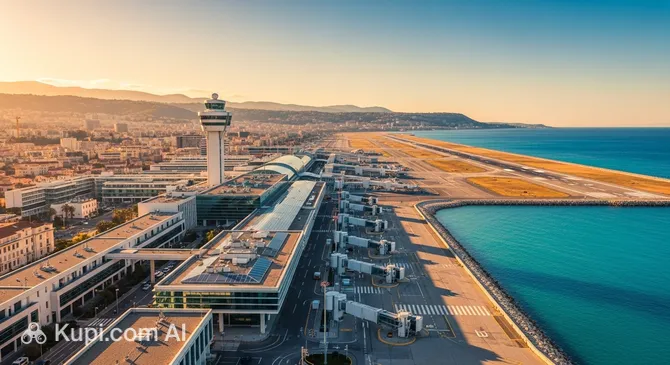
Nice Côte d'Azur Airport. Source: Kupi.com Binoculars

Nice Côte d'Azur Airport is not merely the air gateway to France, but the true beginning of a journey along the famous French Riviera. Located right on the shores of the Mediterranean Sea, it welcomes travellers with breathtaking views of turquoise waters and passing yachts even before landing. As the country's third busiest airport after the Parisian hubs, it serves as the main arrival point for those heading to Nice, Monaco, Cannes, or Saint-Tropez.

IATA Code NCE
ICAO Code LFMN
City Nice, France
Distance to Centre About 7 km
Status International
Passengers per Year About 14.8 million (2024)
Popular Airlines easyJet, Air France, British Airways
Schedule online flight board "Nice Côte d'Azur Airport"

Nice Airport consists of two modern terminals connected by a free tram, making movement around its premises quick and convenient. In addition to standard services such as Duty Free shops and numerous cafes and restaurants, travellers have access to VIP services, Fast Track security clearance, and business centres. One of the unique features of the airport is the helicopter service to Monaco, highlighting its status as a gateway to one of the world's most prestigious regions. Excellent transport links, including tram line No. 2, allow you to easily and quickly reach the centre of Nice and other cities on the Côte d'Azur.

Contact Information

For your convenience, we have compiled the main contact information for Nice Côte d'Azur Airport (NCE). We recommend checking the official website for the most up-to-date data, especially before your trip.

  • Official Website: Current schedules, terminal maps, parking information, and services are available on the airport's official website: www.nice.aeroport.fr.
  • Information Service Phone: For information about flights, services, and airport operations, you can call: +33 4 89 88 98 28.
  • Airport Address: Rue Costes et Bellonte, 06206 Nice, France.
  • Email: A direct email address for general inquiries is not published. It is recommended to use the contact form on the airport's official website for communication.
  • Social Media: The airport maintains active pages on popular social networks. Links to official accounts can be found on their website.
  • Lost Luggage Information: If your luggage was lost during the flight, you should first contact your airline's baggage tracing service. If you have lost personal items within the terminal, please contact the airport's Lost and Found office (Service des Objets Trouvés).
  • Passenger Support Contacts: Information desks are located in the arrival and departure halls of both terminals. Staff are ready to assist with navigating the airport and answering your questions.

How to Get to the Airport

Nice Côte d'Azur Airport (NCE) is located just 7 kilometres west of the city centre, making it one of the most accessible on the French Riviera. You can reach the terminals in many ways, from budget-friendly public transport to comfortable taxis. The choice depends on your budget, amount of luggage, and point of departure in the city or region.

The most modern, fastest, and most economical way to get from the centre of Nice to the airport is tram line No. 2. The route runs from Port Lympia through the heart of the city to both airport terminals (stops Terminal 1 and Terminal 2). The journey from the central stop Jean Médecin will take about 25-30 minutes. The fare is equal to the price of a standard city ticket, making this option incredibly good value. Trams run frequently, from early morning until late at night.

For those arriving from other cities on the French Riviera, such as Toulon, Antibes, or Marseille, the train is an excellent option. The nearest railway station to the airport is Nice Saint-Augustin, located approximately a 10-15 minute walk from Terminal 1 (the path is well signposted). TER (Train Express Régional) trains run along the entire coast, connecting France with Italy, allowing access from places like Genoa.

Bus services also play an important role, especially for regional travel. Express buses depart directly from the airport to key Riviera cities such as Monaco and Cannes. Additionally, local routes of the Lignes d'Azur network connect the airport with various districts of Nice not covered by the tram line.

Taxi is the most comfortable way to get to the airport, especially if you have a lot of luggage. A trip from the centre of Nice is usually charged at a fixed rate, which is around 32-35 euros. Travel time without traffic is 15-20 minutes. Car booking services via apps (such as Uber) also operate actively in the city and may offer competitive prices. Be sure to tell the driver which terminal you need — 1 or 2.

If you plan to actively explore the Côte d'Azur by car, it makes sense to rent one directly at the airport. Offices of all leading global rental companies are present here. For those arriving at the airport in their own vehicle, several car parks are provided. There are both short-term parking areas for quick passenger drop-off and long-term storage lots. It is recommended to book a space in the long-term car park online — this often allows for significant savings.

Terminals and Map

Nice Côte d'Azur Airport (NCE) has a simple and clear structure consisting of two main passenger terminals — Terminal 1 and Terminal 2. This organisation allows for efficient distribution of passenger flows and makes navigation as convenient as possible for travellers.

Terminal 1 is historically the airport's first terminal. It primarily serves international flights outside the Schengen zone, as well as flights by some budget and charter airlines. Despite its more compact size compared to the second terminal, it is fully equipped with everything necessary: check-in zones, security checkpoints, shops, and cafes. Navigation inside is intuitive thanks to clear signage.

Terminal 2 is more modern and spacious. It serves as the main base for Air France and its SkyTeam alliance partners, and also handles the majority of flights within the Schengen zone. Here, a wider selection of shops is presented, including luxury brand boutiques and diverse restaurants. Departure and arrival areas are spacious, making waiting for a flight more comfortable.

Movement between terminals is organised very conveniently. A free tram (lines L2 and L3) runs for passengers, quickly transporting you from one terminal to the other. Stops are located right at the exits of the airport buildings. The airport layout is logical: typically, arrival zones are on the ground floor, while departure and check-in zones are on the first floor.

It is recommended to arrive at the airport well in advance to complete check-in and security procedures. On average, you should allow about 2 hours for Schengen flights and up to 3 hours for international flights, especially during the peak tourist season (summer) when the airport can be very busy. To avoid mistakes, always check your flight information on the departure boards — the required terminal and check-in desk number will be listed there.

Airport History

The history of Nice Côte d'Azur Airport (NCE) is a chronicle of tourism development on one of the world's most famous coastlines. Its story began in the first decade of the 20th century with a small airfield for airshows, but it received official status in 1929 when it started serving postal flights. From the very beginning, its location at the edge of the Mediterranean Sea defined its unique character and future significance.

The true flourishing of the airport occurred in the post-war years, when the Côte d'Azur became a magnet for travellers from all over the world. To cope with the growing flow of passengers, a decision was made in France in 1946 to build a full-scale air terminal in Nice. One of the boldest engineering decisions of that time was the construction of a runway on land reclaimed from the sea. This ambitious project allowed for the reception of larger aircraft and laid the foundation for future expansion.

Nice Côte d'Azur Airport. Source: Kupi.com Binoculars

A key stage in development was 1987, when Terminal 2 was opened. This event doubled the airport's capacity and allowed for the separation of international and domestic flights, significantly improving logistics and comfort for passengers. Later, a second runway was also built on reclaimed land, finally securing Nice Airport's status as one of the most modern in Europe.

In the 21st century, the airport continued to modernise. Large-scale renovations of both terminals in the 2010s were aimed at creating a first-class environment for travellers: new retail zones, restaurants, and lounges appeared. Today, Nice Côte d'Azur Airport consistently ranks among the country's three busiest airports. An interesting fact: thanks to its location, it offers one of the most scenic landing approaches in the world and serves as a base for helicopter services to Monaco, highlighting its elite status.

Services and Amenities

Nice Côte d'Azur Airport (NCE) offers passengers a full range of services to make their stay as comfortable and convenient as possible. Being one of the busiest airports in France, it is excellently equipped to meet the needs of various travellers, from tourists to business people.

For those wishing to have a snack or do some shopping, a wide selection of establishments is presented in both terminals. You will find everything here: from fine dining restaurants offering Mediterranean cuisine to cosy cafes with aromatic pastries and fast-food outlets. Numerous shops, including Duty Free, offer souvenirs, local delicacies, clothing from famous brands, cosmetics, and perfumes, allowing you to pass the time pleasantly before your flight.

To wait for their flight in comfort, passengers can use free Wi-Fi throughout the airport, as well as numerous charging stations for electronic devices. For those who value enhanced comfort and privacy, several business lounges are available. They offer snacks and beverages, fresh press, and a quiet atmosphere for work or relaxation.

Practical matters can also be easily resolved at Nice Airport. Passengers have access to bank branches, ATMs, and currency exchange points, which is particularly convenient for international guests. A medical centre also operates on the premises, ready to provide first aid if necessary.

Special attention is paid to passengers with children and people with reduced mobility. For families, nursery rooms and special play areas are provided where young travellers can entertain themselves. For passengers with special needs, an assistance service is available, and the airport infrastructure, including lifts, ramps, and specially equipped restrooms, is fully adapted for their convenience.

If you have an early departure or a long layover, you can stay at one of the hotels located in the immediate vicinity of the terminals. For business travellers, a modern business centre operates at the airport, where meeting rooms or conference halls equipped with everything necessary for meetings and events can be rented.

Where to Eat

Nice Côte d'Azur Airport (NCE) offers passengers a wide choice of establishments for every taste and budget, reflecting the rich culinary traditions of the Côte d'Azur and France in general. Whether you are looking for a quick coffee before departure or wish to enjoy a leisurely lunch, you will easily find a suitable option in both terminals.

For a quick snack before and after security control, numerous cafes and bakeries are ideal. In both terminals (T1 and T2), you will find globally recognised chains like Starbucks and Pret A Manger, as well as famous French bakeries such as Eric Kayser. Here you can grab fresh pastries, sandwiches, salads, and quality coffee. This is an excellent choice if you are short on time.

If you have time for a full lunch or dinner, consider the full-service restaurants. In Terminal 2, which is the main hub for international flights, the selection is particularly extensive. Restaurants offering Italian and Mediterranean cuisine operate here. This is a wonderful opportunity to try a classic "Niçoise" salad or fresh pasta. Terminal 1 also has cosy bistros where you can sit comfortably while waiting for your flight.

To experience local flavour, be sure to visit cafes offering Provençal delicacies. For instance, look for the famous "Tarte Tropézienne" dessert — a delicate brioche with cream. Establishments also offer refreshing beverages to complement your meal, providing a pleasant conclusion to your journey along the French Riviera.

Most establishments open early in the morning and operate until the last flight. Prices at the airport are generally higher than in the city, but the quality of food in full-service restaurants is often pleasantly surprising. Passengers with specific dietary needs will find suitable dishes without difficulty: many cafes offer vegetarian and vegan sandwiches and salads, and restaurants with a la carte menus can often accommodate requests for gluten-free options. Guests requiring Halal options are advised to speak with staff regarding ingredients, though many seafood and vegetarian choices are readily available.

Traveller Tips

To ensure your journey through Nice Airport goes as smoothly as possible, take advantage of our tips. These recommendations will help save time, reduce stress, and potentially save money, making the start or end of your holiday on the Côte d'Azur more comfortable.

Arrival Time and Check-in. During peak season (summer and holidays), the airport can be busy. We recommend arriving 2.5-3 hours before international flights and 1.5-2 hours before flights within the Schengen zone. To avoid queues, complete online check-in in advance and, if travelling with hand luggage only, proceed directly to security control.

Security Control. Be prepared for inspection: pack all liquids up to 100 ml in a transparent bag in advance, and remove laptops and other large electronics from your bag. This is a standard procedure, but preparation will significantly speed up the process. When flying from France to a non-EU country, allow extra time for passport control.

Hand Luggage. Remember standard restrictions: sharp objects, weapons, and flammable substances are prohibited. The volume of liquids must not exceed 100 ml per container, and the total capacity is 1 litre per passenger. Always check hand luggage and baggage allowances on your airline's website, as they may differ.

Seat Selection and Transfers. If you want to enjoy stunning views of the Côte d'Azur during takeoff or landing, choose a window seat. For convenience and the ability to leave the cabin quickly, choose an aisle seat. Passengers with a transfer (transit) should carefully follow the "Flight Connections" signs. The airport is well organised, but if you are transferring from a non-Schengen flight to a Schengen one (or vice versa), you will need to pass through passport control.

Savings and Tax-Free. Prices at the airport are traditionally higher. Bring an empty reusable water bottle and fill it after passing security. If you are not an EU resident, you can claim a tax refund (tax-free) on purchases made in France. Find the "Détaxe" counters before checking in for your flight and allow at least 30-40 minutes of extra time for this.

In Case of Flight Delay. Do not panic. First, find an information board or check the flight status online. Contact your airline representative for information. According to EU regulations, for long delays, passengers are entitled to drinks, meals, and in some cases, hotel accommodation. Keep all receipts and boarding passes.

Reached the end of the page?

That means the route is fully explored