Support

Firenze-Peretola Airport

About the Airport

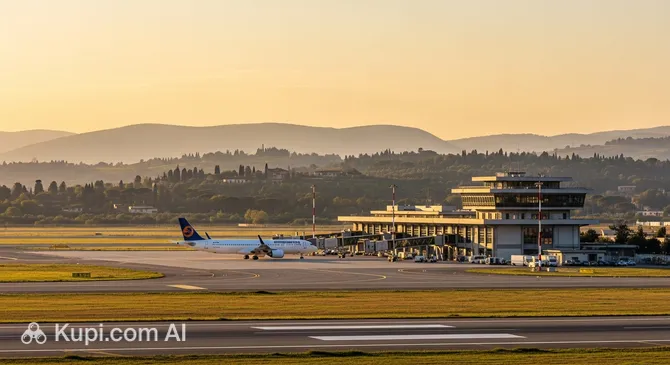
Firenze-Peretola Airport. Source: Kupi.com Binoculars

Florence Airport, Amerigo Vespucci, often referred to simply as Peretola by locals and seasoned travellers, is your aerial gateway to the very heart of Tuscany. Located remarkably close to the city centre, it serves as the ideal starting point for immersing yourself in the atmosphere of the cradle of the Renaissance. Despite its compact size, the airport is the second busiest in the region and proudly bears the name of the famous Florentine navigator, adding a special symbolism to your journey from your very first minutes on Italian soil.

IATA Code FLR
ICAO Code LIRQ
City Florence
Distance to centre About 6–8 km
Status International
Passengers per year Over 3 million (2023)
Popular Airlines Volotea, Vueling, Air Dolomiti
Schedule online board "Florence Peretola Airport"

The main advantage of Peretola Airport is its exceptional proximity to the historical centre of Florence. This allows you to reach your hotel or apartment in a matter of minutes. Travellers have access to modern and convenient modes of transport: the T2 tram line will take you to the centre in approximately 20 minutes, and shuttle buses and taxis with fixed fares are also at your service. The airport has one passenger terminal, which significantly simplifies navigation and helps save precious time. Inside, you will find everything necessary for a comfortable wait for your flight: Duty Free shops, cafes, currency exchange points, and a Tax Free refund office.

Contact Information

  • Official Website: www.aeroporto.firenze.it
  • Information Service Phone: +39 055 30615
  • Address: Via del Termine, 11, 50127 Firenze FI, Italy
  • Email (General Inquiries): infoaeroportofirenze@toscana-aeroporti.com
  • Lost & Found Service: Phone: +39 055 3061300; E-mail: oggettismarriti@toscana-aeroporti.com
  • Social Media: Follow airport news on Facebook, X (Twitter) and Instagram.

How to Get to the Airport

Getting from the centre of Florence to Amerigo Vespucci Airport (FLR), also known as Peretola, is effortless—it is located just a few kilometres from the city. Travellers have several convenient options available, from a fast tram to taxis and rental cars. The choice depends on your budget, the amount of luggage, and the time you have available.

The fastest, most cost-effective, and popular method is the T2 Vespucci tram line. It directly connects the Santa Maria Novella central station (Unità stop) with the airport terminal. The journey takes only about 20 minutes, and trams run at intervals of 5-10 minutes throughout the day. Tickets can be purchased at machines at any stop, and the price is very reasonable, making this option ideal for most tourists.

If you value comfort, are travelling with family, or have a lot of luggage, a taxi is an excellent choice. The trip from the city centre to the airport usually takes 15-25 minutes depending on traffic conditions. In Florence, there is a fixed fare for trips to the airport from the central part of the city (approximately 22-28 euros; surcharges for luggage, night hours, or public holidays may apply). You can also book a private transfer in advance so that a driver meets you at a designated location for a fixed price.

For those planning to travel along the picturesque roads of Tuscany, getting to the airport by rental car is convenient. Offices of all major rental companies are represented at Peretola Airport, allowing you to easily return the car right before your departure. There are several car parks on the airport territory—both for short-term stops and for long-term vehicle storage.

When planning a trip around Italy, it is worth considering alternative routes. If you haven't found convenient flights to Florence, consider arriving in neighbouring cities. Major aviation hubs, such as Pisa International Airport or Guglielmo Marconi Airport in Bologna, are just an hour or an hour and a half away and are excellently connected to Florence by high-speed trains. You can also check flights to Luigi Ridolfi (Forlì), Miramare (Rimini), and Sant'Egidio (Perugia) airports, which are located slightly further away.

Terminals and Map

Florence Airport, Amerigo Vespucci (FLR), also known as Peretola, is distinguished by its compactness and simple structure. All airport operations are concentrated in one two-storey terminal, which serves both domestic and international flights. Such an organisation makes it very convenient for navigation, and you won't have to worry about transferring between different buildings.

The terminal layout is intuitive. The Ground Floor (piano terra) is entirely dedicated to the arrivals area. Here you will find baggage claim belts, car rental counters, customs control, and the exit to the city, where taxis and the T2 tram stop connecting the airport to the centre of Florence await you. The First Floor (primo piano) is the departures area. Upon ascending here, you will find check-in counters, baggage drop-off points, and the entrance to security screening.

Despite the airport's small size, everything necessary is present. After passing security control, passengers enter the secure area (airside) with several boarding gates. Duty-Free shops, small cafes, and souvenir stalls are located here. It is important to note that space is quite limited, and it can get crowded during peak season hours.

Check-in and screening procedures at Florence Airport generally proceed faster than in major hubs. Nevertheless, one should not arrive at the last moment. It is recommended to arrive at the airport at least 2 hours before departure for Schengen zone flights and 3 hours for other international destinations. This time will be sufficient to check in luggage without rushing, pass through control, and enjoy a cup of coffee before the flight.

Airport History

The history of Florence Peretola Airport, officially named after the famous navigator Amerigo Vespucci, begins in the 1930s. The first airfield in the Peretola area was opened on 4 June 1931 and was initially used primarily for experimental and postal flights. In those times, it was more of a large meadow space than a fully-fledged airport in the modern sense.

After the Second World War, a new stage of development began. In the late 1940s, the airport received its first commercial passenger flights, connecting Florence with Rome. However, the real breakthrough occurred in the 1980s. In 1984, the management company AdF (Aeroporto di Firenze) was created, which undertook massive modernisation. A new runway was built, and in 1986 a modern passenger terminal opened. These changes allowed for the reception of larger aircraft and significantly increased passenger flow.

An important event was the naming of the airport after Amerigo Vespucci in 1990, highlighting the air harbour's connection with the great history of Florence. In subsequent years, the airport was reconstructed multiple times: in 1992 and 1994, the terminals were expanded, and in 2006, another major modernisation of the arrival and departure zones took place. Thanks to constant development, the airport surpassed the milestone of one million passengers in 2000, and later two million, becoming an important transport hub for all of Tuscany.

Interesting fact: despite all modernisations, Florence Airport is still known for its relatively short runway, which imposes certain limitations on the types of aircraft it can receive. Nevertheless, its close proximity to the city centre—only about 8 kilometres—makes it extremely convenient for tourists arriving to discover the treasures of the Renaissance capital.

Services and Amenities

Florence Airport, despite its compact dimensions, offers passengers a full range of services for a comfortable wait for their flight. Here you will find everything necessary to relax, have a snack, or attend to work matters before departure.

Dining and Shopping. The terminal houses several cafes and restaurants where you can enjoy a final cup of authentic Italian espresso or have a full lunch. Shops offer a wide assortment of goods: from souvenirs and Tuscan delicacies, such as premium olive oil, to fashionable clothing and accessories. Of course, there is also a Duty-Free zone with perfumery and cosmetics.

Relaxation and Connectivity. For those who value enhanced comfort, the Masaccio Lounge VIP hall is available. Guests are offered snacks, beverages, fresh press, and a tranquil atmosphere. Free Wi-Fi is available throughout the airport territory, and charging stations for electronic devices are installed in waiting areas.

Financial and Medical Services. The airport has ATMs and currency exchange points for handling financial matters. In case of need, a first aid medical point operates within the terminal building.

Services for Passengers with Special Needs. The airport is well-equipped for travellers with children: there are mother and child rooms with changing tables. For passengers with reduced mobility, special assistance (Sala Amica service), ramps, lifts, and equipped restrooms are provided. It is recommended to notify the airline in advance regarding the need for assistance.

Business Services and Hotels. Although there are no specialised conference halls within the terminal itself, many business hotels located in the immediate vicinity of the airport offer such services. Near Florence Airport, there are several hotels where one can comfortably rest before an early flight or after a late arrival.

Dining Options

Florence Airport, despite its compact size, offers passengers a decent selection of places to have a snack before departure or a full lunch, enjoying the final moments in Tuscany. Dining options are concentrated both in the public area and in the departure zone after passing security control.

In the landside zone (before control), cafes are usually located, perfect for having a cup of espresso or cappuccino with a croissant (here called a cornetto) while saying goodbye to those seeing you off. This is an excellent place for a quick and light breakfast or snack.

The main part of the establishments is found in the airside zone, that is, in the departure lounge. Here the choice is wider: from establishments offering famous Tuscan beverages to cafeterias and self-service restaurants. This is a wonderful opportunity to try a classic Italian drink or enjoy pasta and pizza. Many establishments offer panini with local delicacies and Pecorino cheese.

For those looking for a quick snack, a freshly prepared sandwich or a slice of pizza will be the ideal choice. If you have time for a full lunch, pay attention to restaurants serving hot dishes. Regarding special dietary needs, vegetarians and those preferring halal-friendly ingredients can easily find options, for example, panini with mozzarella and tomatoes or vegetable salads. It is best to clarify the availability of gluten-free or specific vegan dishes on-site, but the staff is usually ready to assist.

Prices at Florence Airport correspond to the average European level for airports—be prepared to pay slightly more than in the city. Most cafes and restaurants open early in the morning and operate until the departure of the last flight, adjusting to the flight schedule.

Travel Tips

Travelling through Florence Peretola Airport (officially named Amerigo Vespucci) usually proceeds smoothly, as it is quite compact. Nevertheless, to avoid rushing, especially during the tourist season, it is recommended to arrive 2-2.5 hours before international flights and 1.5-2 hours before domestic or Schengen zone flights. This will give you enough time for check-in, baggage drop, and security control without unnecessary stress.

To save time at check-in, take advantage of the online check-in option offered by almost all airlines. This will allow you to proceed immediately to the bag drop-off or, if you are travelling light, directly to the security screening area. Security control here is standard, but queues can occur during peak hours. Prepare your documents in advance and remove all liquids and electronics from your carry-on luggage.

When planning what to take with you, remember the standard restrictions on liquids in hand luggage (no more than 100 ml in one container). If you wish to bring famous Tuscan olive oil or local beverages from Florence, they must be checked in with your luggage. When choosing a seat on the plane, give preference to a window seat—during take-off and landing, picturesque views of the Tuscan hills may open up to you.

Florence Airport is rarely used as a major transfer hub; most passengers begin or end their journey here. If you do have a transfer planned, its small size will be an advantage. Customs control for those arriving from non-Schengen countries follows standard procedure with green (nothing to declare) and red channels. Those travelling within the Schengen area do not need to pass through passport and customs control.

To save money on the way to or from the city, use the T2 tram line, which connects the airport with the centre of Florence (Unità stop near the main Santa Maria Novella station). This is significantly more affordable and often faster than a taxi. Also, do not forget simple savings: take an empty water bottle with you and fill it at drinking fountains after passing security control.

In case of a flight delay, first check the information on the departure boards or the airport website. There are several cafes and shops on the premises where you can pass the time. It is important to remember that for long delays or cancellations of flights operated by European airlines, you are protected by regulation EC 261/2004, which provides the right to assistance (meals, drinks) and potential compensation. Contact your airline representative to clarify details.

Reached the end of the page?

That means the route is fully explored