Support

Saint-Clément Aqueduct

About

The Saint-Clément Aqueduct is an outstanding historical hydraulic engineering structure located in the city of Montpellier, in the south of France. This grandiose 18th-century aqueduct, built in the image and likeness of ancient Roman designs, played a key role in supplying the city with drinking water from the Saint-Clément spring, located several kilometers from the center.
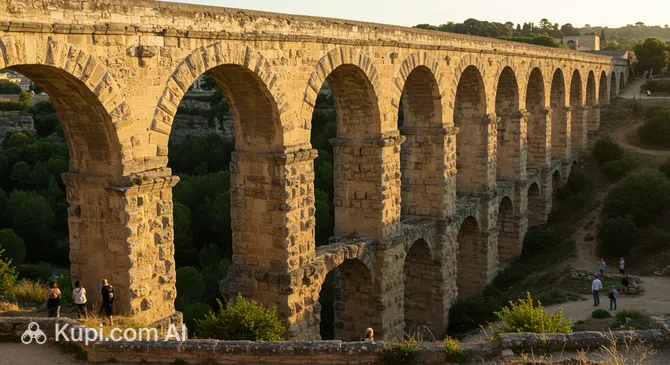
Saint-Clément Aqueduct. Illustration.
Source: Kupi.com AI

Traveler photos:

The engineering skill embodied in the Saint-Clément Aqueduct is imaginative. The structure stretches from the Saint-Clément-de-Rivière district to the famous Promenade du Peyrou in the heart of Montpellier. One of its notable parts is the elegant 19-meter water tower, which served as a reservoir and distribution hub in the city's water supply system.

Today, the Saint-Clément Aqueduct, also known as "The Arches" (Les Arceaux) due to its double-level arched construction, is not just a monument to engineering thought of the past, but also one of the most recognizable and picturesque landmarks in Montpellier. A walk along its majestic arches allows you to touch the city's history and enjoy impressive views, especially at sunset.

Contacts

Saint-Clément Aqueduct is a historical monument open to the public for free, so it does not have specific contact details. For additional information regarding visits, route details, or other tourist information, we recommend contacting the tourist information center in the city of Montpellier.

How to contactContact
AddressAqueduc des Arceaux, 155 Rue Hilaire Ricard 85, 34000 Montpellier, France
Websitewww.montpellier-tourisme.fr

What to Do

The Saint-Clément Aqueduct, also known as "The Arches", offers visitors a unique opportunity to touch history and enjoy impressive 18th-century architecture in Montpellier. The main activity here is, of course, a walk along the aqueduct itself. You can closely examine its majestic double-tiered arches, appreciate the scale of engineering thought from the past, and imagine how water once flowed through it to supply the city. It is also a wonderful place for photographers looking to capture both wide shots of this grand structure and its details against the cityscape.

As you walk along the aqueduct, pay attention to the picturesque views opening up over the surroundings of Montpellier. Although the aqueduct stretches for a significant distance, its most famous and accessible part for viewing is located near the historical center. This allows you not only to study the structural features of the building but also to feel its historical significance, as the Saint-Clément Aqueduct is an important symbol of the city and a witness to its development.

A visit to the aqueduct is often combined with a visit to the adjacent Peyrou Park (Promenade du Peyrou). It is here that the famous "water castle" (Château d'Eau) is located—a monumental structure that served as a reservoir and distributor of the water arriving via the aqueduct. Peyrou Park, with its beautiful terraces, is itself a wonderful place to relax and enjoy the views. From here, it is also convenient to continue exploring Montpellier by heading to attractions such as the Triumphal Arch, the Cathedral, and the Royal Square of Peyrou, located nearby.

Getting There

Getting to the Saint-Clément Aqueduct in Montpellier is quite easy, as it is a prominent landmark in the city. If you are in the center of Montpellier, for example, at the famous Place de la Comédie or the Promenade du Peyrou, you can reach the aqueduct on foot. Such a walk will allow you to better appreciate the architecture and atmosphere of the city, as the aqueduct connects the Saint-Clément-de-Rivière district with the central part where the Promenade du Peyrou is located.

Montpellier is famous for its well-developed public transport system. You can use trams or buses with routes passing near the aqueduct. This is a convenient and economical way to reach the attraction from different parts of the city. Additionally, Montpellier is a bike-friendly city. There are bike paths running along certain sections of the aqueduct, making a bike ride a pleasant and active option.

For travelers arriving in Montpellier from other cities in France or from abroad, several options are available. The city's main railway station, Montpellier-Saint-Roch, receives trains from many major locations. Montpellier also has an international airport, Montpellier–Méditerranée. From the station or the airport, you can easily reach the city center and then the Saint-Clément Aqueduct by public transport or taxi.

Nearest city: Montpellier

History & Facts

The Saint-Clément Aqueduct, also known among locals as "The Arches" (Les Arceaux), is one of the most recognizable and impressive sights in Montpellier. Its construction began in 1753 and took about ten years. The main task of this large-scale hydraulic structure was to provide the city with drinking water from the Saint-Clément spring, located at a distance. In the 18th century, the aqueduct became a critically important element of urban infrastructure, solving the water supply problem for the growing population.

The Saint-Clément Aqueduct is not an isolated structure but part of a larger and more harmonious architectural ensemble. It leads to the famous Promenade du Peyrou, which was established as early as 1689 on the site of the former city walls. This water system is completed by an elegant water tower, built in 1768 according to the design of architect Jean-Antoine Giral. The entire complex was carefully designed for the efficient delivery of water to the center of Montpellier.

Despite the fact that the Saint-Clément Aqueduct was built much later than many ancient Roman counterparts, its architecture is executed in a classical antique style. This makes it a significant example of Neoclassicism in France. The structure, with its majestic double-tiered arcades, not only performed its vital function effectively for many years but also continues to be a valuable historical monument today, attracting both tourists and city residents with its monumentality and beauty.

Time Needed

To see the Saint-Clément Aqueduct in Montpellier, an average visitor will need approximately 1-2 hours. This time is usually enough to leisurely walk along this impressive structure, appreciate its scale and architectural features, and take commemorative photos. The aqueduct, being a significant historical and architectural landmark, attracts visitors with its monumentality and engineering design.

If you plan a more detailed study of the surroundings or want to combine the tour of the aqueduct with visits to other nearby points of interest, such as Peyrou Park, then you should set aside additional time. In this case, your stay in this area may take longer, allowing you to dive deeper into the atmosphere of Montpellier and enjoy its beauty without rushing.

Working Hours

The Saint-Clément Aqueduct in Montpellier is an open-air historical monument, so it has no formal opening hours. Access to the aqueduct is possible 24/7 and is completely free, allowing for flexible visit planning. No prior booking or ticket purchase is required.

Despite the 24-hour accessibility, for the best impression and the ability to take beautiful photos, it is recommended to view the Saint-Clément Aqueduct during daylight hours—from early morning until sunset. At this time, the architectural details of the structure are most clearly visible, and the walk will be more comfortable and safer. The attraction is open to visitors year-round.

7:00 – 21:29

Nearby

After seeing the majestic Saint-Clément Aqueduct, don't be in a hurry to leave this area of Montpellier. Exploring nearby attractions will allow you to dive deeper into the city's atmosphere, discover new interesting places, and form a more complete impression of its rich history and culture.

Every street and square around might hide its own little secrets and charming corners that will complement your memories of your trip to France. Below is a list of some interesting places located nearby.

NameDistance
Arc de Triomphe of Montpellier0.3 km
Broc Café0.3 km
Bonobo Centre Ville0.5 km
La Panacée0.8 km
Coldrip Food and Coffee0.8 km
Place de la Comédie0.9 km
Babote Tower0.9 km

Have you reached the end of the page?

So the route has been studied inside and out