Support

Old Crane of Lüneburg

About

The Old Crane of Lüneburg (German: Alter Kran) is a remarkable historical port crane that stands proudly on the banks of the Ilmenau River in the heart of the city of Lüneburg, Germany. It is more than just a structure; it is one of the city's most recognizable and valuable architectural gems, which today is a protected industrial monument and a true symbol of Lüneburg's rich history.
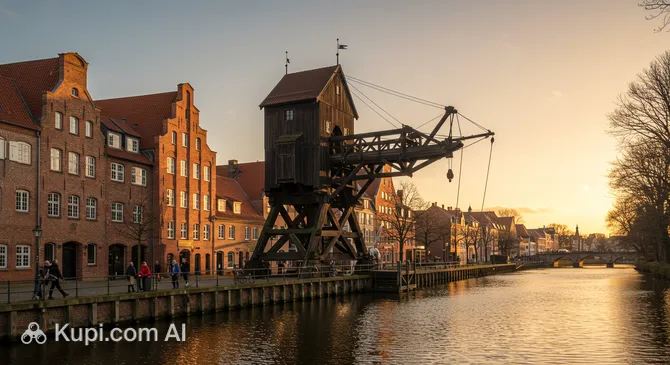
Old Crane of Lüneburg. Illustration.
Source: Kupi.com AI

Traveller photos:

Built in 1797, this crane was considered one of the most powerful and high-capacity in northern Germany at the time of its creation. Its appearance was a major event for the city, which was an important center for salt mining and trade, and the crane played a key role in loading and unloading goods transported along the Ilmenau River.

The massive wooden construction of the Old Crane, with its characteristic domed roof, still makes an indelible impression today. It fits wonderfully into the historical appearance of the old town, as if transporting us back several centuries. Its mechanism, though no longer used for its original purpose, still commands admiration for its engineering design.

Today, the Old Crane of Lüneburg is not only an important historical site but also a popular tourist attraction. It draws many travelers and photographers wishing to touch the past and capture this unique monument. A walk along the Ilmenau riverfront with a view of the Old Crane is a must for every visitor to Lüneburg.

Contacts

Since the Old Crane of Lüneburg is a historical site, direct contact details such as a phone number or email may not be available. Usually, this landmark is freely accessible as part of the historical landscape of the city of Lüneburg.

To reach the Old Crane of Lüneburg, head towards the banks of the Ilmenau River in the old part of Lüneburg. For more precise route information or potential guided tours, it is recommended to contact local tourist information centers upon arrival in the city.

How to contactContact
AddressAm Fischmarkt, 21335 Lüneburg, Germany
Websitewww.lueneburger-heide.de

What to Do

A visit to the Old Crane of Lüneburg offers a unique opportunity to touch the history of this Hanseatic city. The main attraction, of course, is the historical crane itself, which once played a key role in loading salt—Lüneburg's "white gold." You can examine its construction in detail, imagine how it functioned centuries ago, and take impressive photos against the backdrop of this engineering marvel of the past. A walk along the picturesque Ilmenau riverfront where the crane is located will allow you to admire the views of old warehouses and merchant houses reflected in the water.

Guided tours are often organized around the Old Crane, where guides tell fascinating stories about the rich commercial and industrial history of Lüneburg and the importance of the Ilmenau River for its prosperity. This is a wonderful opportunity to gain a deeper understanding of how salt mining and trade shaped the city's appearance and economy. You will learn exactly how precious salt was loaded onto barges through this crane for centuries, to be sent to other cities and countries.

In addition to seeing the crane itself and diving into history, the surrounding area offers pleasant ways to spend your time. There are many cozy cafes and restaurants nearby where you can relax and try local cuisine while enjoying the atmosphere of the old port district. Thus, a visit to the Old Crane is not just about seeing a landmark, but a comprehensive experience that combines history, architecture, and gastronomic delights.

Getting There

Getting to the Old Crane of Lüneburg is quite easy, as it is located in the heart of the city's historical center on the picturesque Ilmenau riverfront. If you are already in Lüneburg, the most pleasant way is on foot. From the central city square or the Lüneburg train station, the walk to this unique landmark will take no more than 10–15 minutes at a leisurely pace, allowing you to enjoy the atmosphere of the ancient streets.

For those who prefer to travel by car, there are parking spaces available in the center of Lüneburg. However, it is worth checking the parking map in advance and keeping in mind that there may be traffic restrictions and paid parking zones in the historical part of the city. Plan your route and parking spot in advance to avoid any inconvenience.

If you are arriving in Lüneburg from other cities in Germany, such as Hamburg, the most convenient way is by rail. Trains run regularly in this direction. Upon arrival at the Lüneburg train station, as mentioned, you can walk to the Old Crane or, if you wish, use local public transport to get closer to the waterfront.

Nearest city: Lüneburg

History & Facts

The Old Crane of Lüneburg (Alter Kran Lüneburg) is not just a picturesque structure on the banks of the Ilmenau River, but an important witness to the rich history of the city of Lüneburg. The first mentions of a crane in the city harbor date back as far as 1330. Over the centuries, the crane was rebuilt and improved many times, adapting to the growing needs of the city, whose prosperity was inextricably linked to salt mining and trade. The crane acquired its current, well-recognized appearance after a major reconstruction in 1797. This reconstruction was necessitated by the need to rebuild after a devastating flood in 1795 that damaged many port structures.

The main task of the Old Crane was to load "white gold"—the salt mined at the famous Lüneburg saltworks. Salt was loaded onto barges, which then set off via the Stecknitz Canal to Lübeck and other Hanseatic cities, bringing fame and wealth to Lüneburg. Additionally, the crane was used to unload firewood, which was required in huge quantities to keep the fires burning in the salt pans. Thus, this structure played a key role in the city's economic cycle related to salt production and export.

The operation of the crane was strictly regulated by the Lüneburg city council. The authorities clearly defined which types of cargo and which of the available cranes (there were several in the city) should be used for lifting. Special fees were charged for the use of the crane, which went into the city treasury. This highlights not only the technical but also the important economic and administrative significance of the Old Crane for medieval and early modern Lüneburg. Today, this historical monument is one of the city's main attractions, serving as a reminder of its glorious salt-trading past.

Time Needed

When planning a visit to the Old Crane of Lüneburg, one of the iconic landmarks of Lüneburg, it's worth noting that the time needed for viewing can vary. To simply see this historical port crane, take some photos, and go for a short walk along the picturesque Ilmenau riverfront nearby, 30-45 minutes is generally sufficient. This is enough time to get a general impression of this unique structure and its role in the city's history.

If you want to dive deeper into the history of the Old Crane and learn interesting details about its construction and operation, you should plan for more time. For instance, if a tour is available or if you decide to independently study the information boards (if present) and learn more about the history of the salt trade in Lüneburg associated with the crane, the visit may take from 1 to 1.5 hours. This will allow you to leisurely examine the crane from all sides and better understand its significance to the city.

Working Hours

The Old Crane of Lüneburg is a unique historical site that can be viewed from the outside at any time of day, as it is an open-air exhibit. Access to the inside of the crane is generally not provided, as it functions as a museum monument.

Since this structure is located outdoors, it is available for viewing year-round. If you are interested in potential tours related to the crane's history or special events taking place nearby, it is recommended to check for current information on the official Lüneburg tourism website or at local tourist information centers. Advance booking is not required for a simple viewing of the crane from the outside.

Open 24/7

Nearby

Exploring the Old Crane of Lüneburg is undoubtedly a highlight, but you shouldn't stop there. Exploring the surroundings will allow you to dive deeper into the atmosphere of Lüneburg and discover other treasures of this charming city. Every street and every building here breathes history, and nearby attractions will complement your experience and make your trip even more fulfilling.

A stroll around the Old Crane of Lüneburg will reveal new facets of the city. You can visit other interesting places within walking distance to get a more complete picture of Lüneburg's cultural and historical heritage. Below is a list of some nearby attractions.

NameDistance
La Taverna0.1 km
AGRON Lüneburg0.2 km
Feierabendkultur Bar0.4 km
Am Sande Square0.5 km
Pacos0.5 km
Lüneburg Museum0.5 km
Lüneburg Water Tower0.5 km

Reached the bottom of the page?

Looks like you know this route inside out