Support

Old Elbe Tunnel

About

The Old Elbe Tunnel, also known as the St. Pauli Elbtunnel, is not just a transport structure but a genuine historical monument of engineering in Hamburg. Opened in 1911, it was one of the first underwater tunnels in Europe, built so that thousands of port workers could reach the shipyards on the other side of the Elbe River more quickly. Today, this tunnel is under state protection and is a unique landmark in Germany.

A walk through the tunnel is an immersion into the atmosphere of the early 20th century. It is 426.5 meters long and located nearly 24 meters underwater. The walls of the two parallel tubes are lined with glazed tiles and decorated with terracotta bas-reliefs depicting river inhabitants — fish, crabs, and other aquatic creatures. A special feature of the tunnel is its spacious freight elevators, which still lower and raise not only pedestrians and cyclists but also passenger cars.
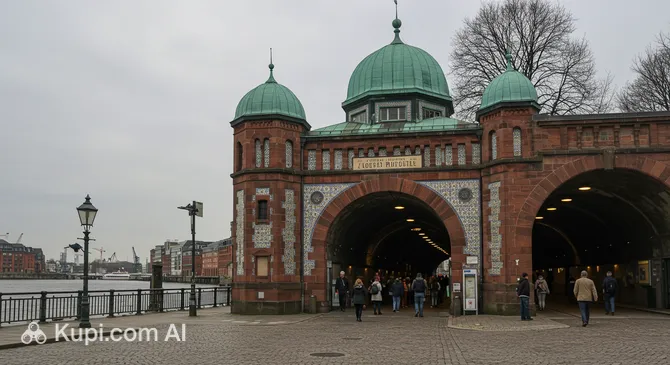
Old Elbe Tunnel. Illustration.
Source: Kupi.com AI

Traveler photos:

Although its importance for transport has decreased with the arrival of new bridges and tunnels, the Old Elbe Tunnel remains a favorite spot for tourists and locals alike. Entry for pedestrians and cyclists is free and open 24/7, allowing for an unusual walk under the river at any time. After crossing to the other side, to the Steinwerder district, you will be rewarded with a magnificent panoramic view of the city and the port.

Contacts

For up-to-date information on the tunnel's operation, including potential transport restrictions, it is recommended to consult official sources. You can reach the northern entrance using Hamburg's public transport: take the subway (line U3) or the S-Bahn (line S1) to the St. Pauli-Landungsbrücken station.

How to contactContact
AddressBei den St. Pauli-Landungsbrücken, 20359 Hamburg, Germany
Phone number+49 40 115
Websitewww.alter-elbtunnel-hamburg.de

What to Do

Visiting the Old Elbe Tunnel is more than just a way to cross the river; it's a real adventure. The main thing to do here is, of course, to take a unique walk under the Elbe riverbed. It all begins with a descent in one of the historic freight and passenger elevators, which are themselves working exhibits of early 20th-century engineering. Once at a depth of nearly 24 meters, you are immersed in the special atmosphere of this historic structure.

Walking through the two parallel tunnel tubes, lined with tiles and decorated with bas-reliefs of marine life, is an impressive activity in its own right. However, the main reward awaits you on the southern bank in the Steinwerder district. From there, you get a magnificent panoramic view of Hamburg, which is considered one of the best in the city. It's the perfect place to take striking photos. The tunnel itself, with its unique architecture and historical aura, is also a very popular location for photo shoots.

Getting There

Getting to the Old Elbe Tunnel is quite easy, as it is located in one of Hamburg's busiest tourist districts — St. Pauli. The northern entrance to the tunnel is situated near the famous Landungsbrücken promenade, which is a major transport hub and a popular spot for a stroll in its own right.

The most convenient way to reach the attraction is by public transport. The nearest station, also called Landungsbrücken, serves both subway trains (line U3) and the S-Bahn (lines S1, S2, S3). It is only a few minutes' walk from the station exit to the tunnel entrance; numerous signs will help you find the way.

If you are traveling by car, you can also drive to the tunnel. However, keep in mind that finding a parking space in central Hamburg can be difficult, especially during peak tourist season. Given this, taking public transport is often a faster and more cost-effective option.

Nearest city: Hamburg

History & Facts

The history of the Old Elbe Tunnel is a story of engineering courage and the search for the best solution for a growing city. The idea of connecting the banks of the Elbe didn't arise immediately in Hamburg, and in 1901, the city Senate made the final decision after lengthy discussions. Construction began in 1907 based on a project by engineer Ludwig Wendemuth. An interesting fact: the management of this ambitious project was entrusted to Otto Stockhausen, who was only about 30 years old at the time of his appointment.

Before settling on the tunnel option, authorities considered other equally impressive alternatives. One was a high bridge (about 55 meters), which would not obstruct ocean-going vessels, but its construction would have required enormous costs and long approach roads, which was impossible given the dense development of the city center. A swing bridge, which would have taken up a lot of space and interfered with shipping, and even a cable car were also discussed. Ultimately, the tunnel project was chosen, inspired by a similar structure under the River Clyde in Glasgow.

The tunnel's grand opening for pedestrians took place on September 7, 1911. A few months later, on November 30 of the same year, horse-drawn carriages and the first cars were allowed through. This event was preceded by heated debates in the Senate regarding the cost of using the tunnel. Thanks to the persistence of the Social Democratic faction, a decision was reached that remains in effect today: passage for pedestrians and cyclists became free of charge, while a fee was charged for vehicle traffic.

Time Needed

A visit to the Old Elbe Tunnel in Hamburg usually takes from 1 to 2 hours. This is plenty of time to leisurely descend in one of the historic elevators, walk through the tunnel in both directions, examine its technical features, and take photos. The tunnel is just over 426 meters long, so crossing it doesn't take much time, but the atmosphere of this early 20th-century underground structure invites a slow-paced exploration.

If you have extra time, it is worth spending it exploring the surroundings on both sides of the tunnel. Upon exiting on the south bank in the Steinwerder district, you will be rewarded with one of the best panoramic views of the city. This is a great spot for a photo shoot against Germany's urban landscape. Returning to the north side, you will find yourself in the lively Landungsbrücken area, where you can also enjoy your time, making a visit to the tunnel easily part of a longer half-day stroll.

Working Hours

One of the main advantages of the Old Elbe Tunnel for tourists is its accessibility. It is open to pedestrians and cyclists 24/7, year-round, allowing for an unusual walk under the river at any convenient time. Entry for these categories of visitors is free, and no advance booking is required. You can descend either via the stairs or using modern passenger elevators, which also operate 24/7.

Restrictions apply to motor vehicles. Currently, car access is temporarily closed until further notice. The historic freight elevators that used to carry cars operate on their own schedule: usually Monday to Friday from morning to evening, and on weekends and holidays with reduced hours. Before planning a visit, especially if you want to use the freight elevators, it is recommended to check the current information on the official website, as changes in the tunnel's operation are possible due to maintenance work or events.

DayOpening hours
Monday5:30 – 20:00
Tuesday5:30 – 20:00
Wednesday5:30 – 20:00
Thursday5:30 – 20:00
Friday5:30 – 20:00
Saturday10:00 – 18:00
Sunday10:00 – 18:00

Nearby

Visiting the Old Elbe Tunnel is a unique experience, but Hamburg offers much more than just one attraction. Exploring the area around the tunnel, located in the lively St. Pauli district, will allow you to dive deeper into the city's atmosphere and make your trip even more rewarding and memorable. A walk through the nearby streets will reveal many interesting spots — from historical piers to modern cultural sites.

Thanks to the tunnel's convenient location, you can easily reach many of Germany's iconic landmarks on foot or by public transport. This is a wonderful opportunity to combine a look at this early 20th-century engineering marvel with visits to other attractions just a stone's throw away. Below is a list of some interesting sites located nearby.

NameDistance
Panik City0.4 km
The Madison Bar1 km
Feldstrasse Bunker (Flak Tower IV)1.2 km
Tortue Hamburg1.4 km
Miniatur Wunderland1.5 km
Edmondo1.6 km
Hamburg City Hall1.8 km

Have you reached the end of the page?

So the route has been studied inside and out