Support

Messe Berlin

About

Messe Berlin, also known as Berlin ExpoCenter City, is one of the largest and most significant exhibition complexes not only in Berlin but also in all of Germany and Europe. Located in the Charlottenburg-Wilmersdorf district, it serves as a central venue for large-scale international exhibitions, congresses, and events, attracting business people and tourists from all over the world. The complex is managed by Messe Berlin GmbH.
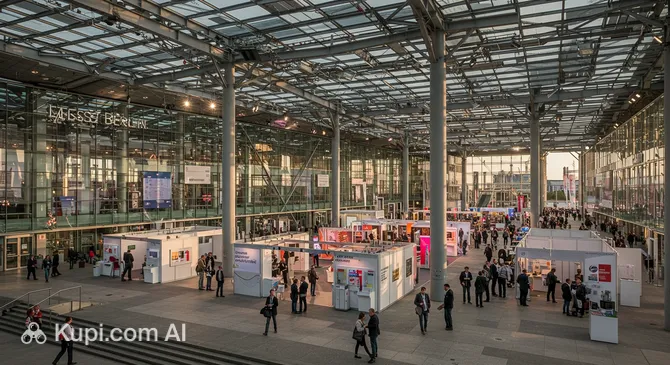
Messe Berlin. Illustration.
Source: Kupi.com AI

Traveler photos:

The scale of the complex is impressive: it includes 26 indoor exhibition halls covering a total area of approximately 160,000 square meters. In addition, there are 100,000 square meters of outdoor exhibition space, ideal for demonstrating large machinery. The total area of the complex reaches approximately 550,000 square meters.

In addition to vast exhibition spaces, Messe Berlin offers a developed infrastructure that makes it a real city within a city. The grounds feature numerous conference rooms, offices, an exhibitor service center, and a variety of dining options. One of the unique features is the "Summer Garden" (Sommergarten) — a 10,000-square-meter green space in the heart of the complex where visitors can relax between events.

Contacts

To get the most up-to-date information regarding upcoming events, schedules, and tickets, or to ask organizational questions, it is best to contact Messe Berlin representatives directly. You can do this using the contact details provided below.

How to contactContact
AddressMessedamm 22, 14055 Berlin, Germany
Phone number+49 30 30380
Websitewww.messe-berlin.de

What to Do

Visiting Messe Berlin is primarily an immersion into the world of innovation and professional interests, as more than 100 regional, national, and international events take place on its grounds every year. Depending on the timing of your visit, you might attend world-renowned events. These include ITB Berlin, the world's largest travel trade show; IFA, the international consumer electronics exhibition; the famous agricultural exhibition International Green Week Berlin; and InnoTrans, the world's leading trade fair for transport technology. Each of these events is a unique opportunity to learn about the latest trends in their respective industries.

The experience of visiting exhibitions at Messe Berlin is not limited to simply viewing stands. For visitors, it is also an excellent opportunity for learning and professional growth. As part of most major events, numerous congresses, thematic seminars, workshops, and presentations are organized. Participating in these allows you not only to learn about the latest achievements in various industries but also to communicate directly with experts, ask questions, and establish valuable business contacts.

Getting There

Getting to the Messe Berlin exhibition complex is quite simple thanks to its convenient location and Berlin's well-developed transport network. One of the fastest and most reliable ways is to use public transport. You can take the S-Bahn city train to the Messe Süd or Westkreuz stations, which are located in the immediate vicinity of the complex. Another convenient option is the U-Bahn (metro): the nearest stations, Kaiserdamm and Theodor-Heuss-Platz (U2 line), are just a few minutes' walk from the entrances.

In addition to rail transport, numerous bus routes lead to Messe Berlin, with stops located near the exhibition pavilions. A taxi or car ride from the city center usually takes no more than 20–30 minutes, depending on traffic conditions. For those arriving by car, there are spacious parking lots around the complex. To efficiently manage the flow of guests even during the largest events, Messe Berlin has several main entrances: North, South, East, and West.

Nearest city: Berlin

History & Facts

The history of Messe Berlin dates back to the beginning of the 20th century, although the first craft and automobile exhibition was held on this site as early as 1822. The first stone of the modern complex was laid in 1914 for the construction of an automobile exhibition pavilion. However, due to the First World War, it did not open until 1921. In 1924, a pavilion for the radio industry was built nearby, and 1926 saw the opening of the famous Radio Tower (Funkturm), which quickly became one of the symbols of Berlin's technological progress.

The foundation of the modern exhibition complex as we see it today was laid in the 1930s according to the design of architect Richard Ermisch. The buildings constructed in the 1930s and 1950s have survived decades and today are not just functional spaces, but true architectural monuments. They are protected by the state, highlighting their historical and cultural value to Berlin. This unique combination of historical architecture and modern exhibition technologies makes the complex particularly interesting.

A significant stage in the development of Messe Berlin occurred in the 1970s with the construction of the International Congress Center (ICC). Opened in 1979, it was one of the largest and most modern congress centers in the world at the time. Its futuristic design, resembling a spaceship, was the embodiment of advanced technology and architectural thought of that era. The building, over 300 meters long with an aluminum facade, became a real landmark and a symbol of Berlin's role as a global hub for congresses and large-scale events.

Time Needed

When planning a visit to Messe Berlin, it is worth remembering that the time needed for exploration depends directly on the scale and format of the event. For small, highly specialized exhibitions or conferences, a few hours may be quite sufficient. During this time, you can visit key stands, attend a lecture of interest, and form a general impression of the exhibition.

However, if your goal is one of the major international fairs, such as ITB, IFA, or "International Green Week," you should set aside at least one full day for a comprehensive visit. The scale of such events is enormous, and even a cursory look at all the pavilions will take a lot of time. Many professionals and enthusiasts who want to dive deep into a topic, attend several seminars, and hold business meetings often plan their visit for two or even three days.

To make the most of your time, it is highly recommended to study the event program and the floor plan of the exhibition complex on the official website in advance. This will help you create a personal itinerary, mark the pavilions and stands most interesting to you, and ensure you don't miss important presentations or reports held at specific times.

Working Hours

The Messe Berlin exhibition complex does not have standard opening hours like a museum or gallery, as its schedule depends entirely on the events being held. During exhibitions, congresses, or fairs, the pavilions are usually open to visitors from morning until evening. However, the exact times can vary significantly depending on the specific event, its format, and the schedule.

To find out the current opening hours, it is highly recommended to check the official Messe Berlin website or the page of the event you are interested in beforehand. Information about purchasing tickets can also be found there. For major international exhibitions, it is better to buy tickets online in advance — this not only helps avoid queues but is also often more cost-effective. The complex operates year-round, hosting a wide variety of events in any season.

Nearby

A visit to the Messe Berlin exhibition complex is an event-packed experience, but your exploration of the city should not be limited to its walls. The Charlottenburg district, where the complex is located, and the surrounding areas are rich in interesting places that will help you better understand the culture and history of Berlin. By setting aside a little time to walk around the neighborhood, you can complement your business trip with bright tourist impressions.

From majestic palaces and famous sports arenas to quiet parks and iconic shopping centers, the surroundings of Messe Berlin offer entertainment for every taste. Excellent transport links allow you to quickly reach many of the key attractions in the capital of Germany, turning a break between events into a small trip.

NameDistance
Charlottenburg Palace2.9 km
Maxxim4.2 km
Grunewald Forest4.2 km
Rüyam Gemüse Kebab5.9 km
Grand Hyatt7 km
Garnelen Guemmer Aquarium7.1 km
BRLO Brwhouse7.1 km

Have you reached the end of the page?

So the route has been studied inside and out