Support

Brandenburg Gate

About

The Brandenburg Gate is not just an architectural masterpiece; it is the primary symbol of Berlin and an iconic landmark for all of Germany. Located in the heart of the city on Pariser Platz, it is the only surviving gate of the former city entrance and serves as a monumental portal to the famous Unter den Linden boulevard. Its majestic appearance and rich history attract travelers from all over the world.

Erected at the end of the 18th century, the gate was the first significant structure in the German Classicist style. Architect Carl Gotthard Langhans drew inspiration from antiquity, modeling it after the Propylaea — the monumental gateway to the Acropolis in Athens. This architectural reference emphasizes not only the grandeur of the structure but also its original purpose as a symbol of peace.
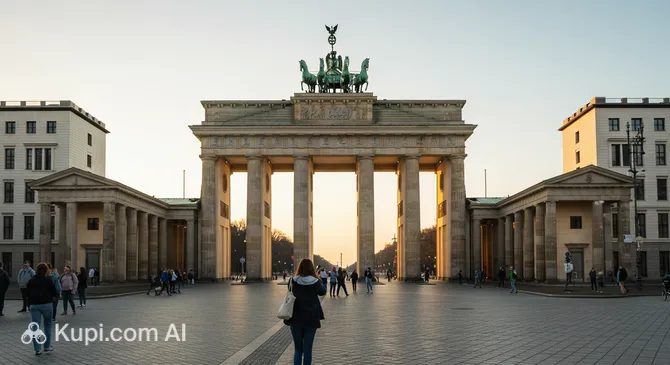
Brandenburg Gate. Illustration.
Source: Kupi.com AI

Traveler photos:

Crowning the gate is the famous six-meter sculptural composition — the Quadriga, driven by Victoria, the goddess of victory. Created by sculptor Johann Gottfried Schadow, it has its own dramatic history, including a temporary relocation to Paris by order of Napoleon. Today, back in its rightful place, the Quadriga gazes over the city, embodying triumph and reunification.

A walk to the Brandenburg Gate is an opportunity to touch history and feel the spirit of modern Berlin. From here, views open up to the expansive Tiergarten park and the Victory Column. Visiting this iconic site, which has become a symbol of peace and unity, leaves an unforgettable impression and is an essential part of any trip to the German capital.

Contacts

The Brandenburg Gate is a public monument open to visitors 24/7 and free of charge, so it does not have a specific administration or direct contact lines for tourists. All up-to-date information regarding events at the gate or tourist routes can be found on the official Berlin portal or at one of the city's tourist information centers, the closest of which is located right on Pariser Platz. Reaching the attraction is very easy by public transport: the eponymous S-Bahn and U-Bahn station Brandenburger Tor is located right nearby.

How to contactContact
AddressPariser Platz, 10117 Berlin, Germany
Websitewww.berlin.de

What to Do

Visiting the Brandenburg Gate is primarily an opportunity to enjoy its monumental beauty and take magnificent photographs. Most tourists begin their visit by closely examining the structure itself. Take the time to photograph the famous "Quadriga of Victory" — the sculptural composition of a chariot that crowns the gate. This is the main photo subject and a symbol that should be in the collection of every traveler visiting Berlin.

The Brandenburg Gate is not just a monument but a central point for exploring the capital of Germany. It is situated on the lively Pariser Platz, which is a great place to people-watch and observe city life. It is the perfect starting point for further exploration of Berlin's historic center, with paths leading to many other iconic sites.

The famous Unter den Linden boulevard begins at the gate. Walking along it is a classic tourist route that will lead you to Museum Island and the Berlin Cathedral. If you are looking for a place to relax, simply cross the road to find yourself in the spacious and picturesque Tiergarten park. Here, you can escape the city bustle, have a small picnic, or simply enjoy nature in the heart of the metropolis.

Getting There

Finding the Brandenburg Gate in Berlin is easy, as it is located in the very heart of the city — in the central Mitte district, on the famous Pariser Platz. Thanks to its location and the German capital's excellently developed public transport system, you can reach this icon quickly and conveniently from almost anywhere in the city.

The easiest way to reach the gate is by public transport. Right next to the landmark is the Brandenburger Tor station, served by both the S-Bahn and U-Bahn. You can take S-Bahn trains (lines S1, S2, S25, S26) and the U-Bahn (line U5). The Unter den Linden station is also nearby, served by lines U5 and U6. Additionally, numerous buses running through the city center stop at Pariser Platz.

Since the Brandenburg Gate is surrounded by other key attractions, it is easily accessible on foot. A stroll along the famous Unter den Linden boulevard or through the picturesque Tiergarten park is an engaging excursion in its own right. If you prefer maximum comfort, you can always take a taxi, which will bring you directly to Pariser Platz.

Nearest city: Berlin

History & Facts

The history of the Brandenburg Gate is inextricably linked to key events in the history of Berlin and all of Germany. Its construction began in 1788 by order of the Prussian King Frederick William II, based on a design by architect Carl Gotthard Langhans. Initially, the structure was named the "Gate of Peace" (Friedenstor), as it was built to commemorate the restoration of peace following the Prussian invasion of the Netherlands. The grand opening took place in 1791, and today it is the only survivor of the capital's former eighteen city gates.

Construction was fully completed in 1793 when the famous Quadriga — a chariot driven by a goddess — was installed atop the gate. The sculpture, created by Johann Gottfried Schadow, originally depicted the goddess of peace, Eirene, holding an olive branch. However, after the Napoleonic Wars, when the Quadriga was returned to Berlin from Paris, its symbolism changed: the goddess of peace became Victoria, the goddess of victory, and the olive branch was replaced by the Iron Cross. During the mid-20th century, the gate and sculpture suffered serious damage but were meticulously restored in the 1950s, with the Quadriga being recast from the original molds.

In the 20th century, the Brandenburg Gate became a powerful symbol of division and subsequent reunification. With the construction of the Berlin Wall in 1961, it stood in a restricted border zone, inaccessible to residents of both East and West Berlin. For nearly three decades, the gate epitomized the "Iron Curtain" and the split of Germany. A historic moment arrived on December 22, 1989, when the gate was reopened, becoming one of the most poignant events on the path to national unification. Since then, the Brandenburg Gate has stood as the ultimate symbol of peace and unity, not only for Germans but for all of Europe.

Time Needed

For a quick look at the Brandenburg Gate itself, to take some photos and appreciate the architectural grandeur, 30 to 60 minutes will suffice. This is enough time to examine the main details of the monument, the famous Quadriga on top, and to feel the historical atmosphere of this iconic site.

However, to fully enjoy the visit, it is recommended to set aside about 2–3 hours. This allows for a leisurely stroll around Pariser Platz, where the gate is located, and to begin a walk down the famous Unter den Linden boulevard. Given that other key attractions, such as the Reichstag and the vast Tiergarten park, are in the immediate vicinity, extra time will allow you to explore this entire significant historical quarter of Berlin without rushing.

Working Hours

One of the main advantages of the Brandenburg Gate is its accessibility. As it is an open-air monument located on a city square, it does not have traditional opening hours. You can visit the gate at any time of the day or night, 24/7 and year-round. This allows tourists to flexibly plan their itinerary and enjoy the landmark both in daylight and under its evening illumination.

No tickets or prior reservations are required to visit the Brandenburg Gate, as access to Pariser Platz, where it is located, is completely free. This makes seeing one of Berlin's main symbols as simple and convenient as possible for every traveler. The only exception may be the "Room of Silence" (Raum der Stille), located in one of the gate's wings, which has its own specific opening hours.

Nearby

The Brandenburg Gate's location in the heart of Berlin makes it the perfect starting point for exploring other iconic sites in the capital. Exploring the surrounding area will allow you to dive deeper into the city's history and culture, as equally important landmarks, museums, and public spaces are located just steps away from this famous monument.

A walk through this district will enrich your experience and help you form a complete picture of Berlin's multifaceted past and dynamic present. Many of the key sites are within walking distance, making it easy to plan a packed and interesting itinerary for a few hours or even a full day.

NameDistance
Grand Bar0.7 km
Mall of Berlin0.7 km
Tränenpalast0.8 km
Grand Hyatt1 km
Topography of Terror1.1 km
Berlin Story Bunker1.5 km
BRLO Brwhouse1.8 km

Have you reached the end of the page?

So the route has been studied inside and out