Support

Jewish Museum Berlin

About

The Jewish Museum in Berlin is not just an exhibition space, but one of the most significant cultural and architectural landmarks in Germany. Dedicated to nearly two millennia of German-Jewish history, it strikes visitors even before they step inside, representing a unique dialogue between the past and the present. The museum complex consists of two buildings: an old Baroque-style wing and an adjacent new zigzagging structure that has become a symbol of the city.
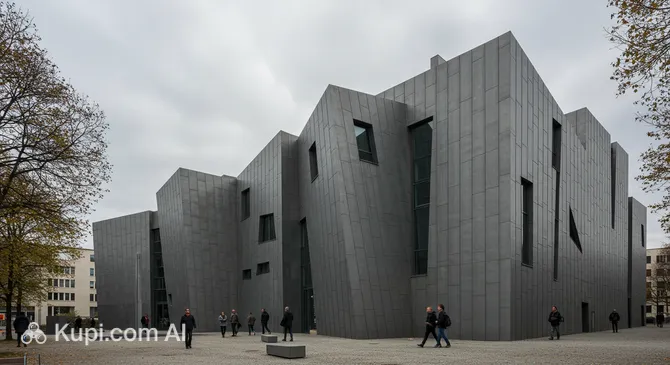
Jewish Museum Berlin. Illustration.
Source: Kupi.com AI

Traveler photos:

The new building is a masterpiece by architect Daniel Libeskind, designed in the Deconstructivist style. His project, titled "Between the Lines," symbolizes the complex and sometimes tragic history of the Jewish people. The asymmetrical shape, titanium-zinc alloy cladding, and narrow windows resembling slashes create a powerful emotional impact. The architecture makes visitors feel a sense of anxiety and disorientation, symbolically conveying the experience of exile and loss.

The interior layout of the museum is equally symbolic. Visitors move along underground "axes," each with its own meaning: the "Axis of the Holocaust," "Axis of Exile," and "Axis of Continuity." Particularly powerful impressions are left by the "Garden of Exile"—a sloped plaza with 49 concrete stelae that evoke a sense of instability—and the almost empty Holocaust Tower. These spaces, called "voids," embody the absence—the void left in German culture after the extermination and exile of the Jewish population.

Contacts

To plan your visit, check opening hours, and see the schedule of temporary exhibitions, we recommend using the museum's official contact information. All current information is available on the website or by calling the information desk.

How to contactContact
AddressLindenstraße 9-14, 10969 Berlin, Germany
Phone number+49 30 25993549
Websitewww.jmberlin.de

What to Do

The main thing to do at the Jewish Museum is to explore its updated permanent exhibition. It will guide you through centuries of German-Jewish history, from the Middle Ages and the Enlightenment to the 20th century. Here you will see thousands of unique exhibits: from ritual objects and ancient manuscripts to personal belongings, photographs, and artworks that tell the story of the traditions, daily life, and contributions of the Jewish community to the culture of Germany.

A special experience that should not be missed is interacting with the art installations integrated into the museum's space. One of the most powerful is the "Fallen Leaves" (Shalechet) installation, located in one of the building's "voids." Visitors are invited to walk across a floor covered with 10,000 metal disks shaped like human faces. The sound they make underfoot forces deep reflection on emptiness and irreplaceable loss. This is an emotional experience, not just an observation of an exhibit.

The museum is dynamic and constantly changing thanks to a variety of temporary exhibitions. These focus on diverse topics: contemporary art, photography, design, and current social issues related to Jewish life today. Additionally, educational programs, lectures, and interactive installations are often organized for visitors, helping them understand complex historical and cultural themes in an accessible way. Thus, a visit to the museum becomes a multilayered experience, combining the study of history, the perception of art, and deep personal reflection.

Getting There

Getting to the Jewish Museum Berlin is quite simple, as it is located in the central district of Kreuzberg. The most convenient way is to use Berlin's extensive public transport system. Several metro stations (U-Bahn) are within walking distance. The closest are Hallesches Tor, where lines U1, U3, and U6 intersect, and Kochstraße/Checkpoint Charlie on the U6 line.

From any of these stations, a short walk of no more than 5–10 minutes will take you to the museum. Additionally, several buses stop nearby. Look for routes M29, M41, and 248—the stop is appropriately named Jüdisches Museum. This is an excellent option if you prefer surface transport to see more of the city along the way.

If you value comfort or are traveling with young children, you can take a taxi. The ride from central points like Alexanderplatz or the main station (Hauptbahnhof) is quick, as the museum is located near major tourist routes. For those driving, please note that finding parking in this area can be difficult, making public transport often the more practical choice.

Nearest city: Berlin

History & Facts

The history of the current museum is rooted in a past that proved tragically short. The first Jewish Museum in Berlin opened in 1933 but lasted only five years. Following the events of "Kristallnacht" in 1938, it was closed by the regime. Originally, this museum, along with the New Synagogue on Oranienburger Straße, was one of the few in the world to house historical Jewish exhibits. After its closure, its valuable collection was taken away and eventually ended up in Israel and Los Angeles.

The idea of reviving the museum emerged decades later. In 1971, during the 300th anniversary of the city's Jewish community, discussions about creating a new museum space resurfaced. In 1988, an architectural competition was announced to expand the Berlin Museum to include a department dedicated to Jewish history. Architect Daniel Libeskind won with his bold project titled "Between the Lines," which became the foundation for the modern building.

The opening of the modern museum complex was overshadowed by global events. The ceremony was scheduled for September 11, 2001. However, due to the terrorist attacks in the USA on that day, the opening had to be postponed. Ultimately, the Jewish Museum Berlin opened its doors to visitors two days later, on September 13, 2001, starting a new chapter in the cultural life of the city and the country.

Time Needed

To fully explore the Jewish Museum in Berlin, you should allow at least 2–3 hours. This time will let you do more than just glance at the exhibits; it allows you to experience the unique architecture of Daniel Libeskind's building, which is an essential part of the exhibition in itself. As the largest Jewish museum in Europe, it offers a deep dive into history, so rushing would be misplaced.

Your visit can be planned according to your interests. If you are short on time, 1–1.5 hours is enough to walk through the main architectural axes—the "Axis of the Holocaust," "Axis of Exile," and "Axis of Continuity"—and visit impressive installations like the Garden of Exile and the Holocaust Tower. However, for a fuller experience, including the main historical exhibition covering two millennia of German-Jewish history, it's best to plan for 2 to 3 hours.

For those who want to thoughtfully examine documents, personal stories, and temporary exhibitions, you should set aside half a day or even more. This allows you to immerse yourself in the details without rushing, reflect in the museum's "voids," such as the space with the "Fallen Leaves" installation, and relax in the garden or café. Ultimately, the Jewish Museum is a place that requires not only time but emotional engagement, so planning a relaxed visit will provide a much deeper and more meaningful experience.

Working Hours

The Jewish Museum Berlin is open to visitors year-round, but it has a specific operating schedule. Generally, the museum is open daily from 10:00 AM to 7:00 PM. However, please note that it is closed on certain major Jewish holidays, such as Rosh Hashanah and Yom Kippur, as well as on Christmas Eve and the day of the annual Prize for Understanding and Tolerance ceremony. Last admission is usually around 6:30 PM, so plan your visit with time to spare.

To guarantee your visit at a convenient time and avoid queues, it is highly recommended to book tickets in advance online via the museum's official website. This is especially relevant for weekends and public holidays when visitor numbers increase significantly. Before your trip, be sure to check the museum's official website to confirm current opening hours, temporary exhibition schedules, and any possible changes to the schedule.

10:00 – 18:00

Nearby

A visit to the Jewish Museum in Berlin leaves a deep impression, but to better understand the context of this site, it is worth exploring the surrounding area. The museum is located in the Kreuzberg district, which is itself a living historical and cultural landmark. Once divided by the Wall, the area is now known for its multicultural flavor, street art, and creative atmosphere. A walk through its streets after your museum visit will help complete the picture of the city's past and present.

In the immediate vicinity of the Jewish Museum, there are other iconic sites that deserve attention. From memorials dedicated to the complex chapters of 20th-century history to modern cultural and entertainment venues, everything is within a short walk. Exploring these sites will provide a more complete and multifaceted perspective on Germany and its capital.

NameDistance
Topography of Terror0.9 km
Berlin Story Bunker1 km
German Museum of Technology1.3 km
Mall of Berlin1.3 km
BRLO Brwhouse1.5 km
Grand Bar1.6 km
Grand Hyatt1.7 km

Have you reached the end of the page?

So the route has been studied inside and out