Support

Würzburg Residence

About

The Würzburg Residence is a majestic Baroque palace and park ensemble located in the center of Würzburg. Once the official seat of the prince-bishops, this magnificent palace is one of the most significant architectural monuments in Germany and is rightfully considered a jewel of the late European Baroque. Due to its historical and cultural value, the Residence became the first German palace to be included in the UNESCO World Heritage list.
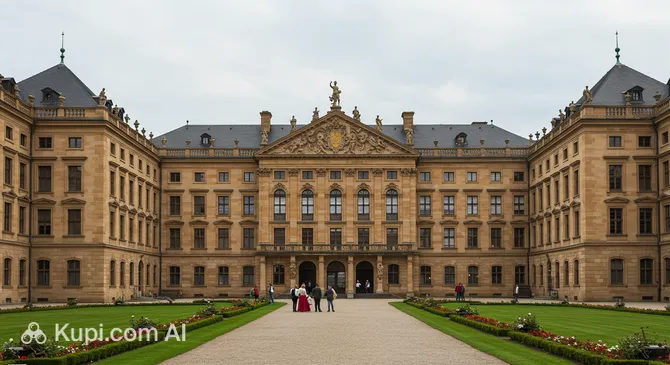
Würzburg Residence. Illustration.
Source: Kupi.com AI

Traveler photos:

The palace project was designed by the outstanding architect Balthasar Neumann. Construction of the main building lasted from 1719 to 1744, while the creation of the luxurious interiors took several more decades, until the 1780s. The Residence impresses with its scale, the harmony of its architectural forms, and the richness of its decoration. One of its main attractions is the monumental Grand Staircase, the ceiling of which is adorned with the world's largest single-piece fresco by the Venetian artist Giovanni Battista Tiepolo.

Today, visitors can explore numerous halls and apartments, including the famous Imperial Hall and the dazzling Mirror Cabinet, which showcase the splendor of 18th-century court life. A visit to the Würzburg Residence is a unique opportunity to touch history and art, and a walk through the adjacent Court Garden (Hofgarten) will be a perfect conclusion to your visit.

Contacts

For the most up-to-date information on opening hours, admission fees, and special events at the Würzburg Residence, we recommend visiting the official website of the palace. There, you can find precise contact details, including a telephone number and email address. This will allow you to plan your visit effectively and avoid any inconvenience.

How to contactContact
AddressResidenzpl. 2, 97070 Würzburg, Germany
Phone number+49 931 355170
Websitewww.residenz-wuerzburg.de

What to Do

A visit to the Würzburg Residence is an opportunity not just to see the halls, but to experience the atmosphere of luxury and grandeur of the Baroque era. Instead of simply moving from room to room, allow yourself to slow down. As you ascend the famous staircase, linger on the colossal ceiling fresco by Giovanni Battista Tiepolo—try to find the artist's own self-portrait among the many figures. In the state rooms, pay attention not only to the overall opulence but also to the details: the intricate wood carvings, the play of light in the mirrors, and the elegance of the original 18th-century furniture that tells the story of the prince-bishops' daily lives.

Do not limit yourself to the palace interiors. Be sure to set aside time for a walk in the Court Garden (Hofgarten), which is an integral part of the experience. It is the perfect place to take a break from the magnificence of the halls and enjoy the silence. Stroll along the symmetrical alleys designed in the strict style of a French formal garden, and admire the elegant sculptures and fountains. The garden is beautiful in any season, offering either vibrant floral arrangements or tranquil greenery.

The Würzburg Residence is not a static museum, but a living cultural center. To make your visit truly special, we recommend checking the event calendar in advance. Classical music concerts are regularly held here, and hearing Bach or Mozart in these historical interiors is a unique experience. Additionally, the palace halls often host temporary exhibitions dedicated to art or history, which complement the main display and allow you to see this place from a new perspective.

Getting There

The Würzburg Residence is conveniently located in the heart of Würzburg, making it easily accessible for all travelers. If you arrive in the city by train, the palace is within walking distance of the main railway station (Würzburg Hauptbahnhof). A leisurely stroll through the picturesque streets will take no more than 15-20 minutes, which is a great way to immediately immerse yourself in the city's atmosphere.

For those who prefer public transport, there are tram and bus stops located near the Residence. This allows for a quick and direct journey to the attraction from almost anywhere in Würzburg. If you are traveling by car, there are paid parking lots in the immediate vicinity of the palace complex where you can leave your vehicle during your visit. Thanks to excellent rail connections, Würzburg is easy to reach from major German cities such as Frankfurt, Nuremberg, or Munich, making the Residence a wonderful stop on any Bavarian itinerary.

Nearest city: Würzburg

History & Facts

The history of the Würzburg Residence is a tale of grand ambitions and unparalleled craftsmanship. Construction of the palace began in 1719 at the initiative of Prince-Bishop Johann Philipp Franz von Schönborn. He entrusted this massive project to a young architect, Balthasar Neumann, who was only 33 at the time. This choice proved incredibly successful, as under Neumann's leadership, one of the most significant Baroque palace complexes in all of Germany was created.

The construction process was long and painstaking. After the death of the first patron, the work was continued by his brother, Friedrich Karl von Schönborn. The main building was completed by 1744, but the decoration of the luxurious interiors continued until the 1780s. Outstanding artists and craftsmen from across Europe were invited to create the interior decor. The crown jewel of the residence is the work of the Venetian painter Giovanni Battista Tiepolo. He painted the ceiling above the grand staircase, creating the world's largest single-piece ceiling fresco, which continues to amaze visitors today with its scale and detail.

Originally, the palace served as the official residence for the Prince-Bishops of Würzburg, symbolizing their power and high status. After the secularization of church properties in the early 19th century, the residence ceased to perform its original function. Today, it is not only a magnificent architectural monument but also a vital cultural site that attracts tourists and art lovers from around the world to witness the grandeur of the Baroque era firsthand.

Time Needed

When planning a visit to the Würzburg Residence, it is worth setting aside at least 2–3 hours for the tour. This time is usually enough to walk through the main halls of the palace without rushing, admire the famous fresco on the Grand Staircase, and appreciate the luxury of the Imperial Hall. A standard route through the residence provides a complete impression of this outstanding monument of Baroque architecture.

Don't forget to include a walk through the magnificent Court Garden (Hofgarten), which adjoins the palace. A leisurely exploration of its terraces, alleys, and sculptures can take anywhere from 30 minutes to an hour. Thus, the total time to experience the residence and the garden will be about three hours.

If you wish to visit special exhibitions that are periodically held on the complex grounds or join an in-depth thematic tour, the duration of your visit could easily extend to half a day. To fully enjoy all the treasures of the Würzburg Residence, it is recommended to allow plenty of free time in your itinerary.

Working Hours

The Würzburg Residence is generally open to visitors year-round, though opening hours may vary depending on the season. Typically, the palace welcomes guests daily from morning until evening. As schedules can change, especially on public holidays, it is highly recommended to check the current information on the official website of the attraction just before your visit.

For a visit to such a popular site as the residence in Würzburg, it is worth thinking about tickets in advance. To avoid long lines, especially during the peak tourist season, check the official website for the option to purchase tickets online. You can also find information there about available guided tours, including those in different languages, which will make your introduction to this magnificent palace even more informative.

9:00 – 18:00

Nearby

A visit to such a grand site as the Würzburg Residence leaves an unforgettable impression, but your introduction to the city would be incomplete without a walk through its surroundings. Often, it is in the small streets, neighboring squares, and cozy parks that the true soul of a city is hidden. Exploring nearby attractions allows you to dive deeper into the history and culture of Würzburg and see how different eras harmoniously coexist.

Fortunately, Würzburg's historic center is quite compact, and many iconic sites are within walking distance of the Residence. This makes a stroll not only pleasant but also very educational. You can easily plan a route for several hours that covers key landmarks located just a stone's throw away.

NameDistance
Residenz Square0.1 km
Court Garden0.1 km
Basecoffee Würzburg0.5 km
Original Berlin Döner Würzburg0.5 km
Würzburg Cathedral0.5 km
Falkenhaus0.7 km
St. Mary's Chapel0.7 km

Have you reached the end of the page?

So the route has been studied inside and out