Support

Natural History Museum of Crete

About

The Natural History Museum of Crete is a fascinating scientific and educational institution located in the city of Heraklion on the sunny island of Crete, in Greece. Since its founding in 1980–1981, the museum has functioned under the auspices of the University of Crete, becoming an important center for the study and promotion of the region's natural heritage. If you are interested in the unique nature of the Mediterranean, this place is a must-visit.
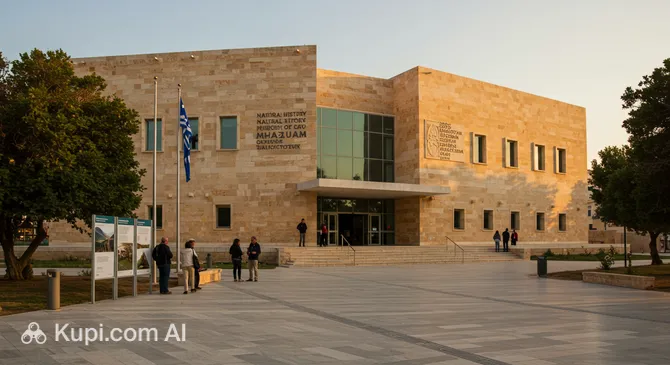
Natural History Museum of Crete. Illustration.
Source: Kupi.com AI

Traveler photos:

The museum occupies an impressive, meticulously restored industrial building of a former power station, located right on Heraklion's scenic waterfront. The total area of its exhibition halls exceeds 3,500 square meters, offering visitors extensive space to discover its rich collections.

The museum's exhibits are dedicated to the diverse nature of the Eastern Mediterranean, with a special emphasis on the unique flora and fauna of Greece and, of course, Crete itself. Here, you can see rare species of animals and plants, learn about the island's ecosystems, and immerse yourself in the world of natural history of this amazing corner of the planet. Special attention is paid to endemic species that can only be found on Crete.

In addition to its exhibition activities, the Natural History Museum of Crete is actively involved in scientific research, archiving and conservation, educational programs, and publications. It is not just a collection of exhibits but a dynamically developing center that makes a significant contribution to the study and preservation of the natural wealth of Crete and the entire Mediterranean region.

Contacts

To plan your visit to the Natural History Museum of Crete and find the latest information on opening hours, ticket prices, or current exhibitions, it is recommended to contact the museum's official resources directly. The primary source for such information is its official website.

How to contactContact
AddressΚόλπος Δερματά, Leof. Sofokli Venizelou, Iraklio 712 02, Greece
Phone number+30 281 028 2740
Websitewww.nhmc.uoc.gr

What to Do

At the Natural History Museum of Crete, visitors can expect a fascinating journey through the island's natural world, spanning from ancient times to the present day. One of the main highlights of the museum is the Mega-dioramas — large-scale and incredibly realistic displays that recreate the ecosystems of the Eastern Mediterranean. Here, you can see representatives of the local flora and fauna in detail, presented in their natural habitats, creating a fully immersive effect.

Of particular interest is the area called the "Live Museum." This part of the exhibition features numerous aquariums and terrariums home to live animals and reptiles characteristic of the Eastern Mediterranean region. It is a wonderful opportunity to observe the behavior of these creatures in conditions as close to nature as possible. Children and adults alike are delighted to see snakes, lizards, turtles, and other inhabitants.

A unique experience offered by the museum is a visit to a special room with an earthquake simulator. Here, visitors can not only gain theoretical knowledge about the nature of tremors of various magnitudes but also experience them for themselves in a safe environment. This is an educational and impressive addition to the main exhibition, allowing for a better understanding of the natural phenomena characteristic of this seismically active region.

On the museum's ground floor, there is an impressive collection of fossils of animals that once inhabited Crete. A special place among the exhibits is held by the skeleton of the giant Deinotherium — a prehistoric trunked mammal that is striking in its size. This part of the exhibition offers a glimpse into the island's distant past and helps imagine what amazing creatures lived here millions of years ago.

Getting There

The Natural History Museum of Crete boasts a prime location in Heraklion, right next to the picturesque Venetian harbor. Thanks to this central waterfront position, the museum is easy to find, especially if you are strolling through the historic part of the city. Most hotels and apartments in central Heraklion are within walking distance, allowing you to combine a pleasant walk with an educational visit.

If you prefer to use public transport, city buses run throughout Heraklion. It is recommended to check the route numbers heading towards the waterfront or the Venetian harbor in advance. For travelers arriving in Greece via Heraklion International Airport, several options are available: you can take a taxi directly to the museum or use a bus to the city center, from where the Natural History Museum of Crete is just a few minutes' walk away.

Nearest city: Heraklion

History & Facts

The Natural History Museum of Crete has a fascinating founding story. It was established in 1981 and has operated under the patronage of the University of Crete from the very beginning. The core idea behind its creation was not just to collect exhibits, but to establish a center for the in-depth study, reliable protection, and active promotion of knowledge about the unique flora and fauna of the entire Eastern Mediterranean, with a special focus on Crete itself.

A very notable location was chosen to house the museum – a historic industrial building in Heraklion. This structure formerly served as the city's electrical substation, providing power to the capital of Crete. Before the museum opened its doors to visitors, the building underwent a thorough renovation and was carefully adapted for exhibition needs while preserving its unique historical appearance and industrial charm. This in itself makes the building part of the display, telling the story of the city’s history.

Since its opening, the Natural History Museum of Crete has not stood still. It has constantly evolved, consistently expanding its exhibitions and actively implementing modern interactive technologies. This has made the presentation of the region's complex natural world more visual, engaging, and accessible to visitors of all ages. Today, the museum is rightfully considered one of the most important scientific and educational centers not only in Heraklion but in all of Greece, making an invaluable contribution to the study and preservation of the priceless natural heritage of Crete and the broader Eastern Mediterranean region.

Time Needed

When planning a visit to the Natural History Museum of Crete, you should expect to spend about 2 to 3 hours exploring. This time is usually enough to see the main exhibits without rushing, focusing on the sections that interest you most. The museum is quite large, and there is truly a lot to see.

Of course, the duration of your visit may vary. If you have a deep interest in paleontology, zoology, or botany, or if you are traveling with children who want to explore the interactive exhibits in detail—such as the earthquake simulator or the "Live Museum" with its inhabitants—you could easily spend half a day here. A quick walk through the main halls will take less time, perhaps around 1.5 hours.

Keep in mind that the museum has several key zones: the Mega-dioramas recreating ecosystems, the "Live Museum" with terrariums and aquariums, the fossil hall including the Deinotherium skeleton, and the earthquake simulator room. Each of these deserves attention, so it's best not to plan a rushed visit to get the most out of this educational site in Heraklion.

Working Hours

When planning a visit to the Natural History Museum of Crete in Heraklion, it is important to check the current opening hours in advance, as they may change depending on the season. You will always find the most reliable information on the museum's official website or by contacting the administration directly. We also recommend checking if advance ticket booking is necessary, especially during the peak tourist season, to ensure your visit is as comfortable as possible.

As a rule, the Natural History Museum of Crete is open to visitors year-round. However, like many tourist attractions, it may have different opening hours during the summer (high) and winter (low) seasons. For example, the museum may stay open later in the summer and have a reduced schedule in the winter. Therefore, checking the current information on official resources will help you plan your visit in the best way and ensure you find the museum open.

Nearby

Visiting the Natural History Museum of Crete is undoubtedly a fascinating experience, but Heraklion offers much more for the curious traveler. Exploring the museum's surroundings will allow you to dive deeper into the city's atmosphere, discover its cultural and historical heritage, and simply enjoy a walk through its streets, discovering new and interesting spots.

By combining a visit to the museum with a tour of nearby attractions, you can form a more complete and vivid impression of Heraklion. A short walk can lead you to other iconic sites, each telling the story of this amazing Cretan city in its own way. Below is a list of some interesting places located near the Natural History Museum of Crete.

NameDistance
Historical Museum of Crete0.4 km
Thirathen Museum of Musical Instruments0.6 km
Kuzina Casual Food0.6 km
Peskesi0.6 km
Talos Plaza0.6 km
Cathedral of Saint Minas0.6 km
Morosini Fountain0.7 km

Have you reached the end of the page?

So the route has been studied inside and out