Support

Koules Fortress

About

The Koules Fortress is an impressive stone defensive structure rising proudly at the entrance to the old port of the city of Heraklion on the island of Crete, Greece. This historical landmark is more than just a fortress; it is a true symbol of the city's rich maritime history and one of its most recognizable landmarks, attracting travelers from all over the world.
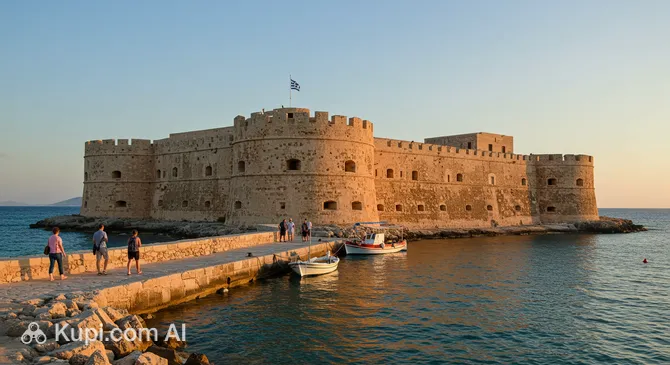
Koules Fortress. Illustration.
Source: Kupi.com AI

Traveler photos:

Architecturally, Koules is a massive two-story fortress built from sturdy stone blocks, many of which, according to historical data, were brought from nearby islands. On its powerful walls, you can still see well-preserved bas-reliefs of the winged lion—the symbol of Saint Mark and the Venetian Republic. These details speak volumes about the Venetian period in the fortress's history and highlight its strategic importance in the past.

A visit to the Koules Fortress allows you not only to touch centuries of history but also to enjoy magnificent panoramic views of the harbor, the city, and the endless Cretan Sea. Inside the fortress, you can explore its interior rooms, which once served as barracks, a prison, and storage facilities. Today, cultural events and exhibitions are often held here, giving this historical site a modern feel and making it even more attractive to tourists.

Contacts

Since the Koules Fortress is a historical site, direct contact phone numbers may not be available. It is recommended to check for the most up-to-date information regarding opening hours, ticket prices, and possible tours on the official tourism websites of Heraklion or directly at tourist information centers upon arrival in Greece. The fortress is highly visible and easily accessible on foot, as it is located at the entrance to the old port of Heraklion.

How to contactContact
AddressHeraklion 712 02, Greece
Phone number+30 281 024 3559
Websitekoules.efah.gr

What to Do

An exploration of the Koules Fortress can begin with a walk along its impressive walls. From here, breathtaking panoramic views of the bustling Heraklion port and the vast Aegean Sea open up, allowing you to fully appreciate the strategic location of this ancient structure.

Inside the fortress, travelers can immerse themselves in history. Temporary exhibitions are often organized here, dedicated to Crete's rich past, archaeological finds, maritime history, and the unique culture of the region. This is a wonderful opportunity to learn more about the civilizations that left their mark on this land and to see artifacts that tell the story of maritime glory and daily life in bygone eras.

The fortress's underground rooms are of particular interest to curious visitors. Once used for storage and even as prison cells, they now hold silent testimony to the past. You can explore the exhibition, which details the stages of construction and the important defensive role of Koules, and see authentic historical artifacts discovered in Heraklion and its surroundings.

Getting There

Getting to the Koules Fortress in Heraklion is quite simple thanks to its central location. The fortress is situated right at the entrance to the old Venetian port, making it easily accessible from anywhere in the historical city center. If you are staying nearby, the best way to get there is a pleasant stroll—the distance from the main square and central streets of Heraklion is only a few hundred meters.

For those traveling by car, there are parking spaces near the port area where you can leave your vehicle. If you prefer public transport, the port can be easily reached by city buses from other districts of Heraklion. Public transport stops are conveniently located in the immediate vicinity of the fortress, so you won't have to walk far after getting off the bus.

Nearest city: Heraklion

History & Facts

The history of the Koules Fortress is rooted deep in the past. The first defensive structures at this strategically important location at the entrance to Heraklion harbor appeared as early as the 9th and 10th centuries, during the period of Arab rule in Crete. Later, during the Byzantine Empire, these fortifications were significantly reinforced, highlighting the growing importance of the harbor. With the arrival of the Venetians on the island in the 13th century, the fortress was fundamentally rebuilt and named Rocca al Mare, which translates to "Rock by the Sea" or "Fortress on the Sea," reflecting its dominant position.

The Koules Fortress began to take on its modern appearance much later. Following several devastating earthquakes that seriously damaged the old fortifications and the realization that existing defenses were outdated against new military technology, the Venetians decided to build a new, more powerful fortress. Large-scale work began in 1523 and was completed by 1540, giving Heraklion the majestic structure we see today.

An interesting fact is that the Venetians showed great ingenuity during construction: to create a solid foundation and a protective breakwater around the port, they used old ships loaded with stones and then sunk them. Over the centuries, the Koules Fortress played a key role in the defense of Heraklion, repeatedly withstanding sieges and attacks. Its resilience was particularly evident in the 17th century, when it became one of the most important defensive hubs in the entire Eastern Mediterranean, reliably protecting Venetian maritime routes and territories.

Time Needed

When planning your visit to the Koules Fortress, expect to need about 1 – 1.5 hours for a full tour. This time is generally sufficient to take a leisurely walk along the mighty fortress walls, enjoying views of the Heraklion port and the sea, as well as to explore the inner rooms and exhibitions.

This timeframe typically includes visiting the exhibition halls, where you can learn about the history of the fortress and seafaring, and descending into the atmospheric underground casemates. Of course, if you want to study each exhibit in more detail or simply stay longer at the observation decks to soak up the sea air and historical aura, your stay may be slightly longer. Overall, the Koules Fortress offers a compact but rich immersion into history that does not require an entire day to explore.

Working Hours

The opening hours of the Koules Fortress may vary depending on the time of year. Generally, in the summer, the fortress is open to visitors daily from the morning until about 7:00 PM, while in the winter, hours may be reduced, and it closes earlier, around 5:00 PM. Given this seasonal variability, it is highly recommended to check the current schedule on the official website of the attraction or at local tourist information centers in Heraklion before planning your visit.

Although the Koules Fortress is usually open to visitors year-round, it is always a good idea to check in advance not only for the exact hours on a specific date but also whether advance ticket booking is necessary, especially during the peak tourist season. This will help avoid potential inconveniences and allow you to plan your visit in the best way possible to fully enjoy this historical monument in Greece.

DayOpening hours
Monday8:00 – 18:00
TuesdayClosed
Wednesday8:00 – 18:00
Thursday8:00 – 18:00
Friday8:00 – 18:00
Saturday8:00 – 18:00
Sunday8:00 – 18:00

Nearby

Visiting the Koules Fortress is just the beginning of a fascinating journey through historical Heraklion. To fully experience the atmosphere of this ancient city, it is worth spending time in its immediate surroundings. Exploring nearby attractions will allow you to dive deeper into the rich culture and history of Greece, complementing the impressions of the majestic fortress with new discoveries.

Numerous interesting sites are concentrated around the Koules Fortress, each unique and worth your attention. A walk through the ancient streets of Heraklion leading from the fortress can turn into a real adventure, full of unexpected finds and vivid emotions. Below is a list of some attractions located in the immediate vicinity.

NameDistance
Venetian Harbor of Heraklion0.2 km
Museum of Ancient Greek Technology0.4 km
El Sur Ethnic Resto Bar0.5 km
Church of Saint Titus0.5 km
Swing Thing0.6 km
Heraklion Archaeological Museum0.6 km
Historical Museum of Crete0.6 km

Have you reached the end of the page?

So the route has been studied inside and out