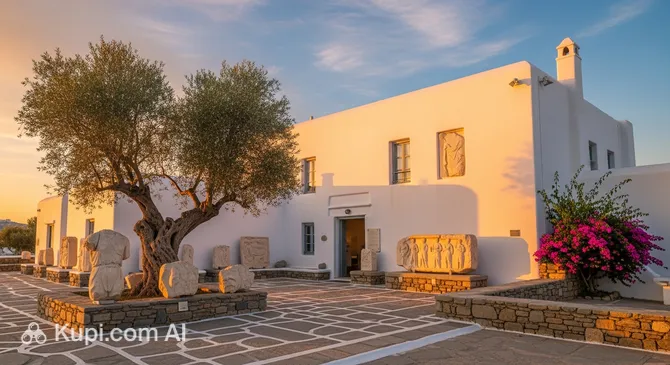
Located on the picturesque waterfront of the old port, the Archaeological Museum of Mykonos is one of the island's most important cultural sites. This elegant neoclassical building was opened in 1902 in the island's capital, Mykonos, to preserve the unique heritage of the ancient era.
Archaeological Museum of Mykonos. Illustration.
Source: Kupi.com AI
Traveler photos:
The core of the collection consists of artifacts found on the neighboring sacred island of Delos. Visitors can view a rich collection of ceramics, vessels, and amphorae spanning the period from the Geometric era to Roman times. This is a place where the history of Greece comes to life through the exquisite work of ancient artisans.
The museum's primary treasure is considered to be the unique 7th-century BC relief amphora, which depicts scenes from the fall of Troy and the famous Trojan Horse. Thanks to its high scientific significance and cozy atmosphere, the museum is popular with antiquity enthusiasts wishing to complement their Cycladic vacation with deep cultural context.
Contacts
To confirm current information before your visit or to organize group tours, you can use the following contact details:
A journey into the ancient era should begin with exploring the halls featuring ancient ceramic works. Here, you can trace the evolution of pottery craftsmanship from simple geometric patterns to complex Hellenistic forms. Pay special attention to a detailed viewing of the amphora depicting the Trojan Horse—it is a rare opportunity to see such an ancient visualization of Homeric legends.
Strolling through the halls, visitors can admire Roman statues and funerary stelae that have retained their elegance over millennia. The museum often hosts temporary exhibitions that expand the main display and introduce new findings from archaeologists working in the Cyclades region.
This location is perfect for thoughtful contemplation and photography (be sure to check the photography rules at the entrance). A cultural visit will be a wonderful addition to a walk through Chora, creating a harmonious contrast between the island's whitewashed modern architecture and the austere beauty of ancient antiquities.
Getting There
Finding this building in the labyrinth of Chora's whitewashed streets is quite simple: the museum is located in the heart of the town, on the old port's waterfront. It is situated just above the central bus station, making it an excellent starting point for a walking tour of the island's main attractions.
If you are arriving on the island of Mykonos by ferry from Athens (Piraeus port) or from the neighboring Cycladic islands, the walk from the pier to the museum takes about 10–15 minutes at a leisurely pace along the cobbled streets. For those staying in more remote parts of the island, it is convenient to use local buses—they run regularly from the beaches and the airport to the stop in Chora, located within walking distance of the entrance.
An alternative option is to rent a scooter or take a taxi, which will bring you as close as possible to the pedestrian zone of the old town. The walk from the famous Little Venice neighborhood also doesn't take long and allows you to enjoy the sea breeze on your way to the cultural center.
Nearest city: Mykonos
History & Facts
The establishment of this cultural institution in 1902 was born of necessity: a place was needed to store and protect the priceless finds discovered on the neighboring sacred island of Delos. The building, designed in a strict neoclassical style, was erected specifically for this purpose, becoming one of the oldest museums in Greece.
The museum's collection has been formed over decades, including artifacts from the Geometric era, exquisite ceramics from the 6th–7th centuries BC, as well as Roman and Hellenistic pieces. These finds eloquently testify to the rich maritime and trade history of the Cycladic archipelago, where Mykonos has always played an important role.
The true jewel of the collection is the famous "Mykonos Amphora" from the 7th century BC. Its surface features a unique relief depicting the Trojan Horse, making it one of the oldest surviving monuments illustrating this mythological subject. The museum not only preserves the heritage of Delos—a UNESCO World Heritage site—but also continues to tell the region's story to new generations of travelers.
Time Needed
When planning your itinerary through the town of Mykonos, set aside approximately 1–1.5 hours to visit the museum. This is plenty of time to explore all the halls without rushing, read the information plaques, and carefully examine the main masterpieces of the collection, including the ancient ceramics.
Despite its compact size, the exhibition is very dense. The museum is perfect for an intellectual break in the middle of the day, allowing you to briefly swap the busy tourist streets for the cool and quiet of halls filled with ancient artifacts.
Working Hours
Before your visit, it is worth keeping in mind that the museum operates on a standard schedule for most state cultural institutions in Greece. The doors are open to visitors from 08:30 to 15:30 every day of the week except Tuesday.
Tuesday is the official closing day. Since working hours can change depending on the season or public holidays, it is recommended to check the official website in advance or confirm the information at the entrance.
Day
Working hours
Monday
08:30–15:30
Tuesday
Закрыто
Wednesday
08:30–15:30
Thursday
08:30–15:30
Friday
08:30–15:30
Saturday
08:30–15:30
Sunday
08:30–15:30
Nearby
Exploring the surroundings of the old port can significantly enrich your experience, as iconic island locations are concentrated within a few minutes' walk. After visiting the exhibits, it is pleasant to stroll by the sea or explore the historic quarters.