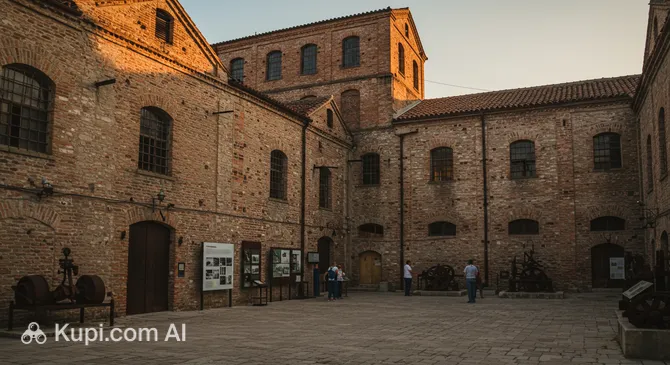
Imagine a place where time seems to have stood still among giant gears and brick walls. The Tsalapatas Brickworks Museum is a unique monument of industrial architecture located in the city of Volos. The former factory of brothers Nikolaos and Spyridon Tsalapatas has today been transformed into a fascinating cultural space covering a vast territory of 22,000 square meters.
Tsalamatas Brickworks Museum. Illustration.
Source: Kupi.com AI
Traveler photos:
This museum in Greece is a rare example of carefully preserved industrial heritage. Here, visitors can see more than just static exhibits; they experience a complete production line from the early 20th century. The museum clearly demonstrates how simple clay was transformed into the materials that shaped the country's landscape for decades.
The main value of the complex lies in its authenticity. Inside the restored halls, the original machinery, trolleys, and the impressive Hoffmann kiln—which once operated around the clock—have been preserved. The museum doesn't just explain technology; it conveys the atmosphere of the daily life of workers at that time, making history tangible and accessible for every guest.
Contacts
To clarify current information about events or group tours, you can use the following contact details for the museum:
In this museum, you don't just look at display cases; you literally take a journey back in time. The entire route is designed so that you follow the path of a piece of clay from its extraction to its transformation into a finished tile. Huge vats, presses, cutting machines, and dryers—all the equipment remains in place, creating the feeling of being in a working factory.
One of the most powerful impressions will come from examining the giant Hoffmann kiln. Visitors can step inside this engineering marvel to appreciate the scale of production that once supplied building materials to the entire country. Exploring the workshops and restored rooms allows for a detailed study of industrial archaeology and an understanding of how mechanization changed people's lives in the last century.
For families with children, the museum offers special interactive activities. Thanks to educational programs like "Making Bricks and Tiles," young visitors can play with miniature copies of the machinery and try their hand as craftsmen. This place is perfect for those who love unusual locations and want to see the other side of Greek history, hidden behind the facades of classical ancient monuments.
Getting There
The museum is located in the South Gate (Notia Pili) area, which is very close to the city center and the port. This makes it easily accessible for tourists walking along the Volos embankment.
If you are using public transport, you can take city buses heading to the center and then either take a taxi or walk. For those arriving from Athens or Thessaloniki, it is most convenient to use KTEL intercity buses or the train. From the train station and the bus terminal, a taxi ride to the museum will take no more than 10–15 minutes.
For travelers arriving by car, parking is provided on the complex grounds. Follow the signs leading to the industrial zone and the historical center, or use GPS coordinates for precise navigation.
Nearest city: Volos
History & Facts
The history of this unique site began in 1926, when brothers Nikolaos and Spyridon Tsalapatas founded a ceramics factory. Over time, the enterprise grew into one of the largest industrial giants in Greece, with its products used in home construction across the country.
The factory's resilience against the elements is particularly noteworthy. Its massive Hoffmann kiln operated almost continuously for decades. The only significant breaks in production occurred during the devastating earthquakes of 1954–1956 and during the difficult years of the early 1940s. The factory finally ended its operations in 1978, leaving behind a rich legacy.
In 1995, the Volos municipality purchased the complex, deciding to preserve it for future generations. After a large-scale restoration lasting several years, a modern museum opened here in 2007. Today, it serves as a living reminder of the region's industrial boom and is an important part of the Piraeus Bank Group Cultural Foundation.
Time Needed
To leisurely explore the entire museum grounds, get acquainted with the exhibitions, and peek into the most hidden corners of the old workshops, visitors typically need 1 to 2 hours.
This is enough time to walk through the entire production chain, examine the vintage machinery, and take impressive photos of the industrial interiors. If you plan to participate in educational programs or spend some time in the local cultural space, your visit could last half a day.
Working Hours
Currently, the museum is temporarily closed. When planning your visit, be sure to check the current schedule and any possible changes to the opening hours.
We recommend visiting the official website of the Piraeus Bank Group Cultural Foundation in advance or calling to get the latest information on exhibition availability and possible reopening dates.
Nearby
The museum's location in the historical part of the city allows you to combine your visit with other points of interest. Exploring the surrounding area will help you better feel the atmosphere of this port city and get to know its ancient and modern history.