Support

Colossus of Rhodes

About

The Colossus of Rhodes is a legendary giant statue of the ancient Greek sun god Helios that once adorned the port city of Rhodes on the island of the same name in Greece. It is one of the most famous "Seven Wonders of the World" of antiquity, capturing the imagination of its contemporaries with its grand scale and daring engineering.
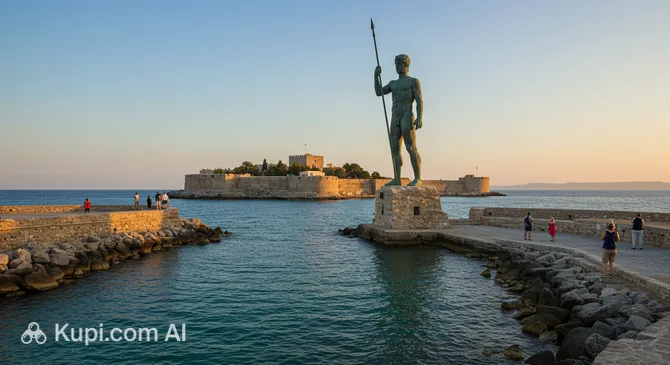
Colossus of Rhodes. Illustration.
Source: Kupi.com AI

Traveler photos:

The statue was not just a work of art but also a powerful symbol of the freedom and power of the Rhodians. Erected in honor of a victory over an enemy, it was also an outstanding creation of the renowned Rhodian school of sculpture. It is believed that the Colossus stood at the entrance to the harbor, majestically greeting ships and travelers heading to the prosperous city.

Although the structure itself has not survived to this day, the memory of the Colossus of Rhodes has lived on for centuries. The stories and legends associated with this wonder of the ancient world continue to inspire and intrigue, serving as a reminder of the incredible achievements of human genius and ambition from the distant past. A visit to Rhodes provides an opportunity to touch this great history and imagine what this amazing monument was like.

Contacts

Since the Colossus of Rhodes is an ancient wonder of the world that has not survived to this day, this historical site has no direct contact details. To visit the place where, according to legends, this giant statue once stood, you should head to the city of Rhodes. Historians suggest that the Colossus was located at the entrance to Mandraki Harbour, and today this spot can be visited while strolling along the waterfront.

How to contactContact
AddressPl. Neoriou, Rodos 851 00, Greece
Websitewww.rhodestouristguides.com

What to Do

Although the majestic Colossus of Rhodes, one of the seven wonders of the ancient world, has not survived to our day, its spirit is still felt in Rhodes. Travelers can visit its presumed location—Mandraki Harbour. Here you can walk along the pier where, according to legend, the giant statue greeted ships. Enjoy the views of the harbor, take commemorative photos, and look for historical plaques and markers telling the story of the Colossus while trying to imagine its former grandeur.

To better understand the historical context and significance of the Colossus of Rhodes, it is recommended to visit the Archaeological Museum of Rhodes. The museum's exhibits and other historical sites in the city will help you immerse yourself in the atmosphere of antiquity when this masterpiece was created. Additionally, themed excursions are often held directly at Mandraki Harbour. Guides tell fascinating stories about the construction, legends, and fate of the famous statue, allowing you to better grasp the scale of this grand structure of antiquity.

Getting There

Reaching the site where the legendary Colossus of Rhodes once stood is quite simple, especially if you are already in Rhodes. The statue's presumed location is the entrance to Mandraki Harbour, which is in the immediate vicinity of the city's historic center, the Old Town of Rhodes. Therefore, you can easily walk to Mandraki Harbour from any point in the Old Town, enjoying the picturesque streets and medieval architecture along the way.

For tourists arriving at the island of Rhodes by sea, Mandraki Harbour itself is one of the main entry points. If you are arriving by plane, you can get from Rhodes International Airport "Diagoras" to the port in several ways. A taxi ride will take approximately 20-30 minutes, depending on traffic. Public transport is also available—buses run regularly between the airport and various parts of the city, including the port area.

The Mandraki Harbour waterfront itself is excellent for walking. City bus stops are also located here, connecting the port with other districts of Rhodes. This makes the port easily accessible from any part of the city, allowing you to conveniently plan your route to this historical site.

Nearest city: Rhodes

History & Facts

The Colossus of Rhodes, one of the Seven Wonders of the Ancient World, was erected on the island of Rhodes in Greece between 292 and 280 BC. This grand structure became a symbol of gratitude to the gods and commemorated the successful defense of the city against the forces of Demetrius Poliorcetes. The siege was lifted, and the people of Rhodes decided to mark this victory by creating a monument the likes of which the world had never seen.

The construction of the statue, depicting the sun god Helios, the patron of the island, took about 12 years. The master who undertook this ambitious project was the sculptor Chares of Lindos, a student of the famous Lysippos. Financing such a large-scale enterprise was made possible by funds raised from the sale of military equipment and trophies abandoned by the besiegers. It was truly a grassroots project, in which many of the island's residents participated.

According to ancient authors, the height of the Colossus of Rhodes reached an impressive 33–36 meters, making it one of the tallest structures of its time, comparable to the height of a modern 10-12 story building. The statue was made of bronze sheets fixed to an iron frame, which in turn rested on a stone base. The exact location of the statue is still a subject of debate among historians, but it is believed that it stood at the entrance to the harbour of Rhodes.

Unfortunately, the majestic Colossus did not stand for long. Only 56 years after its erection, around 226 or 222 BC, it was destroyed by a powerful earthquake. The statue snapped at the knees and collapsed. Despite plans for restoration that were never realized, the remains of the Colossus of Rhodes lay on the ground for more than 800 years, attracting travelers and inspiring awe with its size and craftsmanship, until they were—according to one version—sold by the Arabs in the 7th century AD.

Time Needed

Since the Colossus of Rhodes itself has not survived to this day, "seeing" the attraction amounts to visiting the place where it presumably stood—the entrance to Mandraki Harbour in the city of Rhodes. This usually takes a short amount of time. If your goal is simply to walk around the port, see the presumed location of the statue, and the commemorative markers (columns with deer), then 30-60 minutes will likely be enough.

However, if you want to dive deeper into history and imagine the greatness of this ancient wonder of the world, a longer visit is worth considering. Many tourists combine seeing the site of the Colossus with visits to other historical sites in Rhodes, such as the Palace of the Grand Master or the Archaeological Museum. In this case, it is better to set aside 2-3 hours or even more to explore the city's heritage, including the presumed site of the Colossus, depending on your interest in the details.

Working Hours

Since the Colossus of Rhodes, one of the seven wonders of the ancient world, has not survived to this day, there are no traditional "opening hours" for this attraction. The site where the giant statue presumably stood is located in Mandraki Harbour in the city of Rhodes. This area is a public space and is accessible 24/7, year-round.

As it is an open public area, no tickets or prior booking are required to visit the presumed site of the Colossus. You can freely walk along the waterfront and imagine the grandeur of this ancient structure at any time that is convenient for you.

Open 24 hours

Nearby

Although the Colossus of Rhodes itself, one of the Seven Wonders of the Ancient World, has unfortunately not survived to this day, the place where it once majestically stood still attracts travelers from all over the world. A walk through its surroundings in Rhodes will allow you to dive deeper into the rich history and culture of this amazing island.

Exploring nearby attractions will not only complement your visit to the legendary site of the Colossus but also help you form a more complete picture of the splendor of Rhodes, a city with a thousand-year history. Around Mandraki Harbour, where the giant presumably stood, there are many interesting sites worthy of your attention.

NameDistance
Saint Nicholas Fortress0 km
Rhodes Windmills0.2 km
Throne of Helios0.3 km
New Market (Nea Agora)0.4 km
Elli Beach0.4 km
The Last Butler0.6 km
Palace of the Grand Master of the Knights of Rhodes0.7 km

Have you reached the end of the page?

So the route has been studied inside and out