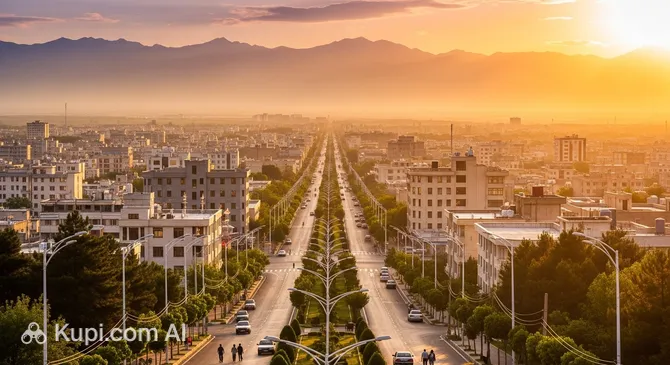
Qods is a dynamically developing city in Iran, located in the Tehran Province. As an important satellite of the capital, it possesses a unique atmosphere that combines the everyday rhythm of an Iranian suburb with deep historical roots. The city is situated northwest of the metropolis, offering its residents and guests a slightly calmer environment compared to the bustling heart of the country.
Qods. Illustration.
Source: Kupi.com AI
Geographically, Qods is located on hilly terrain at an altitude of about 1,180 meters above sea level. The city's population exceeds 300,000 people, making it a significant residential and social hub for the region. Formerly known as Qaleh Hasan Khan, the city has undergone a long transformation, which is detailed further in the history of Qods.
For the traveler, Qods is interesting primarily for its authentic corners, such as the ancient Kavusiyeh Hill and the sacred Emamzadeh-ye Hazratain shrines. Here, you can see the real, non-touristy Iran, stroll through local markets, and experience the hospitality of the local residents. We invite you to visit this city to discover the hidden treasures of the Tehran region and enjoy its original character.
Weather Overview
Qods is characterized by a continental climate with clearly defined seasons, due to its location at an altitude of about 1,180 meters. Expect truly hot summers with minimal precipitation and cool, sometimes quite harsh winters. The city's hilly terrain facilitates natural air ventilation, which favorably distinguishes it from the smoggy areas of central Tehran.
In the hottest month, July, the air temperature often reaches +35°C, and nights bring only relative relief. In winter, especially in January, the thermometer can drop to -4°C, accompanied by frosts and occasional snowfalls. If you want to learn more about temperature records and precipitation, check the detailed weather forecast in Qods by month.
The most comfortable times to visit the city are considered spring (April-May) and early autumn (September-October). During these periods, pleasant warmth sets in, and the surrounding nature comes to life. The average temperature in April stays around +14°C...+20°C, which is ideal for walking and seeing local attractions without the exhausting heat.
Average monthly temperature
Average monthly precipitation
Interesting Facts
Until recently, the city bore the historical name Qaleh Hasan Khan, which translates from Persian as "Fortress of Hasan Khan."
The city is home to Kavusiyeh Hill, an archaeological site that is over five thousand years old.
Local residents deeply revere the Emamzadeh-ye Hazratain shrine, where direct descendants of one of the most important Islamic imams are buried.
The ancient Firuz-Bahram stream flows through the territory of the modern suburb, and it was used for land irrigation as far back as antiquity.
Qods is considered one of the most densely populated suburbs in the Tehran Province, serving as a vital "bedroom community" for the capital.
How to Get There
Thanks to its location in the capital region, Qods enjoys good transport accessibility, although it does not have its own airport or major railway station. Most travelers arrive here via the transport hubs of the neighboring metropolis. To plan your route in advance, it is worth checking information on how to get to the city in the most convenient way.
For those traveling by air, the gateways of Tehran are the closest. Imam Khomeini International Airport (IKA) handles most international flights, while Mehrabad Airport (THR) specializes in domestic flights. From both terminals, Qods can be reached by taxi in about 40-60 minutes, although travel time can increase significantly during peak hours due to traffic jams.
There is no direct rail connection to the city. Travelers who prefer trains should head to Tehran Railway Station. From there, regular suburban buses and taxis run to Qods. Traveling by car along the expressways connecting Qods to the capital remains the fastest and most popular way to get around.
Station
Passenger traffic
Distance
Tepe Sefid Railway Station
5
21 km
Tehran Railway Station
12
26 km
Qom Railway Station
7
120 km
Kashan railway station
3
194 km
Sari Railway Station
2
198 km
Main Attractions
Despite the city being considered primarily a residential area, Qods has preserved several sites worth the attention of history buffs. One of the oldest monuments is Kavusiyeh Hill, located in the district of the same name. Archaeological finds here date back to the 3rd millennium BC, evidencing centuries of human presence in these parts.
The stone tombs of Emamzadeh-ye Hazratain hold special spiritual and architectural significance. This is the final resting place of two descendants of Imam Musa al-Kadhim — Abulhasan and Abulhusayn. People come here not only for prayer but also to appreciate traditional Islamic architecture and feel the atmosphere of serenity characteristic of such sanctuaries.
The old hammam, which was skillfully built directly into the fortress structure, is also of interest to researchers of local history. Additionally, the Firuz-Bahram stream flows in the vicinity, its history also stretching back to ancient times. Although these sites are not always equipped for mass tourism, they allow visitors to touch the authentic heritage of the region.
Local Cuisine
The gastronomic face of Qods is a celebration of classic Persian cuisine. The local menu is based on aromatic rice dishes and juicy meats. You should definitely try chelow kebab — tender grilled meat served with fluffy saffron rice, and dizi (abgoosht) — a rich meat stew with chickpeas and vegetables, traditionally served in clay pots.
The food culture here is closely tied to family traditions. Locals often dine in small, home-style restaurants where recipes are passed down through generations. Bakeries hold a special place, where fresh flatbreads — sangak or barbari — are baked right before your eyes, filling the city streets with their aroma in the mornings.
Among drinks, Iranian tea remains the favorite, enjoyed at any time of day, often with a piece of rock sugar or dates. In the hot season, dosh ab (a local variation of doogh) — a fermented milk drink with mint and salt — is perfectly refreshing. In Qods, you won't find pretentious restaurants, but sincere hospitality and the taste of real food are guaranteed.
Travel Tips
A trip to Qods will be a pleasant and informative experience if you consider a few important practical points typical for this region.
Clothing and Dress Code: Remember to observe local norms. Women must cover their heads with a scarf and wear loose clothing that covers their arms and legs. Men are not recommended to wear shorts. Choose comfortable closed shoes for walking on the city's hilly terrain.
Transport: To get around the city and travel to Tehran, download the Snapp or Tapsi apps — these are the most reliable and transparently priced ways to travel. Be prepared for serious traffic jams during peak hours.
Finances: Visa and Mastercard do not work in Iran. Bring cash (Euros or Dollars) and exchange them for Iranian Rials at official exchange offices in Tehran. Finding an exchange office in Qods itself can be more difficult.
Communication: The primary language is Persian. English is not widely spoken, so learn basic phrases ("salam" — hello, "mamnun" — thank you). Install an offline translator.
Connectivity: It is better to purchase a local SIM card (e.g., Irancell) upon arrival at the airport, as the registration process for a foreigner in the suburb itself may take more time.
Etiquette: Familiarize yourself with the concept of taarof — a complex system of courtesy. If you are offered something for free, it may just be a gesture of politeness; it is customary to politely refuse several times before agreeing (or realizing it is truly a gift).
Safety: Qods is a peaceful city, but as in any suburb, try to avoid walking in sparsely populated outskirts after dark.
Following these simple rules will help you feel confident and enjoy the hospitality of the local people.
Entertainment & Nightlife
Entertainment in Qods is predominantly quiet and family-oriented. There are no noisy nightclubs or bars, which is due to the cultural and religious norms of the region. The main leisure spots for citizens in the evening are the numerous teahouses and small, cozy cafes where leisurely conversations take place over a cup of traditional Iranian tea.
For those who prefer active outdoor leisure, several parks are open in the city, becoming especially lively after sunset when the heat subsides. If you are looking for large-scale concert venues, modern cinemas, or a vibrant nightlife, the best decision would be to head to neighboring Tehran, which is just a short trip away.
Daytime entertainment in Qods focuses on local markets and shopping streets, where you can observe colorful everyday life. For safe nighttime walks, it is recommended to stick to central, well-lit streets and use official taxi services, such as the Snapp or Tapsi apps, which operate around the clock.
Parks & Museums
Parks in Qods play the role of important social centers where citizens take a break from the dense urban development. Although there are few large forest-park zones within the city limits, local squares and green spaces are favorite spots for evening walks and family picnics. They provide much-needed coolness during the hot summer months and allow visitors to enjoy fresh air thanks to the hilly terrain.
The museum infrastructure in the city itself is limited, so the main cultural discoveries for tourists here are related to religious heritage sites. Emamzadeh-ye Hazratain partially serves as a cultural space where elements of traditional art and architecture can be studied. For those who want to visit art galleries or historical museums, the best option is a trip to Tehran, which can be reached in less than an hour.
Nevertheless, a walk through the Kavusiyeh Hill area can be a kind of "open-air museum" for those with an imagination and an interest in archaeology. The combination of ancient layers of earth and modern suburban life creates an interesting contrast reflecting the continuity of the history of this region.
Getting Around
The transport system in Qods is fully integrated into the infrastructure of the capital region. The main types of public transport within the city and for trips to Tehran are buses and shared taxis. The route network is quite dense, allowing for budget travel between districts; however, tourists should keep in mind that transport can be very crowded during morning and evening hours.
For more comfortable trips, residents and guests of the city actively use taxi-hailing apps. Snapp and Tapsi are local counterparts of popular global services that allow you to see the trip cost and route in advance. This is particularly convenient for foreigners, as it removes the language barrier when communicating with the driver and eliminates the need to haggle.
Qods does not have its own metro, but the nearest stations of the Tehran Metro are relatively accessible by car or bus. When planning trips, it is important to remember Tehran's famous traffic jams: the journey to the center of the capital during peak hours can take two to three times longer than usual. Payment in city transport is made in cash or with special transport cards valid within the province.
Accommodation
Accommodation options in Qods are primarily geared towards those visiting the region for business or planning a long-term stay. Luxury five-star hotels are hard to find here; however, the city offers a decent selection of budget guesthouses and apartments. This type of accommodation allows tourists to feel like part of the local community and significantly save on their stay.
Most available rental properties are concentrated in the central blocks, close to transport interchanges and markets. This is convenient for those who plan to travel to Tehran daily but prefer to return to a quieter environment at night. Housing prices here are noticeably lower than in the capital, making the city attractive for budget-conscious travelers.
When planning your trip, it is recommended to book accommodation in advance through local services or by contacting hosts directly, as international booking systems may operate with restrictions in Iran. If you are looking for a high level of service and developed infrastructure, it is worth considering hotels in the western part of Tehran, which are only a 15-20 minute drive from Qods.
Nearby Cities
Qods is an excellent starting point for exploring the outskirts of Tehran and getting to know less famous but interesting suburbs. Proximity to major highways makes it easy to plan small one-day trips, discovering the diversity of life in the center of the country.
Just 8 kilometers away is the city of Shahriar, known for its orchards and greener landscapes. It is also worth visiting Fardis and Malard, which are typical modern Iranian cities with bustling trade and local parks. The most important destination, however, remains Tehran — a treasure trove of museums, palaces, and grandiose bazaars.
Exploring these settlements will allow you to better understand the structure of the capital region and see the contrasts between quiet residential blocks and noisy shopping centers. Each such trip is a chance to meet interesting people and try unique dishes characteristic of the specific locality.
Shopping & Souvenirs
Shopping in Qods is primarily about visiting traditional Iranian bazaars and small family-run shops. There are no giant, glittering malls here, but there is an abundance of local markets where you can buy high-quality everyday goods, the freshest spices, dried fruits, and the famous Iranian nuts. Prices in such places are often much more attractive than in the tourist centers of Tehran.
The main shopping activities are concentrated in the central part of the city, along the main streets. Here you can find shops with textiles, tableware, and household items. Special attention should be paid to local fabrics and handmade items, which make excellent and inexpensive souvenirs. Payment is most often made in cash in rials, as international bank cards are not accepted in local shops.
Shops in Qods usually open around 9-10 AM and stay open until late in the evening, taking a break for rest during the hottest afternoon hours. A walk through a local market is not only an opportunity to shop but also a great way to practice the art of taarof (Iranian etiquette) and chat with friendly vendors.