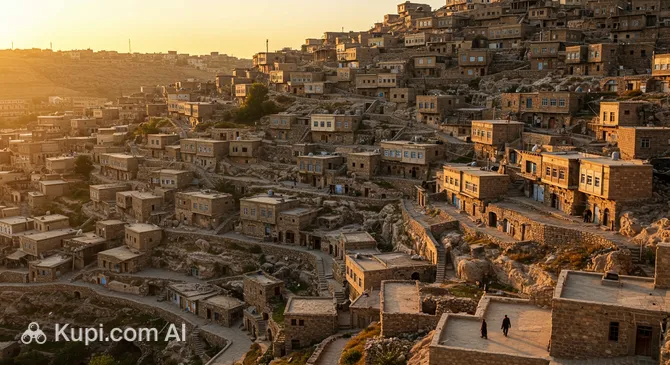
Nestled among the majestic mountains of northern Iraq, Akre (or Akra) captivates travelers with its authentic atmosphere and unique landscape. Perched at an altitude of approximately 655 meters above sea level, this city serves as the administrative center of the district of the same name and is home to a community composed primarily of Kurds, Assyrians, and Arabs. Population estimates vary from 27,000 to 80,000 residents, making it a lively settlement that nevertheless maintains its quaint provincial charm.
The city is famous for its secluded character and traditional way of life. Here, you won't find the noise of a capital; instead, there is an abundance of crisp mountain air and panoramic views visible from almost any point. The rich history of this region dates back to ancient times, which is reflected in the architecture and layout of the old quarters that cascade down the hillsides.
Akre. Illustration.
Source: Kupi.com AI
For tourists, Akre is, above all, an opportunity to see the real Iraqi Kurdistan in its unvarnished form. The main points of interest here are the central market, where daily life hums, and the picturesque surroundings. A visit to this city is an excellent choice for those seeking tranquility, who appreciate the sincere hospitality of the locals and want to experience the region's culture in its original state.
Weather Overview
The climate in Akre is typical of northern mountainous regions and is characterized by pronounced seasonality. Summers here are hot and dry: in July and August, average daytime temperatures often reach +39°C, and rainfall is almost entirely absent. Thanks to the altitude, the heat is somewhat easier to bear than on the plains, and the evenings bring a long-awaited coolness.
The winter period in the city is moderately cold and quite humid. Expect cool weather with frequent precipitation, peaking in January and March (up to 150–160 mm per month). The average temperature in January hovers around +5°C, but nighttime frosts are not uncommon. The transitional seasons, spring and autumn, are considered the most comfortable for visiting, when the city's climate delights with mild warmth and freshness.
If you are planning a trip, aim for May or October as they offer an ideal balance: daytime temperatures stay around +20...+27°C, which is perfect for walking on the mountain slopes. Don't forget to bring warm clothing if your visit is planned for the period from November to March, as high humidity and mountain air can make the weather feel colder than it actually is.
Average monthly temperature
Average monthly precipitation
Interesting Facts
Ancient Roots: The city's territory has been continuously inhabited since the 7th century BC, and Akre experienced a period of significant prosperity during the Median era.
Rapid Growth: The city's population shows impressive dynamics: while fewer than 9,000 people lived here in the mid-1960s, the number of residents could exceed 80,000 by 2025.
Multi-ethnic Character: Akre is a vivid example of the region's cultural diversity, where Kurds, Assyrians, and Arabs have coexisted peacefully for centuries.
Mountain Fortress: The city is located at an altitude of 655 meters, making it one of the most picturesque mountain settlements in the Nineveh Governorate.
Administrative Significance: Despite its quiet nature, Akre plays an important role as the administrative center of the district of the same name.
How to Get There
Getting to Akre is a small journey in itself, requiring planning due to the mountainous terrain. There is no direct air service to the city, so the main route for tourists lies through neighboring major hubs. The most convenient way is to travel by car or taxi from Mosul (about 100–120 km) or Erbil, which takes approximately 2–3 hours. Detailed information on routes can be found in the section describing Akre's transportation accessibility.
The nearest international airport is located in Erbil (approximately 150 km from the city). This aviation hub hosts flights from many international airlines and serves as the main "gateway" to the region. From the airport, you can reach Akre by rental car or by using intercity taxi services, which are quite popular and affordable here.
Railway service in this part of Iraq is currently not developed, so trains are not an option. Public transport consists of irregular buses and minibuses from regional centers, though they may be inconvenient for foreign tourists due to the lack of a clear schedule. The drive from Baghdad takes 8 to 10 hours, including travel through scenic mountain serpentines.
Station
Passenger traffic
Distance
Urmia Railway Station
2
141 km
Salmas railway station
5
196 km
Van railway station
6
203 km
Azarshahr Railway Station
7
211 km
Nusaybin railway station
3
239 km
Main Attractions
Although Akre is not a world-class tourism hub, it possesses its own unique charm hidden in the details of daily life and its natural setting. The main attraction worth visiting for breathtaking views is Sare Gri, a hilltop observation deck. From here, the city is visible in the palm of your hand: the dense clusters of traditional houses, literally "written" into the mountain terrain, create a striking geometric pattern.
The heart of urban activity is the local market and the adjacent central squares. Here, you can see the traditional architecture characteristic of the region's mountain settlements. Administrative buildings and residential quarters form narrow, winding streets, and walking through them allows you to feel the true rhythm of life in Kurdistan. It is an ideal place for those who prefer leisurely exploration of an authentic environment over organized excursions.
For nature lovers, the primary attractions are the mountains surrounding Akre themselves. While there are no specially equipped trails, the outskirts of the city offer magnificent opportunities for contemplating the landscape. Locals often use the slopes for evening strolls, enjoying the coolness and silence that are so highly valued in this hospitable land.
Local Cuisine
The gastronomy of Akre is a reflection of the rich culinary traditions of Iraqi Kurdistan, where fresh local products and aromatic spices play the lead roles. The diet is based on dishes made from lamb, rice, and seasonal vegetables. You should definitely try the traditional kebabs, which are prepared here with special skill, as well as dolma—vegetables stuffed with tender minced meat, rice, and herbs. The local cuisine is hearty and simple, making it ideal for the mountain climate.
A popular place to get acquainted with local flavors is Akre Qalya, which serves traditional Kurdish dishes. If you are looking for a place with a broader menu, check out Khanedan Cafe and Restaurant—this establishment is famous for its hospitality and is an excellent example of where modern city residents eat. A meal here is often accompanied by freshly baked flatbreads and yogurt-based soups.
The drink culture in Akre centers around strong, sweet tea, which is drunk at any time of day, as well as ayran—a refreshing fermented milk drink indispensable in hot weather. Street food also deserves attention: in the markets and on central streets, you can always find stalls with aromatic shawarma and crispy falafel. This is not just a way to grab a bite, but an important part of daily life in the city, where socializing over food is highly valued.
Travel Tips
Welcome to Akre! To make your journey to this picturesque mountain corner of Iraq as comfortable and pleasant as possible, we have prepared a few practical tips.
Clothing and Essentials: Since Akre is located in the mountains, the weather can be changeable. Bring comfortable shoes with good grip for walking on the hills. Clothing should be conservative enough to respect local norms, and layered—evenings in the mountains can be cool even in summer.
Transport: Within the city, it is most convenient to move around on foot or by taxi. For trips to the surroundings, we recommend renting a car, as public transport is irregular and may be inconvenient for newcomers.
Finances: Be sure to bring cash in the local currency. ATMs are rare in the city, and international cards are virtually never accepted. Don't forget small bills for tips and market purchases.
Health and Safety: The city is generally safe, but it is better to stick to the central, well-lit streets after dark. Pharmacies can be found in the center, but it is better to bring any specific medications with you.
Communication: The main languages are Kurdish and Arabic. English is not widely spoken, so learn a few basic phrases in the local language—this will be very helpful for communication and will win the sympathy of the locals.
Local Etiquette: Greetings are very important; always respond to smiles and well-wishes. If you are invited for tea, it is a sign of sincere hospitality that you should not refuse without a good reason.
What to Avoid: Do not photograph people without their explicit consent, especially women. Also, avoid walking in remote, unlit outlying areas at night.
Connectivity: For internet access, it is better to buy a local SIM card in Erbil or Mosul before arriving in Akre, as Wi-Fi in public places is not available everywhere.
We hope these tips help you better feel the spirit of Akre and enjoy the hospitality of this amazing region. Have a great trip!
Entertainment & Nightlife
Akre is a city with a quiet and steady pace of life, so fans of loud nightclubs and discos should prepare for a different experience. There is no conventional Western entertainment industry here; instead, the leisure activities of locals are centered around socializing in cozy cafes and home gatherings. Evening life in the city quietens down quite early, giving way to the peaceful atmosphere of a mountain settlement.
Coffee shops on the central squares become the main gathering spots in the evening. It is customary to leisurely sip tea, discuss the news, and enjoy the cool mountain air. One of the popular places for relaxation is the Khanedan Cafe and Restaurant, where you can spend an evening in a traditional setting. It is also worth visiting Akre Qalya—an establishment respected by locals for its cuisine and atmosphere.
For those seeking more active entertainment or a modern nightlife scene, the best option is a trip to Erbil, located about an hour and a half to two hours away. Within Akre itself, the cultural program might include exploring historical locations, such as Akre Castle, or walking to the Sare Gri viewpoint to watch the sunset and see the city lights begin to twinkle in the valley.
Parks & Museums
The cultural landscape of Akre is closely intertwined with its historical past and natural surroundings. Although there are no classic art galleries or large archaeological museums in the city, its history is literally etched in stone. The main historical site is Akre Castle, which towers over the city as a reminder of ancient times. Exploring this site allows you to touch the region's heritage and enjoy the silence that reigns among the old walls.
Regarding green zones, Akre does not boast an abundance of developed urban parks in the traditional sense. However, this is more than compensated for by the natural surroundings. Locals view the surrounding hills and mountain slopes as natural recreational areas. Walking through these highlands is the best way to escape the city bustle and enjoy the clean mountain air. Particularly popular are walks to the Sare Gri viewpoint, which serves as a natural gathering spot for contemplating the panoramas.
The minimal number of formal parks is explained by a utilitarian approach to the urban environment in mountainous conditions. Nevertheless, the natural landscapes around the city offer opportunities for light trekking and picnics in the fresh air. For tourists, this is a chance to see the pristine nature of Kurdistan, untouched by mass construction, and spend time in harmony with the world around them.
Getting Around
The transportation system in Akre reflects its status as a small mountain town. There are no metros, trams, or large bus networks typical of major cities. Public transport primarily consists of shared taxis (minibuses) that connect the central part of the city with the outskirts and nearby villages. This is the most affordable, though not always predictable in terms of schedule, way for locals to get around.
For tourists, the most convenient option within the city is walking, as the main attractions and markets are concentrated in the center. If you need to cover a significant distance or head higher up the mountain, it is better to use the services of a regular taxi. The fare is usually negotiated in advance, as meters are rarely used. During peak hours, especially near the central market, slight traffic congestion is possible, but overall the transport situation in the city is calm.
For trips outside of Akre along scenic mountain roads, experienced travelers recommend renting a car. This provides freedom of movement and allows you to avoid dependence on irregular public transport. However, one should consider the specific nature of the mountain terrain: roads can be winding and require certain driving skills. If a personal car is unavailable, intercity taxis remain a reliable and popular alternative for connecting with the region's larger cities.
Accommodation
When planning a visit to Akre, it is important to consider that the tourism infrastructure is in its early stages of development. There are virtually no large international-standard hotels or luxury chain properties in the city. Most available accommodation options cater to locals or professionals visiting on business and are primarily presented as guest houses and simple lodges.
For tourists, the most convenient option might be renting apartments or rooms in the private sector. In the city center, you can find modest but clean guest houses that offer a chance to fully immerse yourself in the local way of life. Often, such housing is located in close proximity to main public spaces, such as near Akre Castle or the central market.
Due to the limited number of hotel beds, it is recommended to search for accommodation in advance, especially if you plan a trip during holidays. Accommodation prices in Akre remain quite affordable, although the level of service will be basic. Many travelers prefer to visit Akre as a day trip while staying in hotels in Erbil, where the choice of accommodation is significantly wider.
Nearby Cities
The city of Akre serves as an excellent starting point for exploring the northern territories of the region, offering travelers access to authentic mountain settlements and the natural beauty of Iraqi Kurdistan. Exploring the surroundings allows for a deeper understanding of the culture and traditions of the local residents, which are carefully preserved away from the large metropolises.
One of the most interesting destinations for a trip is Barzan, located just 26 km away. This place is known for its stunning landscapes and holds significant historical importance for the Kurdish people. It is also worth visiting the picturesque Amadiya—an ancient fortress city situated on a flat mountain top, offering incredible views of the valley. For those who appreciate quiet relaxation in nature, Shaqlawa, famous for its gardens and mild climate, is an excellent choice.
Additionally, within an hour's drive are small settlements such as Mahad and Harir, each possessing its own unique character. Trips to these towns allow you to see the diversity of the region's landscapes—from steep mountain slopes to fertile plains. We strongly recommend not limiting yourself to the center and taking the time to explore these amazing places.
Shopping & Souvenirs
Shopping in Akre is not a trip to modern shopping malls, but an exciting immersion into the atmosphere of a traditional Eastern bazaar. The city's entire trading rhythm is concentrated at the central market, which is not only a place for buying and selling but also the primary hub of social life. Here you can find everything from the freshest local products to basic necessities used by the residents of surrounding villages.
If you are looking for something special to remember your trip by, pay attention to local fabrics. Textile manufacturing in this region has long-standing traditions, and you can often find high-quality canvases with traditional patterns at the market. Aromatic spices, honey from mountain wildflowers, and dried fruits, which are famous for their taste, also make excellent souvenirs. These items can be found in shops near iconic spots like Akre Qalya.
Shops and stalls usually open early in the morning and operate until sunset, with a short break during the hottest time of day. Keep in mind that international bank cards are practically not accepted in Akre, so be sure to have an adequate supply of cash with you. Payment is made in the local currency, and the buying process is often accompanied by friendly bargaining, which is an integral part of the local social culture.