Support

Dublin Airport

About the Airport

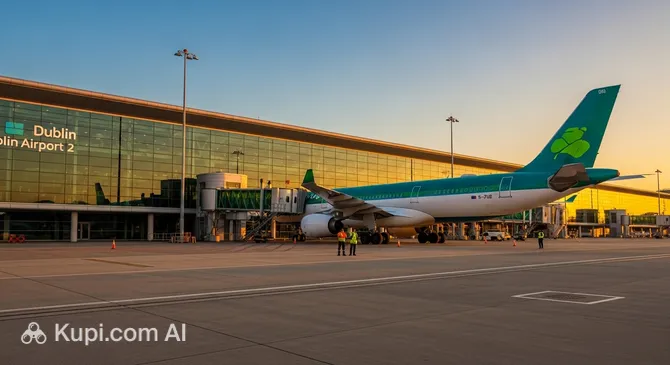
Dublin Airport. Source: Kupi.com Binoculars

Dublin Airport is not merely a transport hub, but the true gateway to the Emerald Isle, where your journey begins with legendary Irish hospitality. It is the country's main air harbour, which, despite its impressive passenger traffic, surprises visitors with its cosiness and intuitive navigation. Even upon landing, looking at the endless green fields through the porthole, you will feel the special atmosphere of this place, connecting the ancient traditions of Ireland with a modern rhythm of life.

IATA Code DUB
ICAO Code EIDW
City Dublin
Distance to Centre approx. 10 km
Status International
Passengers per Year over 33.3 million (2024)
Schedule Available on the official website

Airport Features and Amenities

Dublin Airport boasts a unique feature that makes it incredibly popular for transatlantic flights: it hosts a US Preclearance facility. This means that passengers flying to the States undergo all immigration and customs formalities while still in Ireland, and upon arrival, they exit as domestic passengers, bypassing queues.

The airport terminals (T1 and T2) are modern and offer an excellent range of services. Of particular note is The Loop shopping area, where you can purchase high-quality Irish souvenirs, fragrances, and cosmetics. The airport is also famous for its fast and free Wi-Fi, which works without time limits.

It is important to note that currently, the airport is not connected to the city by a railway line. The main and most convenient way to get to the centre remains express coaches (such as Aircoach or Dublin Express) and taxis, which are available around the clock outside the exits of both terminals.

Contact Information

For your convenience, we have compiled the main contact information for Dublin Airport (DUB). We recommend checking the accuracy of the data on the official website before your trip.

  • Official Airport Website: You will find the most complete and up-to-date information on flights, services, and regulations at www.dublinairport.com.
  • Information Service Phone: For general questions and enquiries, you can call: +353 1 944 1111.
  • Airport Address: Dublin Airport, Co. Dublin, Ireland.
  • Email: The airport does not provide a single email address. For communication on specific issues, it is recommended to use the contact forms on the official website.
  • Social Media: A quick way to get an answer to a question or find out the latest news is through the airport's official accounts, for example, on X (formerly Twitter) and Facebook.
  • Lost Luggage Information: In case of loss of checked baggage, you must immediately contact your airline's baggage tracing service. If you have lost personal items within the terminal, contact the airport's Lost Property service.
  • Passenger Support Contacts: Assistance and advice can be obtained at the Information Desks located in both airport terminals, or by calling the general information service number.

How to Get to the Airport

Dublin Airport (DUB) is located approximately 10 km north of the city centre and is excellently connected to it and the surrounding areas. You can reach the terminals in several ways, each having its own advantages depending on your budget, time, and amount of luggage.

Public Transport: Buses

This is the most popular and accessible way to get to the airport. It is important to know that there is no direct rail or metro connection to Dublin Airport, so the bus is the main mode of public transport.

  • Express Coaches (Aircoach, Dublin Express): This is the most convenient option. Companies such as Aircoach (route 700) offer 24-hour services from the centre of Dublin and other key locations. The journey takes about 30-40 minutes depending on traffic. The buses are comfortable, with space for luggage. A one-way ticket costs around €7-€10.
  • City Buses (Dublin Bus): Routes No. 16 and No. 41 are the most budget-friendly method. They travel through the city with many stops, so the journey will take longer (from 45 to 60 minutes or more). This is a great choice if you are not in a hurry and want to save money. The fare is around €2-€3.

Taxi and Transfer

Official taxi ranks are located directly outside the exits of both terminals. A trip to Dublin city centre will take 20-40 minutes and will cost approximately €25-€40, depending on the time of day and traffic conditions. Ride-hailing services such as FREE NOW and Uber are also available. For greater convenience, especially if you are travelling with family or a large amount of luggage, you can pre-book a private transfer at a fixed price.

Car Rental and Private Vehicle

Offices of all major international and local car rental companies are represented at the airport. If you are travelling in your own or a rented car, several parking zones are at your service. There are both Short-Term car parks, located a few minutes' walk from the terminals, and more budget-friendly Long-Term ones, from which free shuttles run to the terminals. It is strongly recommended to book parking online in advance to get the best price, especially during the peak season.

Terminals and Map

Dublin Airport has two terminals — T1 and T2, between which it is easy to move on foot. Their layout is simple, and navigation is intuitive thanks to clear signs in English and Irish.

In Terminal 1, check-in counters and the security zone are located on the first floor (Level 2). After passing security control, passengers enter a spacious departure area with shops and restaurants, from where piers lead to the boarding gates. The arrival zone is located on the ground floor, with direct access to bus stops and taxi ranks.

Terminal 2 has a similar structure: the check-in and security control zone is on the upper level, and the arrival zone is on the lower one. A key feature of T2 is the unique US Preclearance zone. It is located after the main security checkpoint and is intended for passengers departing on direct flights to the United States.

The US Preclearance procedure allows you to go through all immigration and customs formalities before departure. This means that upon arrival in the USA, your flight will be considered a domestic flight, and you will be able to bypass long queues at the border. Important: allow extra time for this procedure and arrive at the airport at least 3 hours before departure.

The terminals are connected by a convenient covered pedestrian walkway. The path from the T1 arrivals hall to the T2 check-in counters takes about 5-10 minutes. Despite this, always check your terminal number on your ticket or the airline's website in advance to avoid unnecessary haste.

Airport History

The history of Ireland's main airport began long before the tourism boom. Dublin Airport was officially opened on 19 January 1940. Initially, it was created for military needs, but just a few years after opening, it began to serve civil flights as well. The first terminal building, built in the elegant Art Deco style, remains an architectural gem and is protected as a historical monument.

The post-war years were a time of rapid growth. With the development of transatlantic flights, the airport became an important gateway between Europe and North America. In 1972, a new, more spacious Terminal 1 was opened to cope with the growing passenger traffic. This event marked a new era in the development of the air harbour. The airport also witnessed significant historical events, such as the visit of Pope John Paul II in 1979, when his plane landed here.

The largest modernisation took place in 2010 with the opening of the modern Terminal 2. This project not only increased the airport's capacity but also brought it to a new level of international significance. One of the key features of Terminal 2 became the US Preclearance zone. This allows passengers flying to the United States to go through all necessary formalities while still in Dublin, which significantly saves time upon arrival.

Among the interesting facts from the airport's history are its records. Before the pandemic, passenger traffic consistently exceeded 30 million people per year, making it one of the busiest airports in Europe for international travel. Today, Dublin Airport is not just a transport hub, but a symbol of Ireland's openness and hospitality, continuing its glorious history and connecting the Emerald Isle with the whole world.

Services and Facilities

Dublin Airport (DUB) offers passengers a wide range of services and amenities to make their stay as comfortable as possible, regardless of the purpose of the trip. Everything here is thought out — from dining and shopping to rest and business solutions.

For those who want to have a snack or go shopping, both terminals offer a huge selection. You will find numerous restaurants, dining areas, and cafes to suit every taste: from quick coffee and sandwiches to full meals featuring Irish and international cuisine. The Loop shopping area offers a wide assortment of duty-free goods, including perfumes, cosmetics, beverages, souvenirs, and designer clothing.

To wait for your flight in comfort, you can use the services of the executive lounges. They are available both for business class passengers and for all visitors for an additional fee. Lounges usually offer complimentary snacks and drinks, press, and a quieter atmosphere. Free Wi-Fi is available throughout the airport, and numerous charging stations for electronic devices will keep your gadgets powered.

It is easy to solve financial matters at the airport: bank branches, ATMs, and currency exchange points are at your service, located both in the arrival halls and in the departure zones. For travellers with children, there are baby care rooms and small play areas. If necessary, you can visit a pharmacy or a first aid point.

The airport is fully equipped for passengers with reduced mobility — special assistance services are provided for them, which are recommended to be booked in advance through the airline. If you need to rest between flights, there are several hotels located directly on the airport grounds and in the immediate vicinity. For business travellers, conference rooms and business centres are available where you can hold a meeting or work in silence.

Where to Eat

At Dublin Airport (DUB), passengers have access to a wide choice of establishments for every taste and budget, from a quick snack to a leisurely dinner. Most cafes and restaurants are concentrated in the departure zones (airside) of both terminals, after passing security control.

Terminal 1 (Airside)
For those wishing to eat heartily, there are establishments operating in a traditional style where you can order a full Irish breakfast, fish and chips, or simply enjoy a refreshing beverage. If time is short, coffee shops such as Starbucks and the popular Irish chain Butler's Chocolate Cafe are at your service, where a signature chocolate is offered free with every hot drink. There are also outlets with sandwiches and salads.

Terminal 2 (Airside)
Here you will find the large Marqette food court, which offers a huge selection of dishes: from fresh pastries and pizza to Asian cuisine and a salad bar. This is an ideal option for families or groups with different preferences. Terminal 2 also features several stylish venues where you can sample local beverages before your flight.

Dietary Options and Prices
Most restaurants offer vegetarian, halal, and gluten-free dishes, which are usually marked on the menu. Establishments like Marqette are the best choice for finding diverse dietary options including vegan meals. Prices at the airport are higher than in the city: the average bill for a hot dish with a drink is about 20-30 Euros, while coffee with pastries will cost 8-12 Euros.

Landside Zone (Before Security) and Opening Hours
In the arrival and check-in zones, the choice is limited mainly to coffee shops and small stores — convenient for those meeting passengers or those who arrived too early. The main restaurants in the departure zones are open from early morning until late evening to serve the majority of flights. However, smaller kiosks and cafes may have reduced hours. For night flights, the choice may be limited to 24-hour vending machines with food and drinks.

Tips for Travellers

Travelling through Dublin Airport can be simple and convenient if you know a few tricks. Here are some useful tips that will make your trip through the main air gateway of Ireland as comfortable as possible.

Arrival Time at the Airport. Dublin Airport can be quite busy, especially in the morning hours and during the tourist season. It is recommended to arrive 2-3 hours before departure for European flights (short-haul) and 3-4 hours before long-haul flights. This will give you enough time for check-in, baggage drop, and passing security control without haste.

Check-in and Security Control. To save time, check in for your flight online and save the boarding pass on your phone. Security checkpoints here are modern, but to pass through them faster, prepare liquids in advance (in containers up to 100 ml, packed in a transparent bag) and remove laptops and other large electronics from your hand luggage.

Choosing a Seat on the Plane. If the airline allows you to choose a seat in advance, consider your preferences. A window seat will give you beautiful views during take-off and landing, while an aisle seat offers more legroom and the ability to stand up freely without disturbing neighbours.

Hand Luggage Regulations. Besides the standard restriction on liquids, remember that it is forbidden to take sharp objects, flammable substances, and other dangerous items in hand luggage. Be sure to check the weight and size limits for hand luggage with your airline, as they may vary.

Transfer Passengers and US Preclearance. One of the unique features of Dublin Airport is the presence of the US Customs and Border Protection Preclearance facility (US Preclearance). If you are flying to the USA, you can go through all American formalities right in Dublin. This means that upon arrival in America, your flight will be considered domestic, which significantly saves time.

Customs Control. When entering Ireland from countries outside the EU, use the green channel if you have nothing to declare, or the red one if you have goods subject to declaration. For travellers within the EU, customs control is usually reduced to a formality.

Saving Time and Money. Book airport parking online in advance — it is almost always cheaper. Take an empty reusable water bottle with you and fill it after passing security control. If you want to pass control faster, you can pre-book the Fast Track service for an additional fee.

In Case of Flight Delay. If your flight is delayed, contact your airline representative for information. According to EU rules (EU261), for long delays, you may be entitled to vouchers for food, drinks, and in some cases — hotel accommodation. The terminals have many shops, cafes, and rest areas where you can wait for your flight in comfort.

Reached the end of the page?

That means the route is fully explored