Support

Belfast International Airport

About the Airport

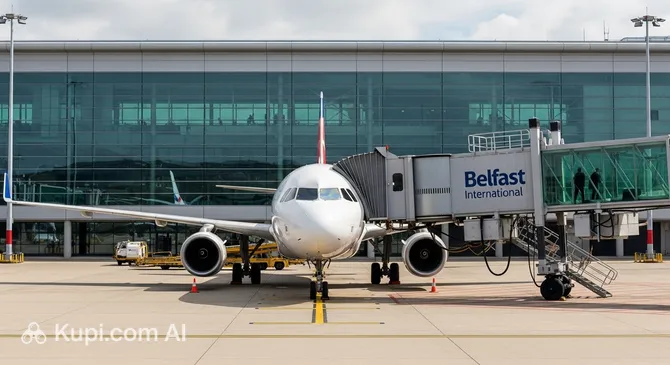
Belfast International Airport. Source: Kupi.com Binoculars

Belfast International Airport, known among locals as Aldergrove, serves as the main aerial gateway to Northern Ireland and the ideal starting point for exploring this picturesque region. Situated amidst green landscapes near Lough Neagh, it combines the atmosphere of countryside comfort with the efficiency of a modern transport hub. From here, travellers begin their journey to the legendary "Giant's Causeway" or the docks where the "Titanic" was built. Despite its compact size, the airport is bustling with life around the clock, receiving flights from all over Europe and ensuring a comfortable start to any journey.

IATA Code BFS
ICAO Code EGAA
City Belfast
Distance to Centre 21 km
Status International
Annual Passengers Over 6 million
Schedule Live flight information on the official website

Airport Features and Advantages

The airport is distinguished by simple and clear navigation: there is only one passenger terminal operating here, divided into two levels, which eliminates the need for long transfers between flights. For those who value enhanced comfort, the Causeway Lounge is available, offering a tranquil environment, snacks, and beverages regardless of your ticket class.

Transport accessibility is another strong point of this air harbour. The 24-hour Airport Express 300 bus provides a fast link to Belfast city centre, departing every 15–20 minutes during peak hours. Within the terminal, travellers will find everything they need: from Duty Free shops and souvenir stalls featuring Irish goods to popular coffee shops and currency exchange points.

Contact Information

Below you will find useful contact details for Belfast International Airport (BFS), which may be helpful when planning your trip or while at the airport.

  • Official Website: www.belfastairport.com — here you will find the most up-to-date information on flights, services, and airport regulations.
  • Information Desk Phone: +44 (0)28 9448 4848. This is the main number for most general enquiries.
  • Address: Airport Road, Belfast, BT29 4AB, United Kingdom. The airport is located approximately 21 km northwest of Belfast city centre.
  • Email: To contact the airport, it is recommended to use the contact form on the official website in the "Contact Us" section.
  • Social Media: The airport actively maintains pages on social networks such as X (formerly Twitter) and Facebook, where operational news and updates are published.
  • Lost Property Information: If you have lost items within the terminal, you should contact the service managed by Luggage-Point. Contact phone: +44 (0)330 223 0893. For lost luggage after a flight, please contact your airline directly.
  • Passenger Support Contacts: For assistance, including requests for special services for passengers with reduced mobility, it is recommended to contact your airline in advance or call the general airport helpline for advice.

How to Get to the Airport

Reaching Belfast International Airport (BFS), Northern Ireland's main aviation hub located approximately 22 km northwest of the centre of Belfast, is possible via several convenient methods. When planning your trip, it is important not to confuse it with the other city airport — George Best Belfast City Airport (BHD), which is located much closer to the centre but primarily serves flights within the United Kingdom.

Public Transport: The most accessible and popular option is the Airport Express 300 bus. It runs between the airport and the Europa Buscentre in the city centre from early morning until late at night. It is important to note that there is a break in service during night hours. During peak times, the interval is about 15-20 minutes. Travel time is approximately 30-40 minutes, though this may increase due to traffic. This is a reliable and economical choice for most tourists. There is no direct rail link to the airport.

Taxi and Private Transfer: For those who value comfort, or are travelling with family or a large amount of luggage, taking a taxi is the optimal solution. Official taxi ranks are located directly outside the terminal exit. A trip to the city centre will take about 30 minutes and will cost significantly more than the bus. To guarantee a fixed price and vehicle availability, you can book a private transfer in advance.

Car Rental and Parking: If you plan to actively travel around the region, car rental is an excellent option. Desks for leading international rental companies are located in the arrivals hall. The airport has direct access to the M2 motorway, simplifying further travel. For travellers with their own vehicles, there are several types of parking at the airport: from short-stay (Main Stay) to long-stay (Long Stay). Booking a parking space online in advance often allows for significant savings.

Terminals and Map

Belfast International Airport (BFS) is distinguished by a structure that is simple and convenient for passengers. The airport operates one main passenger terminal, which serves both domestic and international flights. This compact layout significantly simplifies navigation and makes the stay at the airport as comfortable as possible, eliminating the need for long transfers between different buildings.

The terminal has a logical and clear layout. The departure zone is located on the upper floor, where check-in counters and baggage drop-off points are found. After passing through security control, passengers enter the airside area — a spacious departure lounge with numerous shops, cafes, and boarding gates. The arrival zone is located on the ground floor. Here, passengers pass through passport control (if necessary), collect their luggage, and exit into the arrivals hall, where rental company offices and public transport stops are located.

Thanks to all services being concentrated in one building, completing pre-flight procedures usually happens quite quickly. Nevertheless, the standard recommendation is to arrive at the airport at least 2 hours before departure for domestic destinations and 3 hours before an international flight. This time is sufficient to check in, drop off luggage, and pass through security without rushing, especially during peak load periods such as holidays or summer vacations.

To navigate the terminal, simply follow the clear signs which are duplicated on information screens. Since all boarding gates, check-in counters, and services are in one space, it is practically impossible to get lost here. Regularly check information about your flight on the screens to stay updated on your gate number and boarding time.

Airport History

The history of Belfast International Airport begins long before its modern name. An airfield on this site was established back in 1917 and was initially used by the Royal Flying Corps during the First World War. Subsequently, it became a Royal Air Force base known as RAF Aldergrove, and it retains its military significance to this day, being one of the oldest active RAF bases in the United Kingdom.

The transition to civil aviation began in 1933, when the first commercial flights to Glasgow were launched. However, the key moment in the airport's history was 1963. It was then that the majority of civil operations were transferred here from Nutts Corner airfield, and a new terminal and aprons were opened. From that moment, the airport became the main aerial gateway for Belfast and all of Northern Ireland. In 1983, it received its current name — Belfast International Airport — to highlight its growing role in international transport.

Throughout its history, the airport has been modernized repeatedly. In 1971, the main runway was significantly extended, allowing it to accommodate larger transatlantic aircraft. Significant renovations of the terminal and surrounding infrastructure were carried out in the 1990s and 2000s to cope with constantly growing passenger traffic. One of the highlights in its history was the visit of the supersonic passenger liner Concorde, which attracted thousands of spectators.

Interesting fact: the airport still functions as a dual-use facility. Beside the civil terminal, the RAF Aldergrove military base continues to operate, making it unique in its kind. Today, Belfast International Airport is the busiest in Northern Ireland, serving millions of passengers annually and connecting the region with dozens of destinations across Europe and beyond.

Services and Amenities

Belfast International Airport (BFS) offers passengers a full range of services to make waiting for a flight as comfortable and productive as possible. The terminal infrastructure is designed so that every traveller, regardless of the purpose of their trip, finds everything they need — from a quick snack to conditions for productive work.

There are numerous cafes, dining establishments, and restaurants to suit every taste located within the airport, where one can have a cup of coffee or a full meal. For shopping enthusiasts, there are stores offering souvenirs, press, travel goods, and, of course, a large Duty Free shop with a wide assortment of perfumes, cosmetics, beverages, and confectionery.

For those who value privacy and enhanced comfort, the Causeway Lounge business lounge operates at the airport. Here you can relax in a quiet atmosphere, enjoy complimentary drinks and snacks, and make use of business press. Free Wi-Fi is available throughout the terminal, and numerous charging stations for gadgets will allow you to stay connected at all times.

Financial matters can be easily resolved using ATMs and currency exchange points located in various zones of the airport. For passengers travelling with small children, special mother and baby rooms are equipped where you can feed and change your baby in a calm environment.

The airport is fully adapted to serve passengers with reduced mobility. Special assistance is provided for moving through the terminal, boarding the aircraft, and collecting luggage. It is recommended to notify the airline in advance of the need for such services. In case of feeling unwell, you can visit the first aid point.

If you have an early departure or late arrival, it is convenient to stay at the Maldron Hotel, which is located just a few steps from the terminal building. For business travellers, business centre services and the option to rent conference rooms for meetings and negotiations are available at the airport.

Where to Eat

At Belfast International Airport (BFS), passengers will find diverse options for a snack or a full meal, located both before and after the security zone. Regardless of how much time you have before departure, you will be able to find a suitable establishment.

Before Security (Landside): In the public area, the selection is generally more limited. Usually, coffee shops are located here, where you can have coffee with fresh pastries or a sandwich. This is a convenient option for those seeing someone off or those who have arrived at the airport well in advance. Opening hours of establishments in this zone may be shorter compared to the departure lounge.

After Security (Airside): The main part of the restaurants and dining venues is located in the departure lounge. Here the choice is significantly wider:

  • Casual Dining and Pubs: A traditional feature of UK airports, the Irish-style establishment is a place for a full lunch or dinner. Here you can order classic dishes such as fish and chips, burgers, and in the morning — the famous "Ulster Fry". This is a hearty dish containing bacon, sausages, eggs, and potato bread, which is a well-known local specialty.
  • Cafes and Coffee Shops: For a lighter and quicker snack, chain and local coffee shops are suitable. Here you will be offered a wide assortment of coffee, tea, sandwiches, salads, and desserts.
  • Fast Food Restaurants: Well-known fast-food chains are also represented at the airport, making them a good choice for travellers with children or those who prefer familiar tastes.

Regarding special dietary needs, most establishments offer vegetarian dishes. Vegan options and gluten-free choices are also becoming increasingly available; however, it is recommended to check the menu in advance or speak to the staff. Prices at the airport are typically moderately high, which is characteristic of most major transport hubs. Establishments in the departure zone usually operate from early morning until the last flight, adjusting to the flight schedule.

Recommendations:
For a quick snack: choose one of the coffee shops where you can take a sandwich and a drink with you.
For a full meal: head to a dining establishment to leisurely enjoy a hot dish and experience the atmosphere of Northern Ireland before your flight.

Travel Tips

To ensure your journey through Belfast International Airport goes smoothly and without unnecessary hassle, make use of our tips. These recommendations will help you save time, nerves, and even money.

Arrival Time at the Airport: For international flights, it is recommended to arrive at the airport 2.5-3 hours before departure, and for domestic flights within the UK, 1.5-2 hours will be sufficient. This will give you enough time for check-in, baggage drop, and passing through security control without rushing, especially during peak hours.

Check-in and Security: The fastest way to check in for a flight is to do it online on your airline's website. This way, you can head straight to baggage drop or, if travelling light, to the security checkpoint. When passing through security, prepare liquids in advance (in containers up to 100 ml, packed in a transparent bag) and remove laptops and other large electronics from your hand luggage.

Seat Selection: Want to admire the views of Northern Ireland from above? Choose a window seat. If the ability to stretch your legs or stand up freely during the flight is more important to you, your choice is an aisle seat. Many airlines offer seat selection during online check-in, so the earlier you do this, the more options you will have.

Hand Luggage Rules: Standard restrictions prohibit bringing sharp objects, flammable substances, and liquids in containers larger than 100 ml on board. Be sure to check the weight and dimension limits for hand luggage on your airline's website, as they can vary significantly.

For Passengers with Connections: If you have a connecting flight, follow the "Flight Connections" signs. Depending on your route, you may need to pass through security control again. Ensure you have enough time between flights, especially if you need to collect and re-check your luggage.

Customs Control: When arriving from outside the UK, you will have to pass through customs control. If you have no goods to declare, proceed through the "Green Channel". If you are carrying something that needs to be declared, you need the "Red Channel". For flights within the country, customs control is usually not required.

Saving Time and Money: Pre-booking parking or a taxi to the airport often works out cheaper. Bring an empty water bottle with you and fill it up after passing security at special water fountains — this is more economical than buying water at a premium. Prices in Duty Free shops can be advantageous, but compare them with regular prices in advance.

In Case of Flight Delay: First of all, keep an eye on the departure boards and announcements. If the delay is significant, contact a representative of your airline — according to regulations, you may be provided with vouchers for food or even hotel accommodation. Having travel insurance may also cover unforeseen expenses.

Reached the end of the page?

That means the route is fully explored