Support

Dún Aonghasa

About

On the very edge of sheer cliffs, where the rugged waters of the Atlantic meet the shore, lies one of the most impressive structures of ancient Europe — Dún Aonghasa. This monumental stone fortress, built as far back as the Bronze Age, is the primary pride of the island of Inishmore. The uniqueness of this site lies in its location: the semi-circular structure of the fortress rests on a natural cliff approximately 100 meters high, which serves as its impregnable fourth wall.
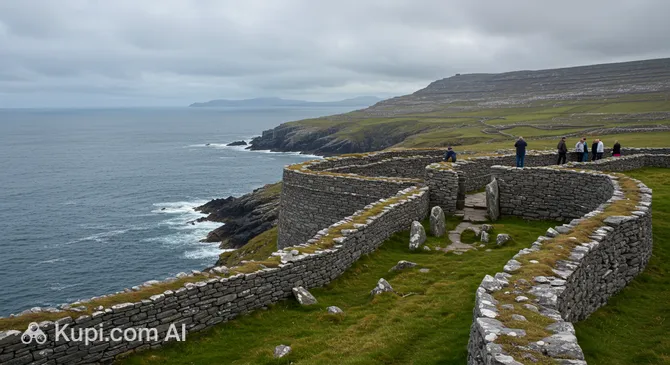
Dún Aonghasa
Dún Aonghasa. Иллюстрация. Источник: Kupi.com AI

While traveling through this part of Ireland, it is impossible to miss this archaeological marvel, which covers an area of more than 5 hectares. The fortress consists of four concentric rings of dry stone masonry. The "chevaux de frise"—a defensive band of sharp vertical stones set thousands of years ago to deter unwanted guests—is particularly striking. This defensive line is perfectly preserved and still captures the imagination of tourists with its sheer scale.

Dún Aonghasa is not just an open-air museum, but a place of incredible energy. Here, history is literally woven into the rugged landscape of the Aran Islands. Visitors are drawn not only by the architectural mastery of the ancient builders but also by the breathtaking panoramic views of the vast ocean that open up from the top of the plateau.

Contacts

To clarify details before your trip or to book tours, you can use the official contact information for the site's administration.

How to contactContact
AddressInishmore, Aran Islands, Kilmurvy, Co. Galway, H91 YT20, Ireland
Phone+353 99 61008
Websitewww.aranislands.ie

What to Do

Your introduction to Dún Aonghasa will begin with a picturesque trail leading from the visitor center through the island's uneven, almost "lunar" landscape. As you ascend to the top, you will pass through three successive lines of terraced walls. Be sure to linger inside the inner ring: the stone foundations of ancient houses are still visible there, with preserved hearths and paved floors that allow you to imagine the lives of the people who lived here thousands of years ago.

The highlight of the experience will undoubtedly be stepping onto the stone platform at the very edge of the cliff. From a height of 87 meters, a staggering view of the boundless Atlantic Ocean unfolds. It is worth remembering that there are no railings at the edge, so you must exercise maximum caution and not approach too closely to the brink, especially during strong gusts of wind.

For visiting this site, it is highly recommended to wear sturdy footwear with good grip, as the limestone slabs underfoot can be slippery and uneven. In clear weather, the fortress becomes an ideal point for scanning the horizon, and the rugged majesty of the cliffs makes this one of the best spots in Ireland for atmospheric photography.

Getting There

The journey to the ancient fortress begins with arrival on the island of Inishmore itself. You can get here by ferry from the ports of Rossaveal (the trip takes about an hour) or Doolin, and for those who prefer speed, short 10-minute flights are available from Connemara Airport. Dún Aonghasa is located on the southwestern side of the island, approximately 3.5–4 kilometers from the main port of Kilronan.

From the pier in Kilronan, tourists have several excellent options. The most popular and atmospheric is renting a bicycle right at the port: the ride along scenic roads takes about 20–30 minutes. If you prefer walking, allow about an hour and a half for the journey along marked trails, enjoying the silence and sea air.

For those who value comfort or are limited on time, mini-buses and taxis run regularly from the port. They will take you to the entrance of the archaeological site in the village of Kilmurvy, from where only the final climb to the ruins themselves remains. Parking is available near the visitor center.

Ближайший город: Inishmore

History & Facts

The history of Dún Aonghasa is rooted in antiquity, dating back to the Bronze Age. The first fortifications at this site appeared around 1500–1100 BC. Archaeological finds, including traces of metalworking, confirm that the site was already an important settlement then. Gradually, by 700 BC, the fortress was expanded with massive outer walls, becoming a key political and ritual center for the region.

One of the most striking defensive features of the structure is the 'chevaux de frise' system. This is a band of densely packed, upright jagged stones designed to literally "break up" an attacker's formation and impede the progress of cavalry. Such engineering for that time period testifies to the high level of military skill possessed by the ancient builders of the Aran Islands.

During the early Middle Ages, around 500–1000 AD, the walls were further reinforced and heightened, reaching an impressive thickness of 5 meters and heights of up to 6 meters. However, soon after this, the fortress was abandoned. The monument found its "second life" only at the end of the 19th century, when it was granted national heritage status and was carefully restored by specialists from the Office of Public Works.

Time Needed

For a comfortable visit to Dún Aonghasa, we recommend allowing 1 to 2 hours. This is quite enough time to leisurely complete the climb from the visitor center, explore all three lines of defensive walls, and fully enjoy the views from the cliff's edge.

It is important to consider that the walk takes place over rough terrain, so the physical exertion can be noticeable. If you plan to have a photo session against the backdrop of the Atlantic or simply want to sit on the rocks for a while listening to the sound of the surf, it is better to plan for a longer stay. You should also account for the islands' fickle weather: strong winds can slow down your progress.

Working Hours

The Dún Aonghasa fortress welcomes visitors daily throughout the year, allowing you to see this ancient wonder in both the summer sun and the harsh winter atmosphere. The site is open from 8:45 AM to 6:00 PM.

Please note that the last entry to the territory is usually permitted some time before closing to give tourists the opportunity to make the climb to the fortress and return before dark.

8:45 – 18:00

Nearby

The island of Inishmore is literally dotted with historical monuments and natural wonders. Exploring the surroundings of Dún Aonghasa will allow you to dive deeper into the atmosphere of ancient Ireland and see how people lived on these harsh but beautiful lands over the millennia.

Many attractions are within walking distance or a short bike ride away, offering tourists routes through picturesque fields divided by traditional dry stone walls.

NameDistance
Teach Nan Phaidi0.9 km
Poll na bPéist (The Wormhole)0.9 km
Kilmurvey Beach1.3 km
Aran Islands Hotel6.1 km

Reached the end of the page?

That means the route is fully explored