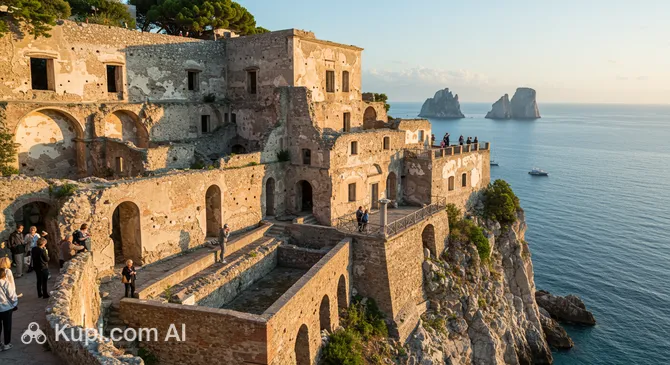
Imagine a majestic palace rising above the azure waters of the Tyrrhenian Sea—this is Villa Jovis (or the Villa of Jupiter), the most grandiose structure from the Roman Empire era on the island of Capri. Built in the 1st century AD for Emperor Tiberius, it was the principal of his twelve residences in Italy.
Villa Jovis. Illustration.
Source: Kupi.com AI
Traveler photos:
The palace covers an area of over 7,000 square meters at the summit of Monte Tiberio. It is not merely a residential building but a true architectural labyrinth that once included imperial quarters, luxurious thermal baths, ceremonial halls, and even a beacon tower for communicating with the mainland. The villa's multi-level structure allowed ancient builders to harmoniously integrate massive walls into the challenging mountain landscape.
Today, it is one of the most important archaeological zones in the region, where among the ruins you can feel the scale of Rome's former power. Visitors are drawn not only by the site's historical value but also by the breathtaking panoramas of the Gulf of Naples, which open up from a height of over 330 meters above sea level.
Contacts
To confirm current information before your visit, you can use the official contact details. While this archaeological site does not have its own website, the administration is available by phone for inquiries. It is also helpful to save the exact address for navigating the island's narrow streets.
Below are the primary contacts for reaching out and finding the location on the map:
The main activity here is exploring the ancient ruins. You can walk through the remains of staircases and corridors where a Roman ruler once trod. Be sure to find the "Specula"—the ruins of an ancient observatory and beacon tower from which messages were transmitted to Rome using smoke and fire.
Panorama lovers should linger on the northern terraces: from there, you get a perfect view of the Gulf of Naples and the island of Ischia. Don't forget to look into the ancient cisterns area—the engineering solution of those years is staggering in its efficiency and preservation. Every point of the villa is a ready-made location for atmospheric photographs, where the grey stone of the walls contrasts with the bright blue sky.
The walk to the villa is also an excellent way to enjoy nature. The path winds past picturesque gardens and private villas nestled in greenery. It is an ideal spot for those seeking solitude and quiet, as the pedestrian-only route usually means there are far fewer people here than on the main streets of the town.
Getting There
The journey to the imperial residence begins with an arrival on the island by ferry or hydrofoil from Naples or Sorrento. Once at the port of Marina Grande, you should take the funicular or a bus up to the town's main square—the famous Piazzetta.
From the Piazzetta, there is only one way to reach the site: a walk along Via Tiberio. This route is approximately 2 kilometers long with a fairly steep incline. The entire walk will take between 40 to 60 minutes depending on your pace. Please note that motor vehicle traffic is prohibited on this section, so be prepared for an active walk.
Navigation address: Via Tiberio, 80073 Capri NA, Italy. It is recommended to wear comfortable shoes, bring water, and plan your ascent for the morning hours to avoid the midday heat, as the path passes through open areas under the sun.
Nearest city: Capri
History & Facts
Villa Jovis was built in the 1st century AD by order of Emperor Tiberius, who ruled the vast Roman Empire from this very spot during the last ten years of his life. The location was not chosen by chance: the sheer cliffs provided the emperor with exceptional privacy and security. According to legend, those who angered the ruler were thrown from the cliff next to the palace, though modern historians tend to view these as merely dark myths.
In the 18th century, during the reign of Charles III, the ruins were subjected to barbaric looting: valuable marble and unique mosaics were removed to decorate new palaces. Scientific interest in the site only awoke in the 19th century, and large-scale archaeological excavations led by Amedeo Maiuri began in 1932. It was Maiuri who succeeded in clearing the area of centuries of debris and revealing the grandeur of ancient architecture to the world.
The engineering genius of the Romans is evident here in the creation of a complex water collection system. Since there were no natural springs at the mountain peak, architects designed enormous cisterns connected to the building roofs, which provided the palace and baths with fresh water even during dry periods. Today, these reservoirs are among the best-preserved elements of the complex.
Time Needed
For a comfortable visit to this location, you should set aside at least 3–4 hours. The bulk of this time will be spent on the walk up from the town's central square and the subsequent descent. The hike itself is a significant part of the experience, requiring a leisurely pace and pauses to take in the views.
Exploring the archaeological zone itself, reading the information boards, and taking photos against the panoramic backdrop of the gulf takes about an hour and a half. If you are a history enthusiast and enjoy studying every foundation and column in detail, plan for half a day so you don't have to rush and can fully soak in the ancient atmosphere.
Working Hours
Visiting the archaeological zone is possible during the day; however, please keep in mind that access to the site is time-restricted. Villa Jovis is open to tourists from Tuesday to Sunday.
The schedule is as follows: Tuesday – Sunday from 10:00 to 16:00. Please note that Monday is a day off, when the entrance to the site is closed. It is recommended to arrive no later than 15:00 to have enough time to see all parts of the complex before closing.
Day
Working hours
Monday
Closed
Tuesday
10:00 – 16:00
Wednesday
10:00 – 16:00
Thursday
10:00 – 16:00
Friday
10:00 – 16:00
Saturday
10:00 – 16:00
Sunday
10:00 – 16:00
Nearby
The island is rich in amazing natural and historical sites, many of which are within walking distance of the imperial palace. Exploring the surrounding area will allow you to see another side of the island—one that is quieter, more authentic, and hidden from the noisy tourist crowds.
A walk along the eastern part of the mountain will reveal views of rocky arches and secluded grottoes that have inspired artists and poets for centuries. Below is a table featuring nearby points of interest: