Support

Basilica of Saint Fara

About

In the southern part of the charming city of Bari lies the Basilica of Santa Fara — a majestic monument of medieval architecture dedicated to the patron saint whose name is closely linked to the region's spiritual traditions. This Catholic church represents a unique fusion of Apulian Romanesque and Byzantine influences, creating an image that is both austere and sublime.
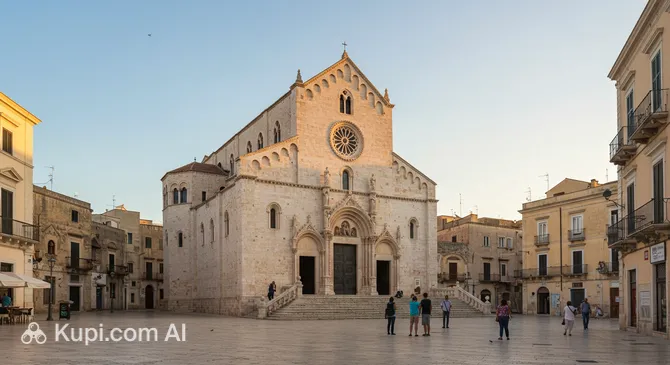
Basilica of Saint Fara
Basilica of Saint Fara. Иллюстрация. Источник: Kupi.com AI

The building impresses with its harmonious composition: massive stone walls, characteristic arches, and columns with intricately carved capitals transport visitors back to the 11th–12th centuries. Inside, Italy reveals itself from its most authentic side — here you can see rare Byzantine mosaics and ancient decorative elements that have survived despite numerous restorations in the 17th and 20th centuries.

Located near the sea coast, the Basilica of Santa Fara is not only an important religious center but also a true magnet for history enthusiasts. The atmosphere of silence and medieval spirituality that reigns within its walls makes this place a must-visit for anyone wishing to look behind the facade of the modern city.

Contacts

To confirm the current schedule for services or organize group visits, you can contact the temple administration. The Basilica of Santa Fara is open to pilgrims and tourists, and all the necessary contact information is provided below.

How to contactContact
AddressVia Generale Nicola Bellomo, 94, 70124 Bari BA, Italy
Phone+39 080 561 8236
Websitewww.santafara.org

What to Do

When visiting the church, the first thing to notice is the interior of the central nave. Be sure to look up at the matronea — the upper galleries that give the space a particular sense of lightness. Deep within the basilica, your attention will be drawn to the central apse, where a unique 12th-century stone ciborium has been preserved, decorated with skillful carvings of angels and animals.

Of particular value is the floor of the basilica, where fragments of a very rare Byzantine-Islamic mosaic dating back to 1013 have survived. For those who enjoy fine details, it is worth carefully examining the portals: you can find sculptural figures of sphinxes and bulls there. It is also recommended to descend into the crypt — a place filled with a sense of deep antiquity and peace.

If your visit coincides with a religious service, you will be able to hear the temple's wonderful acoustics and see it in living, sacred action. Before leaving, take a walk along the exterior galleries to examine the unusual column capitals, where medieval masters embodied whimsical images of people and birds.

Getting There

Reaching this architectural landmark at Via Generale Nicola Bellomo, 94 is quite simple. If you are in the city center or near the Bari Centrale station, it is most convenient to use public transport. Bus routes No. 12 or No. 13 will take you there, stopping in the immediate vicinity of the church. A taxi ride from the central part of the city will take no more than 5–10 minutes.

For those who prefer walking, the route from the waterfront to the basilica takes about 20–30 minutes, allowing you to see residential neighborhoods and feel the rhythm of southern Italy along the way. If you are traveling by car, use the coordinates 41.1012046, 16.8485224. Street parking can usually be found nearby, though traffic in this area can be quite heavy during peak hours.

Ближайший город: Bari

History & Facts

The history of this sacred site is rooted in the Byzantine era. Tradition holds that the current church was built on the foundations of the palace of a Byzantine governor — the Catapan. Major construction work began in the 11th century under the leadership of Abbot Elias, who sought to combine austere Romanesque aesthetics with the elegance of Byzantine traditions.

A significant milestone was the year 1197, when the church was officially consecrated after nearly a century of work. Throughout its long history, the building has faced many challenges: for instance, in 1456, it was damaged by a powerful earthquake. To save the structure from collapse, characteristic reinforcing arches were added in the 15th century, which remain a vital part of its architectural identity today.

The "Golden Age" of the basilica occurred during the reign of the Angevin dynasty, when the monastery regained its lost lands and became a flourishing spiritual center. Despite extensive restorations in the 17th and 20th centuries, during which ancient frescoes were lost, the temple has preserved its unique 1013 mosaics and ancient sarcophagi, making it a living witness to the region's centuries-old history.

Time Needed

To leisurely explore the interiors and feel the special energy of this place, 1–2 hours is sufficient for most travelers. This time is enough to study the architectural details of the upper galleries, view the ancient mosaics, and visit the crypt.

If you plan to attend a service or wish to take detailed photographs of the facade's decorative elements, you should budget a little more time. A visit to the basilica can easily be combined with a walk along the promenade or a visit to other historical points in the old town.

Working Hours

The basilica welcomes worshippers and tourists daily. The operating schedule is divided into morning and evening hours, which is typical for many Italian churches. Please take the afternoon break into account when planning your visit.

Opening Hours:
Monday – Sunday: 8:00 AM – 12:00 PM and 4:30 PM – 8:00 PM.

Please note: access for sightseeing may be limited during church holidays or solemn masses.

8:00 – 12:00, 4:30 – 20:00

Nearby

Exploring the surroundings of the church will allow you to fully experience the flavor of Puglia and see the city from different perspectives — from ancient ruins to modern entertainment centers. A stroll through the adjacent neighborhoods is a great addition to your visit to the basilica.

NameDistance
Gulp0.4 km
Santa Caterina Shopping Park1.4 km
Maximall Bari Santa Caterina1.5 km
Historic Building on Via Sparano2.1 km
Escape Room Bari2.1 km
Parco 2 Giugno2.2 km
Russian Orthodox Church of Saint Nicholas2.2 km

Reached the end of the page?

That means the route is fully explored