Support

Cattedrale di San Giovanni Battista

About

At the heart of the historic center of the ancient city of Brindisi lies the majestic Cathedral of Saint John the Baptist. This church, which holds the status of a pontifical basilica, is considered the main spiritual sanctuary of the region. Italy is famous for its cathedrals, but this site stands out for its unique history, blending Norman austere grandeur with the elegance of late Baroque.
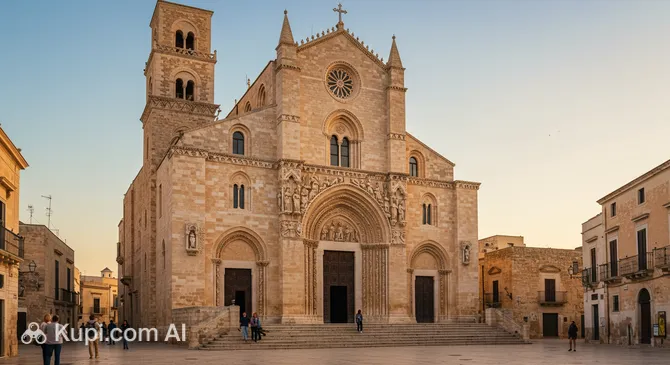
Cathedral of Saint John the Baptist
Cathedral of Saint John the Baptist. Иллюстрация. Источник: Kupi.com AI

Consecrated as early as 1089 by Pope Urban II, the cathedral has undergone a long journey of transformations. Despite serious destruction following an 18th-century earthquake, it has retained its unique energy as a pilgrimage center. Today, it is not just an active church but a true open-air museum where Baroque paintings and rare fragments of a 12th-century mosaic floor coexist under one roof.

The cathedral's significance is emphasized by its location on the picturesque Piazza Duomo. For tourists, this is an essential stop on any itinerary: here, you can see a unique synthesis of eras — from Romanesque apses decorated with elephant figures to the slender campanile soaring above the city. This spot is perfect for those seeking a reflection of the Mediterranean's centuries-old history in architecture.

Contacts

To find out more about special events or private tours, you can contact the cathedral administration directly. The Cathedral of Saint John the Baptist is always happy to welcome guests and pilgrims.

How to contactContact
AddressVia Duomo, 12, 72100 Brindisi BR, Italy
Phone+39 0831 521157
Websitewww.cattedralebrindisi.it

What to Do

Inside the church, your attention will inevitably be drawn to the unique fragments of the 1178 mosaic floor. Exploring these ancient images, you can spot biblical stories, mythical creatures, and even scenes from the famous "Song of Roland." These mosaics once served as a source of inspiration for knights setting off on expeditions from the city's port.

Be sure to walk deep into the presbytery to see the magnificent wooden choir from 1594, created by local craftsmen with incredible delicacy, and the elegant marble balustrade made by Neapolitan sculptors in the mid-18th century. Art lovers will be interested in the Baroque altar paintings, which give the interior a particularly solemn feel.

Outside, take time to study the facade and the surrounding square. Look for the campanile (bell tower) and the archbishops' coats of arms. If you are lucky enough to be here during a service, you can appreciate the cathedral's magnificent acoustics, which make the church chants truly breathtaking. This place is wonderful both for spiritual solitude and for lovers of aesthetic architectural photography.

Getting There

Located in the heart of the historic center, the cathedral is situated at Via Duomo, 12. This area is a pedestrian zone, so a walk through the old streets will be a pleasant addition to your visit. From the Brindisi Centrale railway station, you can reach Piazza Duomo on foot in just 10–15 minutes.

If you are arriving from Brindisi Airport (BDS), it is most convenient to take the special airport shuttle bus or a taxi — the trip to the center will take about 15–20 minutes. Municipal buses (routes No. 1, 3, and 5) also run within the city and stop within walking distance of the cathedral.

For those traveling by car, it is important to remember that parking directly at the cathedral is not possible due to its status as a Limited Traffic Zone (ZTL). It is recommended to leave your car in one of the paid parking lots outside the historical core and enjoy a short walk toward the port.

Ближайший город: Brindisi

History & Facts

The history of this sacred site is steeped in legend: tradition has it that the cathedral was founded as early as the 2nd century on the ruins of an ancient Temple of the Sun and the Moon. It is said that Saint Peter the Apostle himself baptized thousands of local residents here. However, the documented history begins in 1089, when Pope Urban II laid the foundation stone of the Romanesque basilica.

During the era of Norman rule, the cathedral witnessed events of royal proportions. In 1191, the coronation of Roger, son of Tancred, took place here; he became the first Norman King of Sicily to be crowned outside of Palermo. A year later, within these walls, he married Irene, the daughter of the Byzantine Emperor, highlighting the city's vital role as a bridge between East and West.

In 1743, a terrible earthquake practically wiped the cathedral's original Norman appearance off the map. By 1750, the building was completely restored, but in the lavish Baroque style that we see today. Only fragments of the external apses and priceless parts of the 12th-century mosaic floor, miraculously preserved under the rubble, remain from its medieval past.

Interestingly, the 1178 mosaics were commissioned by Archbishop Guidelmo specifically to inspire the crusaders. Before sailing to the Holy Land, the knights would see Old Testament scenes and episodes from "The Song of Roland" on the floor, setting their minds on heroism and spiritual duty.

Time Needed

For a basic tour of the cathedral's interiors and its majestic facade, most travelers find 45–60 minutes to be sufficient. This is enough time to leisurely examine the surviving fragments of the medieval mosaic, the Baroque altars, and to soak in the atmosphere of peace and tranquility.

If you plan to visit the cathedral during a festive service or wish to study the architectural elements of the campanile and the adjacent Piazza Duomo in detail, it is worth setting aside about 1.5 hours. This place invites thoughtful contemplation, so it’s best not to rush your visit.

Working Hours

The cathedral is open to visitors daily, though you should take into account the traditional southern Italian midday break. The opening hours are as follows: from 8:30 AM to 12:30 PM in the morning and from 4:30 PM to 8:30 PM in the evening.

Please note that during liturgical services and on major religious holidays, tourist sightseeing may be limited. It is recommended to plan your visit for the first half of the day or later in the evening to find the cathedral in a quieter setting.

8:30 – 12:30, 4:30 – 20:30

Nearby

Visiting the main cathedral is just the beginning of discovering the city's rich heritage. Many iconic sites are concentrated around Piazza Duomo, allowing you to literally trace the region's history from antiquity to the present day.

A walk through the neighborhood will reveal views of the famous Roman columns and medieval castles that guarded the entrance to the harbor for centuries. Below is a list of interesting sites within walking distance:

NameDistance
Francesco Ribezzo Archaeological Museum0 km
Roman Columns0.1 km
La Locanda del Porto0.1 km
Granafei Nervegna Palace0.1 km
Numero Primo Wine Bar0.2 km
Church of San Giovanni al Sepolcro0.3 km
Fao 370.3 km

Reached the end of the page?

That means the route is fully explored