Source: Kupi.com AI
| Characteristic | Value |
|---|---|
| IATA code | HNA |
| ICAO code | RJSI |
| City | Hanamaki Onsen |
| Country | Japan |
| Time zone | Asia/Tokyo |
| Popular airlines | ITA Airways, Japan Airlines |
| Schedule | Online timetable |
| Characteristic | Value |
|---|---|
| IATA code | HNA |
| ICAO code | RJSI |
| City | Hanamaki Onsen |
| Country | Japan |
| Time zone | Asia/Tokyo |
| Popular airlines | ITA Airways, Japan Airlines |
| Schedule | Online timetable |
Hanamaki Airport (HNA), serving the city of Morioka and Iwate Prefecture, is located approximately 40 kilometres south of the city centre. You can reach it in several ways, each having its own advantages depending on your budget, time, and preferences.
Public transport is the most popular and balanced option. A direct shuttle bus runs regularly between Morioka Station and the airport. The journey takes approximately 45-50 minutes, and the fare is about 1400-1500 yen. This is a convenient and economical method, ideally suited for most tourists. You can also take the JR Tohoku Main Line train to Hanamaki-Kūkō station, but please note that the station is not located at the airport itself. From there, a short trip by taxi or local bus (about 7-10 minutes) will be required to reach the terminal.
Taxi or private transfer is the fastest and most comfortable way to get to the airport. The trip from the centre of Morioka will take about 40-50 minutes depending on traffic conditions. However, this is also the most expensive option: the cost may exceed 10,000 yen. Taxis are convenient for travellers with a large amount of luggage, families with children, or those who value maximum comfort. In Japan, "Ainori Taxi" (shared taxi) services are also popular and can be booked in advance — this may be slightly cheaper.
Car rental is an excellent choice if you plan to explore the picturesque surroundings of Iwate. Counters for several major rental companies operate at Hanamaki Airport. You can pick up a car upon arrival and return it before departure. To rent a car in Japan, you will need an International Driving Permit. A spacious car park is located next to the terminal, where you can leave a vehicle for a short or long term, making this option convenient for those travelling in their own car.
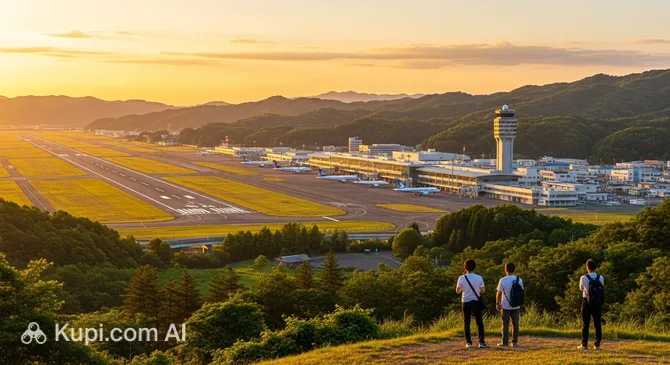
Hanamaki Airport (HNA) is a modern and compact airport distinguished by a simple and clear structure. There is only one passenger terminal here, serving both domestic and international flights. Thanks to this, navigating the airport is intuitive, and the risk of getting lost is minimal, making it especially convenient for tourists unaccustomed to huge aviation hubs.
The terminal layout is logical and simple. The building has several floors, but the main passenger zones are distributed between two of them:
Since there is only one terminal, transitions between zones are made on foot and take just a few minutes. All services — from check-in to baggage claim — are located within a single building. Processing times at Hanamaki Airport are generally short. For domestic flights, check-in and security screening usually take no more than 30-40 minutes. For international flights, it is recommended to arrive 1.5-2 hours in advance to calmly complete all formalities, although queues are rare here as well.
For convenient navigation, simply follow the signs, which are duplicated in English. Airport staff are always ready to help. The terminal building also houses souvenir shops where you can buy local delicacies, and a small restaurant with a view of the runway. This is an ideal example of an efficient and convenient regional airport where everything is thought out for traveller comfort.
The history of Hanamaki Airport, the main aerial gateway of Iwate Prefecture, begins in 1964. It was opened then, originally under the name Morioka Airport, with a runway 1200 metres long. Its primary task was to ensure reliable air connections between the region and major cities in Japan and to facilitate the economic development of the prefecture.
Key stages of growth occurred in the 1980s and 1990s. In 1980, the runway was significantly extended to 2000 metres, allowing it to accommodate jet aircraft. A year later, in 1981, the airport was officially renamed Hanamaki Airport. The next important milestone was 1999, when the runway was expanded to its current 2500 metres. This opened up opportunities for receiving larger aircraft and launching international charter flights, mainly to East Asian countries.
The most significant modernization in the airport's recent history took place in 2009 with the opening of a new, modern passenger terminal. Its architectural concept, "Station of the Sky" (Sora no Eki), is inspired by the works of the famous Japanese poet and writer Kenji Miyazawa, who was born in Hanamaki. The new terminal not only increased capacity but also offered passengers a high level of comfort and modern amenities. The airport also played an important humanitarian role, becoming one of the logistics centres during recovery efforts following the 2011 earthquake.
Today, Hanamaki Airport, often called Iwate-Hanamaki for greater recognition, is not just a transport hub. It is a vital element of infrastructure that continues to develop, supporting the region's business and tourism connections. Its history is a reflection of the drive for progress alongside a careful regard for its cultural heritage, making it a calling card of Iwate Prefecture.
Hanamaki Airport (HNA) offers passengers all necessary amenities for a comfortable wait for their flight. Despite its compact size, the terminal is well-organised and designed for the needs of travellers.
Within the airport, you will find several restaurants and cafes where you can try local cuisine, including famous noodles, or simply have a cup of coffee before your flight. The shops present a wide selection of souvenirs, including products related to the renowned writer Kenji Miyazawa, born in Hanamaki, as well as local delicacies and handicrafts that make excellent gifts from your trip.
For those who prefer to wait for their flight in a quieter atmosphere, the paid Lounge Hanamaki is available. Here, guests are offered beverages, snacks, and fresh press. Free Wi-Fi is available throughout the terminal, and special zones for charging electronic devices are equipped in the departure halls.
ATMs are also available for passenger use. However, for currency exchange, it is recommended to use banking services in major cities, as facilities at a regional airport may be limited. The terminal has a medical point for first aid and a dedicated nursing room equipped with changing tables and space for feeding, making travel with small children more convenient.
The airport is fully adapted for passengers with reduced mobility: there are ramps, elevators, and specially equipped toilets. A wheelchair can be requested if necessary. There are no hotels directly inside the airport, but many accommodation options are located a few minutes' drive away, especially in the area of the famous Hanamaki Onsen hot springs. For business travellers, conference rooms are available for meetings and events.
Hanamaki Airport (HNA), despite its compact size, offers passengers several excellent options for a snack or a full lunch, with an emphasis on the famous cuisine of Iwate Prefecture. All dining establishments are located in the main terminal building, in the general area before security control, making them accessible to both departing passengers and those seeing them off.
For those wishing to enjoy a full lunch with a beautiful view, the "An-un" restaurant operates on the third floor. It offers a panorama of the runway, and the menu features dishes of Japanese and European cuisine. The main gastronomic highlight of the airport is rightfully considered to be the "Miyazawa Kenji" restaurant on the second floor. Here you can taste authentic local delicacies, for example, dishes made from the famous "Platinum Pork" (Hakkinton) — the pride of the region.
If you are short on time and need a quick snack, visit the cafe on the second floor. Here you will be offered coffee, tea, light snacks, and desserts in a cozy atmosphere. Additionally, in the souvenir shops located on the same floor, you can often find ready-made lunch boxes (bento) and local snacks that are convenient to take with you on the plane.
Prices in Hanamaki Airport establishments can be characterised as moderate, typical for regional airports in Japan. Opening hours of restaurants and cafes are usually tied to the flight schedule, but it is recommended to check them in advance. regarding special dietary needs, finding certified Halal, vegan, or gluten-free dishes may be challenging. However, Japanese restaurant menus often feature rice, noodle, and vegetable dishes that may be suitable for vegetarians.
Travelling through Hanamaki Airport, serving the city of Morioka and Iwate Prefecture, usually proceeds smoothly and without unnecessary stress thanks to its compact size and Japanese efficiency. To ensure everything goes perfectly, use our tips.
Arrival Time and Check-in. For domestic flights within Japan, it is recommended to arrive at the airport 1.5–2 hours before departure. This time is sufficient to check in luggage without rushing, pass through security control, and reach the boarding gate. To save time, use online check-in if your airline provides this option. Check-in counters and self-service kiosks are located conveniently and are intuitive to use.
Security Control and Hand Luggage. The screening procedure here is standard, but the staff works very quickly and politely. Prepare electronics (laptops, tablets) for separate scanning in advance. Remember the liquid transport rule: all containers must be no more than 100 ml in volume and packed in a single transparent bag. Sharp objects are prohibited in hand luggage. Power banks can only be carried in hand luggage.
Seat Selection and Transfers. If you want to enjoy views during takeoff or landing, choose a window seat. In clear weather, you can see the picturesque Ou Mountains. For passengers with transfers, navigation in the airport will not be difficult due to its small size. If you are flying with a transfer, check with the airline whether you will need to collect and re-check your luggage.
Customs Control. For rare international flights, customs control follows standard rules. Fill out the customs declaration (usually handed out on the plane) and be ready to present luggage for inspection. The import of certain food products, plants, and animals is restricted.
Savings and Useful Tips. To save money, bring an empty reusable water bottle with you — after screening, it can be filled at drinking fountains. Souvenirs and local delicacies are often cheaper to buy in the city itself than at the airport. Public transport to the airport is generally more economical than a taxi, so study the bus schedule in advance.
In Case of Flight Delay. Remain calm. All up-to-date information is displayed on departure boards. Hanamaki Airport has several restaurants where you can try local cuisine, and shops with souvenirs. Contact your airline representative to find out about the flight status and possible options (provision of meals or accommodation during long delays).
Have you reached the end of the page?
So the route has been studied inside and out