Support

Top of Hallasan Mountain

About

Mount Hallasan is the majestic culmination of an extinct volcano and the highest point that South Korea can boast. Rising 1,950 meters above sea level in the heart of Jeju Island, this natural landmark is visible from almost any part of it. The peak's main centerpiece is Baengnokdam—a fairytale crater lake surrounded by rugged lava fields and basalt cliffs.
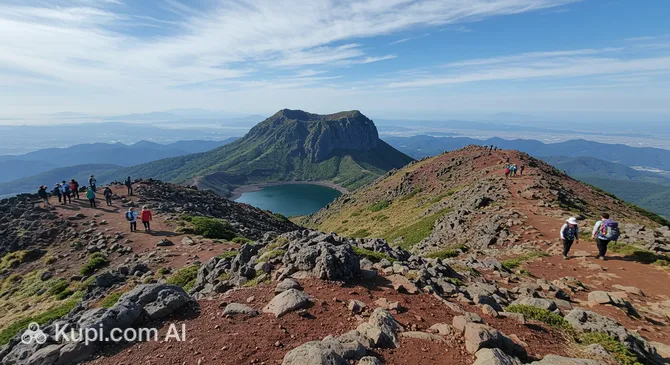
Hallasan Summit
Hallasan Summit. Иллюстрация. Источник: Kupi.com AI

Located within the Hallasan National Park, the summit is in close proximity to the city of Jeju City. This site is recognized as a UNESCO World Heritage site not only for its geological uniqueness but also for its striking biodiversity. It is home to more than 1,800 plant species, and the landscape changes from subtropical forests at the base to rugged alpine meadows at the very top.

For travelers, Hallasan symbolizes the pristine beauty of nature. Depending on the season, the mountain changes its appearance: in spring, the slopes are covered in a soft pink carpet of azaleas, and in autumn, they are painted in fiery tones. It is the perfect place for those seeking inspiration and wanting to feel the power of an ancient volcano beneath their feet.

Contacts

To plan your route and check the current visiting conditions, you can use the park's official resources.

How to contactContact
AddressOdeung-dong, 특별자치도, Jeju-si, Jeju-do, Южная Корея
Websitevisithalla.jeju.go.kr

What to Do

The main magnet for active tourists is trekking. Two main routes lead to the peak: Seongpanak and Gwanimsa. During the ascent, you will be able to see amazing lava fields, centuries-old forests, and hundreds of secondary volcanic cones scattered across the island. At the highest point, a breathtaking view of the crater lake and a panorama of the ocean stretching beyond the horizon awaits you.

Besides the challenging climb, it is worth visiting the Eorimok Visitor Center, which features interactive exhibits about the park's ecosystem. Here, you can learn about endemic species of animals and plants, as well as watch films about the formation of lava caves. If you find yourself here in June, be sure to walk the trails overflowing with blooming royal azaleas—this is the best time for landscape photographers.

For a more relaxed holiday, the ecological trails at the base, such as the route through the "Hallasan 1100" wetlands, are ideal. Here, you can observe rare birds and enjoy the purest mountain air. Remember the strict environmental rules: campfires and littering are prohibited in the park, which allows this place to be preserved in its pristine state.

Getting There

Getting to the foot of the mountain from Jeju City is quite simple. The most popular way is to use public transport. Buses (such as route No. 281 or special expresses) run from the airport or the central bus station, taking you to the main starting points, such as Seongpanak or Eorimok, in about 1 hour.

For those who prefer comfort and independence, a taxi or a rental car is a great option. The drive along the scenic Route No. 1100 takes about 40–60 minutes. Paid parking is available at the main entrances to the national park, but these fill up quickly during the high season, so it is best to arrive as early as possible.

It is important to remember that access to the trails may be restricted due to weather conditions. Before heading out, be sure to check the forecast: in heavy fog, downpours, or stormy winds, the ascent may be prohibited for tourist safety.

Ближайший город: Jeju City

History & Facts

Mount Hallasan is not just a mountain, but the heart of an ancient extinct volcano that began forming hundreds of thousands of years ago. Powerful eruptions created not only the majestic peak but also a whole network of 360 secondary cones called "oreums," as well as unique lava tunnels piercing the island's depths.

For the people of Korea, this mountain has long been considered a sacred place. Ancient texts refer to it as Yeongjusan, which translates to "the mountain that reaches the Milky Way." Legends say that spirits and deities protecting the island dwell here, and the very presence on the summit grants longevity.

Hallasan received global recognition in 2007, when the island's entire volcanic complex was included in the UNESCO World Heritage list. Geologists call this place a "living textbook," where the history of our planet's formation through volcanic activity, frozen basalt flows, and unique coastal formations is clearly visible.

Time Needed

Conquering the country's highest point is a full adventure that is worth dedicating a full day to. The journey to the Baengnokdam crater and back along the main trails (about 10 km one way) usually takes between 7 to 10 hours, depending on your physical fitness and the time spent at observation decks.

If you don't plan to summit the peak, you can choose lighter walking routes at the base or hike to intermediate viewpoints. In this case, exploring the park's nature will take from 2 to 4 hours, allowing you to combine the hike with visits to other attractions on the island.

Working Hours

Hallasan National Park operates on a special schedule tied to daylight hours. Entrance to the trails leading to the summit is usually permitted from 06:00, but there is a strict time limit: if you do not pass the checkpoint by noon (usually by 12:00 or 13:00 depending on the season), you will not be allowed onto the final section of the route to ensure you can descend before dark.

The Eorimok Visitor Center welcomes guests from 09:00 to 17:00 (closed on Mondays). Since opening hours may change due to seasonality or sudden weather deterioration, we strongly recommend checking the latest information on the official website before starting your hike.

Nearby

Jeju Island offers many interesting places beyond mountain climbs. Exploring the surroundings of Hallasan will allow you to discover modern art, theme parks, and unusual landscape gardens that perfectly complement an active holiday.

NameDistance
Hallasan National Park0.2 km
Seogwipo Healing Forest7.2 km
Jeju Citrus Museum12.1 km
Nine Bridges12.3 km
Halla Arboretum12.6 km
Jungjong Jeju Black Pork BBQ14.5 km
Jeju Grand Resort14.6 km

Reached the end of the page?

That means the route is fully explored