Support

펭귄마을

About

In the heart of the historic Yangnim-dong district of Gwangju lies one of the most touching and unusual spots South Korea has to offer — Penguin Village. This is not a traditional village in the typical sense, but a vibrant open-air art district where historic alleys have been turned into a gallery of contemporary urban sculpture and retro installations.
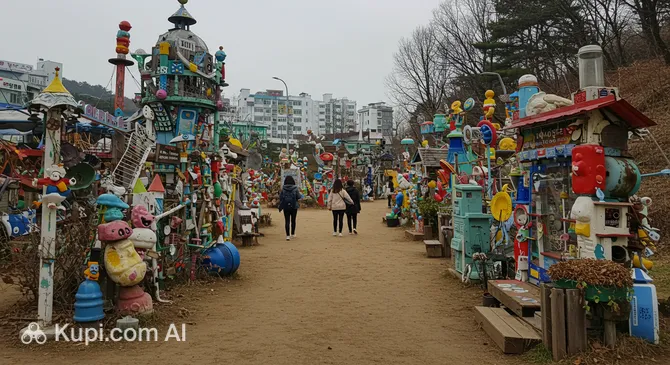
Penguin Village. Illustration.
Source: Kupi.com AI

Traveler photos:

The site earned its charming name from the local elderly residents, whose gait, due to joint pain, resembled the movement of penguins. Today, the neighborhood has become a symbol of creative revival: artists and volunteers have decorated house walls and fences with everyday items from the 70s and 80s, transforming old clocks, dishes, and electronics into works of art. Traditional Korean hanok houses and bright elements of pop art blend here in a wonderful way.

Penguin Village attracts travelers with its sincere, "homey" atmosphere and the unique opportunity to see how memories of the past can become a vibrant cultural phenomenon of the present. Walking through these alleys feels like stepping into a vintage film set where every object tells its own story.

Contacts

To clarify details before your visit or to contact local cultural centers in the area, you can use the following contact information.

How to contactContact
Address7 Cheonbyeonjwa-ro, 446 beon-gil, 남구 광주광역시 South Korea
Phone+82 10-6402-2713

What to Do

The main reason to visit Penguin Village is for the endless strolls through its maze of narrow streets. Every turn hides a new surprise: from giant, colorful murals on the walls to quirky sculptures made from old pans, toys, and broken electronics. It’s the perfect spot for those seeking unique backdrops for photoshoots — every inch practically begs to be captured.

In addition to admiring the art, guests can peek into small workshops. Craft workshops are often held here, where you can try your hand at making a souvenir. It’s a great chance to get to know the local culture and chat with the resident artists who put their hearts into transforming their neighborhood.

For a deeper dive, visit the small exhibitions dedicated to the history of Gwangju and local life in the last century. Families with children will appreciate the abundance of small details and playful elements throughout the space, while those seeking peace can enjoy a cup of tea in one of the cozy cafes housed in reconstructed hanok houses.

Getting There

Penguin Village is conveniently located in the central part of Gwangju, in the picturesque Yangnim-dong district. You can easily reach it by public transport. The nearest subway station is Yangnim (Namgu-cheong). The walk from the subway exit to the entrance of the creative quarter takes no more than 10–15 minutes.

If you prefer more comfort, you can take a taxi. A ride from the city's central train station or bus terminal takes about 15–20 minutes depending on traffic. A good landmark for the driver is Chonnam National University Hospital, which is located in the immediate vicinity.

For those traveling by their own or a rented car, public parking is available near the district. Numerous city bus routes also pass through this area, making the location easily accessible from anywhere in the city.

Nearest city: Gwangju

History & Facts

The history of this site is inextricably linked to the development of the Yangnim-dong district, which became the "gateway" for Western culture in Gwangju over a hundred years ago. It was here that European-style buildings first began to appear alongside traditional Korean hanok houses, creating a unique architectural landscape.

In the 70s and 80s, this was an ordinary residential neighborhood. It got its unusual name from its residents — at the time, many elderly people lived here. Due to age-related joint issues, their gait began to resemble that of penguins, giving the future landmark its name. This name stuck as a tribute and a symbol of care for the older generation.

Over time, the neighborhood began to decline, but local enthusiasts and artists decided to turn it into an art space. They began decorating walls and streets with items from the past, turning old junk into art objects. Thus, the abandoned alleys became a popular cultural hub that preserves the atmosphere of late 20th-century Korea and the community spirit of the locals.

Time Needed

To leisurely explore all the hidden corners of Penguin Village, it is recommended to set aside 1 to 2 hours. This is plenty of time to walk through the narrow alleys, examine the installations in detail, and take many original photos against the vibrant murals.

If you plan to visit the local shops, talk to the artists, or participate in a creative workshop, you should budget about half a day. A walk through the quarter pairs perfectly with a visit to nearby historic-style cafes.

Working Hours

Since Penguin Village is an open urban quarter, you can walk through its main streets and view the outdoor installations 24/7 and for free. In the evening, some areas are lit up, creating a particularly cozy atmosphere.

However, if you plan to visit indoor exhibitions, souvenir shops, or join workshops, keep in mind they usually operate on a standard schedule — roughly from 10:00 to 18:00. It is recommended to check for up-to-date information on the city's official tourism portals before your trip, as individual gallery schedules may vary.

Nearby

Exploring the surroundings of Penguin Village will allow you to dive deeper into the city's atmosphere and see the variety of its entertainment options. The Yangnim-dong district is rich not only in history but also in modern leisure centers.

Below are some interesting spots nearby that may interest fans of aquatic life and active recreation:

NameDistance
Leeleenam Studio0.5 km
First Nepal Curry Story0.6 km
Gwangju Sajik Park Observation Tower0.6 km
Asia Culture Center0.7 km
May 18 Democracy Square0.8 km
Jeonil Building 2450.9 km
Wave Chungjang Branch1 km

Reached the end of the page?

That means the route is fully explored