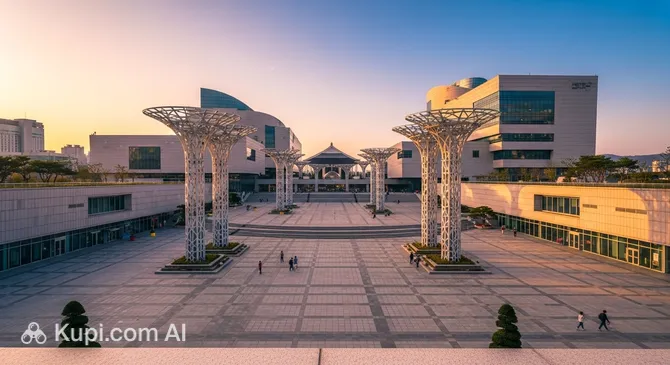
In the heart of Gwangju lies an impressive large-scale project—the Asian Culture Center (ACC). This is not just a museum or an exhibition hall, but a true intellectual and creative "city within a city," created to unite various art forms and traditions from across the region.
Asia Culture Center. Illustration.
Source: Kupi.com AI
Traveler photos:
As a vital part of the ambitious plan to transform the city into a cultural capital developed by South Korea, the ACC serves as a dynamic platform for dialogue. Here, futuristic installations, concert venues, and rich research archives dedicated to Asian identity coexist under one roof.
The complex attracts travelers with its unusual architecture and its status as one of Asia's largest cultural institutions. It is a place where traditional heritage meets future technologies, making every exhibition or concert a unique event for the viewer.
Contacts
To plan your visit to this modern cultural hub, it is helpful to have up-to-date contact information on hand. You can check event details or book tickets in advance through the Asian Culture Center's official communication channels.
A visit to this center promises to be an immersive experience: you can see everything from ancient artifacts to the digital art of the future. Be sure to look into the halls dedicated to ceramics, which present a rich collection of Korean earthenware created over millennia. The Underwater Cultural Heritage Hall is particularly moving, showcasing over 24,000 relics recovered from the seabed off the Sinan coast.
Technology enthusiasts will love the Convergence Media Theater. Here, familiar museum exhibits come to life through modern visual effects, allowing you to literally touch history through a digital medium. This space is ideal for those who appreciate interactivity and an innovative approach to culture.
In addition to the permanent exhibitions, the center regularly hosts concerts, theatrical performances, and contemporary art festivals. A walk through the complex's open areas is also a pleasure: the modern architecture and landscape design provide excellent conditions for relaxation and inspiration right in the center of the bustling city.
Getting There
The Asian Culture Center is located in the heart of the city at 38 Munhwajeondang-ro, Dong-gu, Gwangju. Thanks to its central location, it is easy to reach from almost anywhere in the metropolis.
The most convenient way is to use the Gwangju Metro. You should get off at Culture Complex (Munhwa Jeondang) station, where the exits lead directly to the center's grounds. Numerous city buses also serve the area, stopping near the complex's main gates.
If you prefer more comfort, you can use a taxi. Drivers will easily find the way using the coordinates 35.1467193° N and 126.9202542° E. For navigation in South Korea, it is best to use local apps such as Naver Maps or KakaoMap, as they provide the most accurate public transport routes.
Nearest city: Gwangju
History & Facts
The history of the site where this modern complex stands today is inextricably linked to the past of Gwangju itself. Founded as early as 57 BC, the city was an important administrative and cultural hub for centuries, and in 940, it received its poetic name, meaning "Luminous Province."
In the late 20th century, the city set a course toward becoming a global capital of the arts. A landmark event was the establishment of the Gwangju Biennale in 1995, which quickly earned status as one of Asia's most influential art exhibitions. This laid the foundation for an ambitious state project to create a large-scale cultural space.
The city officially received the status of the Cultural Capital of the Republic of Korea in 2007. Large-scale investments of approximately $5 billion allowed for the realization of the Asian Culture Center project, which became a symbol of creative revival and the country's openness to the world. Today, the center is living proof of how historical heritage can be harmoniously transformed into a futuristic platform for cultural dialogue.
Time Needed
To simply walk around the grounds and appreciate the architectural scale of the complex, you will need about 1–2 hours. However, the Asian Culture Center offers such a rich program that art lovers should set aside at least 3 hours for their visit.
If you plan to explore the ceramics collection in detail, visit the interactive media halls, and check out temporary modern art exhibitions, it is best to allocate half a day (4–5 hours). This will allow you to immerse yourself in the creative atmosphere without rushing and perhaps catch one of the events taking place here.
Working Hours
When planning your visit, keep in mind that the center is open to the public six days a week, with operating hours varying depending on the day. Monday is a day off—the complex is closed to tourists at this time.
On Tuesdays, Thursdays, Fridays, and Sundays, exhibitions are open to guests from 10:00 AM to 6:00 PM. If you want to enjoy art in the evening, choose Wednesday or Saturday, when the center's doors remain open until 8:00 PM. Before your trip, it is recommended to check the official website, as the schedule may change during public holidays.
Day
Working hours
Monday
Закрыто
Tuesday
10:00–18:00
Wednesday
10:00–20:00
Thursday
10:00–18:00
Friday
10:00–18:00
Saturday
10:00–20:00
Sunday
10:00–18:00
Nearby
A stroll around the Asian Culture Center will allow you to immerse yourself even deeper into the city's atmosphere and find interesting places for the whole family. There are many themed venues and entertainment zones within a few kilometers.