Support

Kota Kinabalu International Airport

About the Airport

Kota Kinabalu International Airport. Source: Kupi.com Binoculars
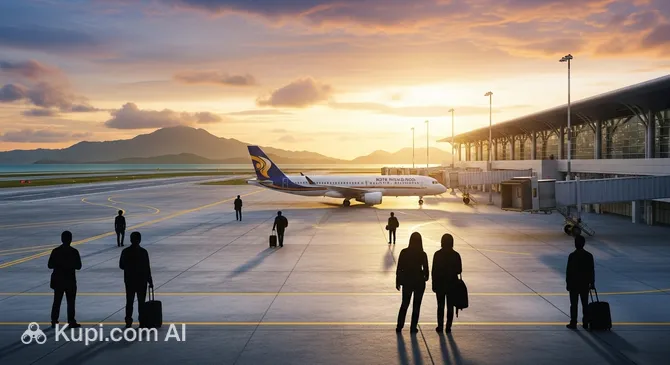
Kota Kinabalu International Airport (KKIA) is not merely a transport hub, but a true gateway to the wilds of Borneo and the underwater wonders of Sabah. Located right on the shores of the South China Sea, it often gifts travellers with unforgettable views upon landing: on one side, an endless expanse of water opens up, and on the other, the majestic silhouette of Mount Kinabalu. As the second busiest airport in Malaysia, it surprisingly combines the dynamics of an international hub with the relaxed atmosphere of a tropical resort, situated just a few minutes' drive from the bustling city centre.
IATA Code BKI
ICAO Code WBKK
City Kota Kinabalu
Distance to centre ~8 km
Status International
Passengers per year Over 7.9 million (2024)
### Airport Features and Advantages Kota Kinabalu Airport is renowned for its compactness and convenience, which distinguishes it favourably from giant and confusing capital hubs. Everything here is intuitive, and the journey from the aircraft stairs to the city exit takes minimal time. * **Fantastic Location:** The airport is located very close to the city centre — a trip by taxi or the Grab ride-hailing service takes only 10–15 minutes, allowing you to start your holiday almost immediately after landing. * **Scenic Views:** The runway lies parallel to the coastline, ensuring some of the most beautiful take-offs and landings in Southeast Asia, especially during the famous Borneo sunsets. * **Modern Infrastructure:** Despite its relatively small size, the terminal is equipped with everything necessary: there are 24-hour cafes (including popular international chains), Duty Free shops, currency exchange counters, and comfortable lounges (Plaza Premium Lounge). * **Key Hub:** This is the main starting point for travel across the state of Sabah — from here it is easy to fly to Sandakan to see orangutans, to Tawau for the diving sites of Sipadan, or to neighbouring Sarawak.

Contact Information

To contact Kota Kinabalu International Airport (BKI), the key transport hub of Sabah state, please use the following details:

  • Official Website: malaysiaairports.com.my
  • Information Desk Phone: +60 88-325 555
  • Address: Jalan Lapangan Terbang (Lama), 88200 Kota Kinabalu, Sabah, Malaysia
  • Email: For general enquiries, you may use the email of the Malaysia Airports operator — care@malaysiaairports.com.my.
  • Social Media: Current information can be found on the official pages of the managing company Malaysia Airports on Facebook and other social networks.
  • Lost Luggage Information: In case of loss of checked baggage, you should first contact your airline's representative. For items lost within the terminal building, please contact the airport information desk.
  • Passenger Support Service: For consultations on general matters, please use the main airport telephone number.

How to Get to the Airport

A journey to the paradisiacal atoll of Layang-Layang Island is a true adventure that begins at Kota Kinabalu International Airport (BKI). It is important to understand that reaching this secluded island, located in the South China Sea, is possible in only one way — by air, and this is not an ordinary commercial flight.

The only route to the island is a special charter flight that departs from Kota Kinabalu. Typically, tickets for this small aircraft cannot be purchased separately. The flight is part of a package tour booked together with accommodation at the island's only resort, which specialises in diving. Thus, by organising your trip, you simultaneously resolve both accommodation and transfer arrangements.

When planning your trip, all flight details will be provided to you by the tour operator or the resort administration. Usually, upon arrival at Kota Kinabalu International Airport, you will need to find the check-in counter for your charter, which may be located in the main terminal or a separate section of it. The flight itself takes about one hour and offers unforgettable bird's-eye views of the endless expanse of the sea and coral reefs.

Therefore, the key to a successful trip to Layang-Layang Island is a pre-planned and booked tour. Independent travellers cannot reach the atoll on their own. All logistics, including the flight from Kota Kinabalu, are fully organised by the hosting party, ensuring the exclusivity and seclusion of this stunning corner of Malaysia.

Terminals and Map

Kota Kinabalu International Airport (BKI) is a modern and well-organised complex. It is important to know that currently, all flights — both international and domestic, including low-cost carrier flights — are serviced in one main building — Terminal 1. The old Terminal 2 has been closed, and all operations have been consolidated under one roof, which significantly simplifies navigation for passengers.

The structure of Terminal 1 is intuitive and logical. The building has several levels, but two are key for passengers:

  • Level 1 (Ground Floor): Arrival Zone. You arrive here after passing through passport control. Located here are baggage reclaim belts, customs control, as well as taxi counters, car rental desks, and bus stops.
  • Level 3 (Third Floor): Departure Zone. Escalators and lifts lead to this level directly from the airport entrance. Here you will find flight check-in counters, baggage drop-off points, and subsequently — passport and customs control zones, after which passengers enter a spacious waiting hall with boarding gates.

Because all flights operate from a single terminal, passengers do not need to worry about transferring between buildings — everything is within walking distance. Navigation inside the terminal is facilitated by clear signage in Malay and English. Departure and arrival zones are clearly separated by floors, preventing overcrowding and making movement around the airport more comfortable.

It is recommended to arrive in advance to complete check-in and security screening. For international flights, it is best to arrive at the airport 2.5–3 hours before departure, and for domestic flights within Malaysia, 1.5–2 hours is sufficient. During peak times, such as early mornings, weekends, or public holidays, queues for security screening may be longer, so it is worth allowing extra time.

To easily orient yourself at Kota Kinabalu Airport, follow simple advice: pay attention to electronic boards with flight information located throughout the terminal, and do not hesitate to ask for assistance from staff at information counters. The linear layout of the building makes it easy to find everything you need — from check-in counters to the correct boarding gate.

Airport History

Kota Kinabalu International Airport (BKI) is the main aviation hub for the state of Sabah and the entire east coast of Malaysia. Its history is closely intertwined with the development of the region. Originally, an airfield on this site was built by Japanese forces during World War II and used for military purposes. After the war ended, it was transferred to civil aviation administration and began servicing the first commercial flights, marking the start of its long history as a civilian airport.

A key stage of development occurred in the 1950s and 1960s. In 1957, the first proper terminal was built, and the runway was lengthened and strengthened to accommodate jet aircraft such as the de Havilland Comet. This allowed for the establishment of direct air links with Hong Kong, Singapore, Manila, and other international destinations, turning the airport into an important regional hub.

The most massive transformation in the airport's history took place in the 2000s. Due to the growth in passenger traffic, especially thanks to the development of tourism, a large-scale reconstruction began. In 2008, the modern Terminal 1 was opened, which today services the majority of flights. The old terminal was repurposed as Terminal 2 and for a time specialised in budget airlines, making Kota Kinabalu even more accessible to tourists. Later, all operations were consolidated at Terminal 1 to increase efficiency.

Thanks to this modernisation, Kota Kinabalu International Airport has secured its status as the second busiest airport in Malaysia after Kuala Lumpur for years to come. One interesting fact lies in its unique location: the airport is just 8 kilometres from the city centre, making it incredibly convenient for travellers. Today, it serves as the gateway to the amazing natural treasures of Borneo, including Mount Kinabalu and world-renowned diving resorts.

Services and Amenities

Kota Kinabalu International Airport (BKI) offers passengers a full range of services for a comfortable wait for their flight. In the terminal, you will find numerous restaurants and cafes where you can try both local cuisine and familiar international dishes. For those wishing to shop, there are Duty Free stores featuring perfumes, cosmetics, and alcohol, as well as souvenir shops and boutiques with local brand goods.

For passengers who value privacy and comfort, business lounges and VIP lounges are available. Here you can relax in comfortable armchairs, enjoy complimentary snacks and beverages, and utilise work zones. Access to such lounges is usually open to business class passengers or available for an additional fee to all travellers.

Staying connected at the airport is easy thanks to free Wi-Fi available throughout the terminal. To charge electronic devices, numerous power outlets and special charging stations are provided in waiting areas and near boarding gates.

Financial matters can be resolved directly at the airport. At passengers' disposal are bank branches, 24-hour ATMs, and currency exchange bureaux where money can be exchanged for Malaysian Ringgit upon arrival or before departure.

To ensure passenger safety and health, a medical centre is in operation at the airport, ready to provide first aid. Travellers with children will appreciate the presence of baby care rooms equipped with everything necessary for looking after little ones. The airport is also fully adapted for passengers with reduced mobility: there are ramps, lifts, and specially equipped restrooms. If necessary, assistance services can be booked in advance.

If you have a long layover or an early flight, several hotels of various price categories are located in the immediate vicinity of the airport. Although there are no specialised conference halls within the terminal itself, basic business services, such as workstations and access to office equipment, are often provided in premium lounges.
Where to Eat

At Kota Kinabalu International Airport (BKI), travellers will not be bored while waiting for a flight when it comes to food. The airport offers diverse dining options, from a quick snack to a full meal, capable of satisfying different tastes and budgets.

The majority of cafes and restaurants are concentrated in the main terminal. In the public area (before passing security), you will find several chain establishments where you can have a coffee or a snack while seeing off friends or waiting for check-in. Coffee shops like Starbucks and local cafes offering sandwiches, pastries, and beverages are usually located here.

After passing passport and customs control (in the departure zone), the choice becomes wider. A food court is located here, featuring both international fast-food chains (such as McDonald's, KFC) and establishments specialising in Malaysian cuisine. This is an excellent opportunity to try local dishes before flying. Look out for hits such as Nasi Lemak (rice cooked in coconut milk with various accompaniments), Laksa (spicy noodle soup), or simply order a traditional Teh Tarik tea. For those seeking a full meal, there are restaurants with à la carte service.

Most establishments at the airport hold Halal certification, which is the standard for Malaysia. Finding vegetarian dishes is also possible, especially in restaurants offering Asian cuisine, where rice and vegetable-based dishes are common. Vegan and gluten-free options may be more challenging to find, so it is best to check the ingredients directly with the staff. The price range varies from budget options at the food court to average prices in restaurants. Major establishments operate from early morning until late evening, and some fast-food outlets may be open 24 hours.

Tips for Travellers

To ensure your journey to Malaysia and perhaps to islands like Layang-Layang Island begins smoothly, follow these tips when using Kota Kinabalu International Airport. It is recommended to arrive at the airport at least 3 hours before international flights and 2 hours before domestic ones. This will give you enough time to complete all formalities without rushing, especially during the tourist season.

To save time, use online check-in, which is offered by most airlines. This allows you to go straight to baggage drop or security screening if you are travelling light. When passing through security control, have your passport and boarding pass ready. All electronics, such as laptops and tablets, as well as liquids in containers up to 100 ml packed in a transparent bag, must be removed from hand luggage for scanning.

When choosing a seat on the plane, consider your preferences: window seats will offer magnificent views of the Borneo coast during take-off and landing, while aisle seats provide more convenience if you need to stand up during the flight. Standard hand luggage rules prohibit sharp objects, weapons, and flammable substances. Be sure to check your airline's current requirements regarding baggage weight and size.

If Kota Kinabalu is a transit point for you, verify in advance whether you need to collect and re-check your luggage when transferring to the next flight. This is particularly important when changing from international to domestic terminals. Upon entering the country at customs control, be prepared to present luggage for inspection and declare large sums of money or valuable goods. Following the rules will help you pass this procedure quickly and without issues.

You can save money by booking an airport transfer online in advance — this is often more cost-effective than using taxi services on the spot. Also, bring an empty water bottle to fill at drinking fountains after the security zone to avoid spending on drinks. In case of a flight delay, immediately contact your airline representative to learn about your rights to compensation, such as vouchers for food or beverages. While waiting for departure, you can visit shops, cafes, or use paid lounges for a more comfortable rest.

Reached the end of the page?

That means the route is fully explored