Support

Bario Airport

About the Airport

Bario Airport is not merely a runway; it is the gateway to one of the most secluded and authentic destinations in Malaysia. Located in the heart of the Kelabit Highlands on Borneo, it serves as a vital artery connecting this isolated community with the rest of the world. Arriving here on a small propeller plane is an adventure in itself, revealing panoramas of boundless jungles to travellers and offering the sensation of arriving in a lost world.
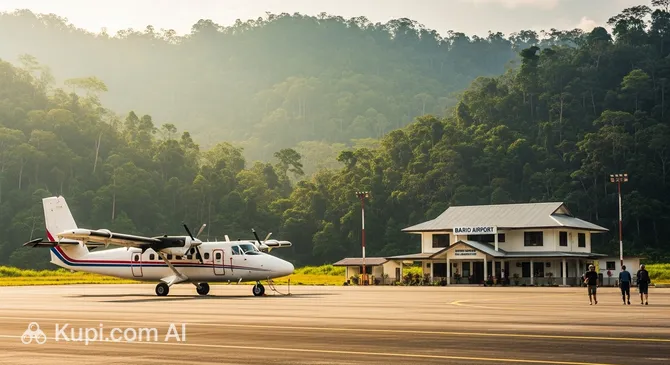
Bario Airport. Source: Kupi.com Binoculars
IATA Code BBN
ICAO Code WBGZ
City Bario
Distance to centre Within walking distance
Status Domestic
Annual passengers Approx. 25,000
Popular Airlines MASwings

The main feature of Bario Airport is its intimacy and simplicity. Do not expect huge terminals or duty-free shops here. This is a small STOL (Short Take-Off and Landing) airport, where everything is homely, simple, and straightforward. Essentially, it consists of a runway and a small building where flight check-in is quick and fuss-free. It is precisely this simplicity that is its virtue, allowing you to immediately immerse yourself in the leisurely atmosphere of the highlands.

The airport's primary advantage is its strategic location. It serves as the starting point for trekking through the Kelabit Highlands, visiting traditional longhouses of local tribes, and exploring the unique culture of this region. Flights here are operated by small DHC-6 Twin Otter aircraft, and the flight itself over the green carpet of the jungle leaves unforgettable impressions. For travellers seeking an authentic experience away from tourist crowds, Bario Airport becomes the first step towards true discoveries.

Contact Information

We have compiled the essential contact information for Bario Airport (BBN) for you. Given that this is a small regional airport, many inquiries are handled through the operator's central services or directly with the airline.

  • Official Website: Bario Airport does not have a dedicated website. It is managed by the national operator, Malaysia Airports Holdings Berhad (MAHB), on whose corporate portal general information can be found.
  • Information Desk Phone: There is no direct public telephone number for Bario Airport. For questions regarding flight schedules and tickets, it is recommended to contact your airline directly (e.g., MASwings).
  • Airport Address: Bario Airport, 98050 Bario, Sarawak, Malaysia.
  • Email: There is no separate email address for the airport. For official enquiries, you may use the feedback form on the MAHB operator's website.
  • Social Media: Bario Airport does not maintain its own pages on social media.
  • Lost Luggage Information: If your luggage has been lost or damaged, you should immediately contact your airline's Lost and Found service. Airport staff do not handle these issues directly.
  • Passenger Support Contacts: For all questions related to your flight, it is best to contact the air carrier's support service.

How to Get to the Airport

Getting to the small airport in Bario is not a difficult task, yet it has its own specifics due to the remote location of this amazing corner of Malaysia in the very heart of the Kelabit Highlands. Forget about the usual city buses and metro; an atmosphere of tranquillity and simplicity reigns here, which is also reflected in the transport options.

Transfer from Hotel or Guesthouse

This is the most common and reliable way to get to your accommodation from the airport and back. Bario Airport is located in close proximity to the main village. Most lodges, hotels, and homestays offer a transfer service for their guests.

  • Recommendation: Make sure to arrange a meeting at the airport with a representative of your hotel in advance, at the booking stage. This will save you from unnecessary hassle upon arrival.
  • Cost: Often the transfer is already included in the accommodation price or offered for a small fixed fee.
  • Travel Time: The journey to most accommodation places will take no more than 5-10 minutes.

On Foot

For travellers with light luggage, a walk from the airport to the accommodation can be an excellent start to getting to know Bario. Distances here are short, and the views of the surrounding landscapes are simply magnificent. Many guesthouses are within a 10-20 minute walk from the runway.

Taxi and Vehicle Rental

There are no official taxi services or international car rental companies in Bario. Transport services are usually provided by locals in their four-wheel drive vehicles (4x4). Such transport can be hired for trips around the area or excursions by arranging it with the driver through your hotel. typically, such trips are booked for journeys to distant villages or the start of hiking trails, rather than for a short trip to the airport.

Public Transport and Parking

Formal public transport, such as buses or trains, is absent in Bario and its surroundings. All life here revolves around the small community. As for parking, the airport is very small and does not have an organized paid car park. Most travellers arrive here by air, so the need for long-term parking is minimal.

Terminals and Map

Bario Airport (BBN) is a small regional airport serving the picturesque Kelabit Highlands in Malaysia. Its structure reflects its main function: to ensure reliable air connectivity with a remote region, rather than servicing massive passenger flows. Therefore, its layout is as simple and functional as possible.

The airport consists of one small terminal. It is a compact single-storey building that houses all zones and services necessary for passenger processing. There is no separation into domestic and international terminals, as the airport receives only local flights, primarily from Miri and Marudi, operated by MASwings on small propeller aircraft.

The airport map is extremely simple. Upon entering the building, you immediately find yourself in the main hall. Located here are the check-in counters, the waiting area, and the boarding gate. Departure and arrival zones are not actually separated by complex corridors. Passengers arriving in Bario walk from the aircraft to the terminal building, collect their luggage (which is usually delivered right to the exit), and leave the airport immediately. For departing passengers, a small waiting area with seats is provided after check-in.

Check-in and security procedures at Bario Airport are very quick due to the small number of passengers on each flight. The entire process from entering the terminal to being ready for boarding rarely takes more than 15-20 minutes. Nevertheless, it is recommended to arrive at the airport approximately one hour before departure to complete all formalities without haste.

The main advice for navigation is not to worry, as it is impossible to get lost here. Everything necessary is located in one hall, within direct line of sight. The absence of bustle, long queues, and complex passageways makes the stay at this airport calm and homely, which fully corresponds to the atmosphere of Bario itself.

Airport History

The history of Bario Airport (BBN) is not just the story of a runway, but a chronicle of life in the entire Kelabit Highlands. The airport was founded not for commercial transport, but out of military necessity. Its creation began in the early 1960s during the Indonesia–Malaysia confrontation ("Konfrontasi"). British and Malaysian armed forces needed a strategic point to supply garrisons and patrol the border in this inaccessible region. Initially, it was a simple dirt strip built in difficult jungle conditions.

After the conflict ended, the military significance of the airport diminished, but its role as a vital artery for the local population only grew. For many years, it remained a very modest airfield, serving mainly small aircraft of missionary organisations and irregular flights. For the residents of Bario and surrounding villages, it was the only fast link with the rest of Malaysia, allowing the delivery of mail, medicines, and essential goods.

A key stage in the airport's development was its modernisation in the late 20th century. The runway was asphalted, which allowed for the reception of more modern turboprop aircraft. A small but functional terminal building appeared. A real breakthrough was the commencement of regular passenger services by MASwings using Twin Otter aircraft, connecting Bario with the cities of Miri and Marudi. This not only simplified life for local residents but also opened up the region to eco-tourism.

Today, Bario Airport is a unique STOL (Short Take-Off and Landing) airfield, the operation of which depends heavily on the changeable mountain weather. Pilots flying here are considered true professionals. Despite its modest size, the airport holds no records for passenger traffic, but its main achievement is its invaluable role in maintaining the life and development of an isolated community. It has transformed from a military outpost into a symbol of connection and hope for the entire highlands.

Services and Amenities

Bario Airport (BBN) is a small rural airstrip serving as the gateway to the unique Kelabit Highlands region. It is important to understand that this is a very compact and basic airport, oriented towards servicing short regional flights, so the range of services here is minimal and corresponds to its size and purpose.

Dining and Shopping: There are no restaurants, cafes, or Duty-Free shops in the conventional sense at the airport. Sometimes, local residents may sell simple snacks, drinks, and handicrafts near the terminal. Travellers are advised to carry a supply of water and food, especially if a wait for the flight is expected.

Waiting Areas and Facilities: The terminal is a simple building with a basic waiting area and toilets. There are no VIP lounges, business centres, or conference rooms here. Regarding technology, public Wi-Fi is absent, and the number of power outlets for charging devices is extremely limited. It is strongly recommended to bring a fully charged power bank.

Financial and Medical Services: There are no banks, ATMs, or currency exchange points at Bario Airport. All financial transactions, including exchanging money for local currency, must be done in advance in larger cities such as Miri. Medical services are not provided on the airport premises, with the exception of possible basic first aid from staff.

Services for Special Categories of Passengers: There are no specialised mother and child rooms or play areas for children. There are also no special services for passengers with reduced mobility; however, airline staff are generally ready to assist with boarding and disembarking if notified in advance. The terminal itself is single-level, which simplifies movement.

Hotels: There are no hotels directly at the airport. All accommodation options, including numerous homestays and lodges, are located in the Bario settlement itself, often within a few minutes' walk or a short drive from the runway.

Where to Eat

Bario Airport (BBN) is a very compact airport serving as the gateway to the famous Kelabit Highlands of Malaysia. Dining options here reflect its status: it is not a major transport hub, but rather a simple air station. Do not expect restaurant chains or a food court here. Instead, you have a unique opportunity to experience genuine local cuisine.

In the single and small airport terminal, there is usually one or two simple eateries or cafes operating. Often these are family-run establishments offering home-cooked food. This is a wonderful chance to try authentic regional dishes. Look out for dishes with Bario rice — a local pride known for its unique aroma and taste. Simple snacks, noodles, or pastries popular among locals may also be offered.

All dining points are located in the general waiting hall, accessible to both departing and meeting passengers (in the landside area). Opening hours are usually strictly tied to the schedule of the few flights, so the cafe may be open only an hour or two before a plane's departure or arrival. Prices here are very affordable. However, the choice of dishes is limited, and finding specialised options (vegetarian, gluten-free) can be difficult. If you have strict dietary requirements, it is recommended to bring food with you.

For a quick snack before departure, the local cafes are quite suitable. You can have coffee or tea and eat something simple here. It will not be possible to organise a full multi-course lunch here. Visiting a local cafe at Bario Airport is less about gastronomic delights and more about immersing yourself in the local atmosphere and the opportunity to feel the hospitality of this amazing corner of Malaysia.

Travel Tips

Travelling through a small regional airport like Bario Airport has its own specifics. To ensure your trip deep into the island of Borneo goes smoothly, use our tips to help prepare for the flight and avoid surprises.

Arrival Time at the Airport. Given the airport's compact size, arriving 2-3 hours before departure is not required. It is recommended to arrive 1–1.5 hours before your flight's departure. This time will be quite sufficient to check in, drop off luggage, and pass security screening without haste.

Check-in and Security. Procedures at Bario Airport are much faster than in major hubs. The terminal is very small, and staff work quickly. However, always carry identification and be prepared for standard screening of personal belongings. The airport infrastructure is quite simple, so do not expect a large number of shops or cafes here.

Seat Selection on the Plane. Flights to this region of Malaysia are often operated on small propeller aircraft. This is a unique opportunity to enjoy stunning views of the jungle and mountains. To get the most out of the experience, try to get a window seat. On some flights, seating may be free, so it is worth arriving for boarding among the first.

Cabin Baggage. On regional flights, particularly strict rules apply regarding the weight and size of cabin baggage. Be sure to check your airline's allowances (most often MASwings) before departure to avoid extra charges. Standard restrictions on carrying liquids (in containers up to 100 ml), sharp objects, and high-capacity portable batteries also apply.

Connecting Passengers. Bario Airport is typically a final destination, not a transit hub. If you have a connection planned, it will likely be at Miri Airport. When planning a connection, allow extra time, as flights to mountain areas may be delayed due to changeable weather.

Customs Control. The airport serves domestic flights, so there is no customs control for passengers arriving from other Malaysian cities. Only standard security checks are conducted.

Saving Time and Money. The main way to save is to book tickets well in advance, as the number of flights is limited and they are in demand. To avoid paying for excess weight, travel light. Time savings are achieved by the very nature of a small airport, where all procedures take minimum time.

In Case of Flight Delay. Delays and cancellations due to weather conditions are not uncommon in the highlands. In this case, keep a book, a charged power bank, as well as a supply of drinking water and snacks with you. Be mentally prepared to wait and remain flexible in your plans. Connectivity in this area can be unstable, so warn those meeting you about possible schedule changes in advance.

Reached the end of the page?

That means the route is fully explored