Support

Long Seridan Airport

About the Airport

Long Seridan Airport (ODN) is not merely a runway, but a true aerial gateway into the heart of the Borneo jungle. Located in a remote corner of the state of Sarawak in Malaysia, it serves as a vital transport artery for local communities and a starting point for the most daring travellers. For those seeking authentic adventures far from the beaten tourist tracks, arriving here becomes the first step in an unforgettable journey through the wild.
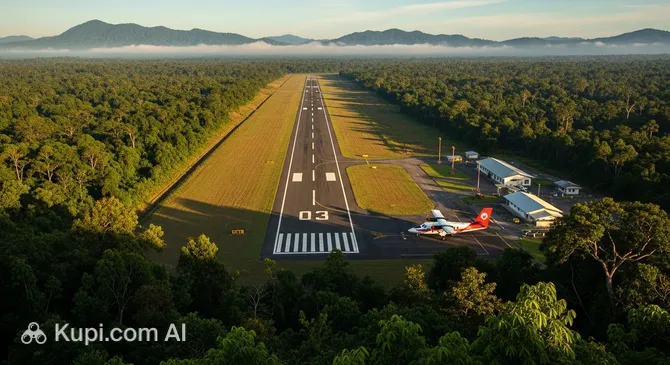
Long Seridan Airport. Source: Kupi.com Binoculars
IATA Code ODN
ICAO Code WBGI
City Long Seridan
Distance to centre less than 1 km
Status Domestic
Annual passenger flow approx. 9,000 people
Popular Airlines MASwings

The main feature of Long Seridan Airport is its status as a STOLport (Short Take-Off and Landing airport). This means it is capable of handling only small turboprop aircraft, such as the DHC-6 Twin Otter, which are ideally suited for flights into difficult-to-access mountainous regions. Flights are operated under the Rural Air Services programme and are subject to weather conditions, adding an element of unpredictability to the journey.

This small airfield plays a key social role, providing a link for local ethnic groups, primarily the Penan and Kelabit people, with the rest of the world. For tourists, however, it is the main gateway for trekking into the Pulong Tau National Park and exploring the Ulu Baram region, known for its pristine nature. There are no familiar duty-free shops or business lounges here; instead, you will find the atmosphere of a small airfield where the adventure begins right at the aircraft steps.

Contact Information

  • Official website: A small airport like Long Seridan (ODN) typically does not have its own website. Up-to-date information on airport status can be found on the portal of the operator, Malaysia Airports Holdings Berhad (MAHB), which manages the air harbours of Malaysia.
  • Inquiry desk phone: A direct telephone number for the airport is not published. To obtain information about flight schedules and other queries, it is recommended to contact the airline operating the route to Long Seridan directly, for example, MASwings.
  • Airport address: Long Seridan Airport (ODN), 98050 Long Seridan, Sarawak, Malaysia.
  • Email: There is no separate email address for the airport. For official enquiries, the general contact details of Malaysia Airports Holdings Berhad should be used.
  • Social media: The airport does not maintain official pages on social networks.
  • Lost luggage information: For all issues related to lost or damaged luggage, you must contact the Lost and Found service of your airline directly.
  • Passenger support contacts: Passenger support regarding booking, ticket changes, and special services is provided by the air carrier operating the flight.

How to Get to the Airport

Getting to Long Seridan Airport is an adventure in itself, as it serves the remote village of the same name in the very heart of the Borneo jungle in Malaysia. It is important to understand that familiar urban modes of transport are practically non-existent here, and planning is the key to a successful trip to Long Seridan.

Public transport (buses, trains): There is no regular public transport in Long Seridan, such as buses, trains, or a metro. The airport consists of a small airstrip located in immediate proximity to the village. The distance to the main longhouses where tourists stay can be easily covered on foot in 5-15 minutes. This is the most common way to get from the aircraft to your accommodation.

Taxi and transfer: There are no official taxi services in this region. A transfer from the airport is usually organised in advance through your tour operator or accommodation hosts. Most often, this involves a journey in a four-wheel drive vehicle (4x4) if your accommodation is at some distance, or meeting a local guide who will escort you on foot. It is crucial to arrange the meeting and transfer before your arrival, as finding transport on the spot may be impossible.

Car rental and parking: It is not possible to rent a car directly in Long Seridan. The roads leading to the village are complex logging tracks, and driving from the nearest major cities, such as Miri, requires special vehicles and experience. Regarding parking, there is an informal area at the airport where locals leave their cars and motorcycles. There is no organised paid parking here.

Recommendations and features:

Since air travel is the primary method of reaching this corner of Sarawak, logistics on the ground are minimal. Your main advisor and helper is your host. Be sure to contact them to clarify all details of your arrival. Given the remoteness, this area is served by a network of small airports, such as Mulu Airport or Bario Airport, highlighting the region's dependence on light aviation. A journey here is an immersion into unique culture and nature, where modern amenities give way to an authentic experience.

Terminals and Map

Long Seridan Airport (ODN) is a small regional airfield, typical of remote districts in Malaysia. Its structure is extremely simple and intuitive, making navigation very easy even for first-time visitors.

The airport operates one small terminal which handles all flights — both arrivals and departures. Due to its compact size, there is no complex map or confusing corridors. The departure and arrival zones are effectively located in one shared space. Immediately upon entering the building, you will see the check-in counter, and nearby is a small waiting area for passengers departing from Long Seridan.

Check-in and security procedures at ODN airport are significantly faster than at major aviation hubs. Thanks to the low passenger flow, there are virtually no queues here. The entire process from entering the terminal to boarding the aircraft rarely takes more than 20-30 minutes. Nevertheless, it is recommended to arrive at the airport approximately one hour before departure to complete all formalities without haste.

Since there is only one terminal, the question of transfers between terminals is irrelevant. Navigation is reduced to moving within a single hall. The main advice for travellers: do not worry about getting lost. The entire airport infrastructure is within sight, ensuring the simplest and most comfortable start to your journey.

Airport History

The history of Long Seridan Airport (ODN) is not a tale of giant terminals and world records, but a story of a vital air harbour in the very heart of the Sarawak jungle in Malaysia. For the isolated settlement of Long Seridan, this small Short Take-Off and Landing (STOL) airfield has been and remains a true bridge connecting it to the rest of the world.

The airport was established in the second half of the 20th century as part of the rural development programme in Sarawak. From the very beginning, its main task was not to serve mass tourism, but to meet the basic needs of local residents. For decades, it has served to deliver mail, food, medicines and, most importantly, for emergency medical evacuation and transport connections with larger cities such as Miri and Marudi.

During its existence, the airport has not undergone the massive reconstructions typical of large hubs. Its development consisted of gradual modernisation: the dirt runway was eventually asphalted to improve flight safety in all weather conditions, and a small but functional passenger terminal was built. These improvements were aimed at maintaining the reliability and stability of air connections, on which life in Long Seridan directly depends.

The main achievement and most interesting fact in the airport's history is its indispensable role in the daily life of the community. There are no records for passenger traffic here, but there is a record for significance to every resident. The arrival and departure of a small turboprop aircraft is often the main event of the day, eagerly awaited by everyone from children to the elderly. This air harbour is a vivid example of how aviation can serve not only global tourism but also be a lifeline for small and remote settlements.

Services and Facilities

Long Seridan Airport (ODN) is a small airfield serving remote settlements in the state of Sarawak, Malaysia. It is important to understand that this is a very small airport with a minimal set of amenities, designed to service small propeller aircraft. Its infrastructure differs significantly from major international airports.

There are no restaurants, cafes, or shops within the terminal. Passengers are advised to carry a supply of water and food, especially if a wait for the flight is expected. Public Wi-Fi and mobile device charging stations are also not provided, so it is worth ensuring your gadgets are charged in advance and considering the use of mobile data.

At Long Seridan Airport, you will not find bank branches, ATMs, or currency exchange points. All financial matters, including currency exchange, must be settled in advance in larger cities. There is no specialised medical point; however, in an emergency, airport staff will be able to provide first aid.

Passengers with children and travellers with reduced mobility must contact their airline in advance to organise any required assistance during boarding and disembarking. Specialised services, such as mother and child rooms or separate lounges, are not available here.

VIP lounges, business centres, and conference rooms are absent at the airport. There are also no hotels on the airfield territory. Accommodation options, typically in the form of homestays, can be found in the Long Seridan settlement located nearby.

Where to Eat

When planning a trip through Long Seridan Airport (ODN), it is important to consider that this is a very small regional airport (STOLport) in Malaysia, serving remote districts of Sarawak. Its infrastructure is minimal and not comparable to large city or international airports, which directly affects available services, including dining.

There are no restaurants, cafes, or specialised food courts on the premises of Long Seridan Airport. You will not find a division into landside and airside zones with various establishments here. The entire infrastructure consists of a small terminal designed for the rapid servicing of passengers on short flights.

The only option one might count on is a small local kiosk or stall where basic packaged snacks, such as crisps, biscuits, and bottled drinks (water, soft drinks), may be sold. The assortment will be extremely limited, and the presence of even such a kiosk is not always guaranteed. Options for vegetarians, vegans, or people with food allergies are absent here.

Passengers departing from Long Seridan are strongly advised to eat beforehand prior to arriving at the airport. The best solution is to bring your own snacks and water. This is especially important if you have specific dietary needs. Unfortunately, one should not count on a full lunch or even a quick hot snack at this airport.

Travel Tips

Travelling through Long Seridan Airport, located in the very heart of Borneo in Malaysia, is a unique experience distinct from the hustle and bustle of major international hubs. To ensure your trip goes smoothly, make use of these tips.

Arrival time and check-in. Long Seridan Airport is a small airstrip (STOLport) serving mainly local flights. It is recommended to arrive 1–1.5 hours before departure. This time is usually sufficient for check-in at the counter and passing security control, which is significantly faster here than in large airports. Bear in mind that online check-in for flights from such small airports may not be available.

Seat selection and hand luggage. Flights to this region are often operated on small propeller aircraft. To enjoy the breathtaking views of the Borneo jungle, try to secure a window seat. Hand luggage rules are standard: liquids in containers up to 100 ml packed in a transparent bag, and no sharp objects. The weight and dimensions of hand luggage are strictly controlled due to limited space on board.

Transfers and customs. Long Seridan is not a transit hub. If you have a connecting flight planned, it will likely be at a larger airport (for example, in Miri). You will need to collect your luggage yourself and check in again for the next flight. Since the airport serves domestic flights, there is no customs control. Document check procedures are minimal and take little time.

Savings and useful advice.

  • Book in advance: The number of flights and seats is limited, so purchasing tickets several weeks or months ahead will help save money.
  • Travel light: Strict luggage weight restrictions apply on small aircraft, and excess baggage fees can be substantial.
  • Stock up on essentials: Infrastructure at the airport is minimal. Bring water, light snacks, a book, and a fully charged power bank.

In case of flight delay. Delays, often related to weather conditions, are not uncommon for flights in the jungle. In the event of a schedule change, contact the airline representative at the check-in counter. Be prepared for the fact that a small terminal may not have cafes or shops, so personal supplies will be very useful. Stay calm and enjoy the opportunity to observe life in a remote corner of our planet.

Reached the end of the page?

That means the route is fully explored