Support

Mulu Airport

About the Airport

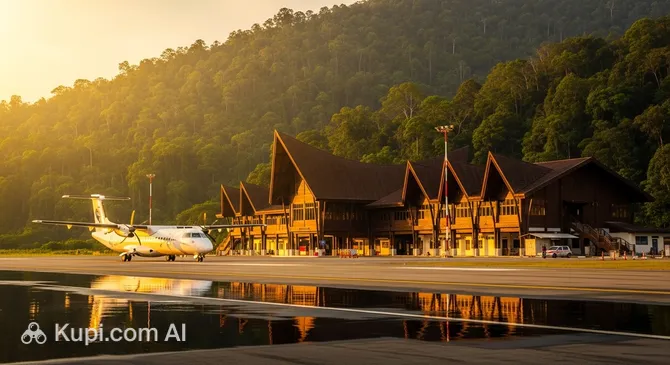
Mulu Airport. Source: Kupi.com Binoculars

Mulu Airport is not merely a transit point, but a true gateway to the lost world of the Borneo jungles. Located in the heart of the state of Sarawak, it serves as the only convenient link to civilisation for travellers seeking to witness the majestic caves of Gunung Mulu National Park. Landing here is the beginning of the adventure itself: the aircraft descends right over the dense canopy of the tropical rainforest, revealing breathtaking views of karst peaks and winding rivers. Despite its modest size, this airport possesses a special charm and fits perfectly into the surrounding natural landscape.

IATA Code MZV
ICAO Code WBMU
City Mulu (Sarawak)
Distance to Centre 1.5 km (to Park Headquarters)
Status Domestic (Regional)
Annual Passengers Approx. 72,000 (2023 data)
Schedule Check airline website

Airport Features and Highlights

Mulu Airport is unique in its atmosphere and location. Unlike bustling international hubs, tranquillity reigns here, and time flows to the rhythm of the jungle. The main advantage for tourists is its walking distance: the airport is located just one and a half kilometres from the entrance to the national park and major hotels, allowing many travellers to reach their accommodation on foot while enjoying the first sounds of the tropical rainforest.

Another feature is the scenic approach for landing. Flights here are operated by small turboprop aircraft (usually ATR-72), which fly quite low. This gives passengers a rare opportunity to view the boundless "green sea" of jungles and limestone cliffs from a bird's-eye view, often described as a complimentary aerial tour.

Thanks to the compactness of the terminal, all procedures here are completed as quickly as possible. Usually, no more than 15 minutes pass from the moment of disembarking the plane to collecting luggage. The absence of long queues and complex navigation makes the start and end of your journey through the national park easy and pleasant.

Contact Information

To obtain current information regarding flights, services, and regulations at Mulu Airport (MZV), please use the following contact details. Please note that the airport is managed by Malaysia Airports Holdings Berhad (MAHB), so many contact points are general for the entire Malaysia Airports network.

  • Official Website: www.malaysiaairports.com.my
  • Information Desk Phone: +60 3 8776 2000 (General Malaysia Airports line)
  • Airport Address: Lapangan Terbang Mulu, 98008 Mulu, Sarawak, Malaysia
  • Email: care@malaysiaairports.com.my (General Malaysia Airports support)
  • Social Media: Official accounts of the operator Malaysia Airports on major social networks.
  • Lost Luggage Information: For issues related to lost or damaged luggage, you should primarily contact your airline's representative directly.
  • Passenger Support Contacts: For assistance, you may use the general phone number and email address of Malaysia Airports.

How to Get to the Airport

Getting to your hotel or the national park from Mulu Airport (MZV) is quite simple, but one must consider the unique location of this place. Mulu is not a city in the traditional sense, but rather a small settlement in the heart of the jungles of Malaysia, so there are no standard urban transport systems here.

Hotel Transfer. The most common and convenient method is a pre-arranged transfer from your hotel or lodge. Most accommodation providers in Mulu offer guest pick-up at the airport. Usually, this is a minibus or an off-road vehicle. The journey takes only 5–10 minutes, as the airport is in the immediate vicinity of the national park and main hotels. The cost of the transfer is often included in the accommodation package or charged as a small fixed fee per person. Be sure to clarify this point and book your transfer when booking your accommodation.

Taxis and Private Carriers. At Mulu Airport, you will likely find several private shared vans offering taxi services. This is a good option if you have not arranged a transfer in advance. The cost of a trip to the park or nearby hotels is generally fixed and inexpensive. However, the number of such vehicles is limited, so it is more reliable to arrange a meeting with a representative from your lodge.

Public Transport and Car Rental. There is no public transport in Mulu, such as city buses, trains, or a metro. Car rental is also not a practical option, as the road network here is virtually non-existent, and all major attractions of the national park are explored on foot or by boat. For this same reason, long-term parking services at the airport are not relevant for tourists.

Terminals and Map

Mulu Airport (MZV) is a small regional airport serving as the main gateway to the famous Gunung Mulu National Park in Malaysia. Given its compact size and primary purpose—serving tourists—its structure is extremely simple and intuitive.

The airport consists of just one small terminal that handles both arriving and departing flights. It is a single-storey building where it is impossible to get lost. Since there is only one terminal, the question of transfers between them is irrelevant—everything is within a few minutes' walk. The airport layout is maximally simple: upon entering the building, you immediately find yourself in a general area with several check-in counters.

Departure and Arrival Zones are located in the same building but are functionally separated. After check-in, passengers pass through a single security screening point and enter a small departure lounge with a boarding gate. The arrival zone consists of a small hall with a baggage claim belt and an exit to the city, where passengers are usually met by representatives of hotels and tour companies.

Due to the modest size of the airport and the small number of flights, all procedures are completed very quickly. Flight check-in and security screening rarely take more than 20-30 minutes. Nevertheless, it is recommended to arrive at the airport approximately 1.5 hours before departure to check in luggage without haste and await boarding. Navigating the terminal will not cause any difficulties—all signs are clearly visible, and staff are always ready to assist.

Airport History

The history of Mulu Airport (MZV) is inextricably linked with the development of the eponymous national park, a UNESCO World Heritage Site. Before the advent of air travel, reaching this corner of Malaysia lost in the jungle was a true adventure, involving several days of travel by river. To make the unique caves and tropical forests accessible to tourists and scientists, a simple airstrip for small Short Take-Off and Landing (STOL) aircraft was built in the late 1970s.

A key stage in the airport's development was the construction of a new, modern terminal and runway, which were officially opened in 2003. This modernisation was a real breakthrough. The old strip could only accommodate small 19-seater planes, while the new infrastructure allowed for larger turboprop liners, such as the ATR 72. This significantly increased passenger traffic and made the journey to Mulu much more comfortable and faster.

The main achievement of the airport is its role in transforming Gunung Mulu National Park into one of the world's leading ecotourism destinations. Its opening to larger aircraft contributed to a sharp increase in visitor numbers, which in turn stimulated the development of local infrastructure—hotels, lodges, and tourism services. The airport has become a vital artery, supporting not only the tourism industry but also providing connectivity for local communities.

One of the most interesting facts about Mulu Airport is its unique location. It sits literally on the doorstep of an ancient rainforest. Passengers arriving here are immediately immersed in the atmosphere of wild nature: the runway is surrounded by lush greenery, and the view from the window reveals breathtaking vistas of karst peaks and endless jungles. For many travellers, landing in Mulu becomes the first unforgettable impression of discovering the wonders of Borneo.

Services and Facilities

Mulu Airport (MZV) is a small and compact air hub serving as the gateway to the famous Gunung Mulu National Park in Malaysia. Its infrastructure is designed to provide basic comfort to travellers arriving to explore nature, so the range of services here corresponds to its size and purpose.

Restaurants, Cafés, and Shops. At the airport, you will find a small café where you can have a snack and refreshing drinks while waiting for your flight. There are also several souvenir stalls offering products by local artisans and memorable gifts related to the national park. The choice of establishments is limited, so do not expect full-service restaurants.

Waiting Lounges and Amenities. A general waiting hall is available to passengers. There are no specialised VIP lounges or business lounges at Mulu Airport. Wi-Fi access may be limited or provided on a paid basis, and the number of power outlets for charging devices is small. It is recommended to carry a portable power bank.

Financial and Medical Services. It is important to remember that there are no banks, ATMs, or currency exchange counters at the airport. It is strongly recommended to ensure you have sufficient cash in advance by exchanging currency in larger cities such as Miri or Kota Kinabalu. Medical assistance is limited to first aid provision.

Services for Passengers with Special Needs and Children. The airport is equipped to receive passengers with reduced mobility, and staff are ready to provide necessary assistance. Basic amenities, such as a baby changing room, may be available for travellers with small children.

Hotels and Business Services. There are no hotels within the airport grounds, however, plenty of accommodation options—from budget lodges to comfortable resorts—are located just a few minutes' drive away, near the entrance to the national park. Conference rooms or business centres are absent at the airport.

Where to Eat

Mulu Airport (MZV) serves as a small aerial gateway to the eponymous national park in Malaysia, so the choice of dining establishments here corresponds to its compact size. Do not expect a wide variety of restaurants as found in international hubs. However, there is everything necessary to grab a bite before departure or after arrival. All food outlets are located in the single terminal, in the public area before security control.

The main place for a snack is a small café-canteen located in the main hall of the airport. Here, travellers can order simple but filling local dishes. Particularly popular are Nasi Goreng (fried rice) and Mee Goreng (fried noodles). This is an excellent opportunity to taste authentic Malaysian food. In addition to hot dishes, the menu includes sandwiches, local cakes known as "kuih", as well as hot and cold beverages.

Regarding special dietary needs, it is important to consider the specifics of the airport. Most dishes are likely to be Halal, which is the standard for Malaysia. Vegetarians may be offered rice with vegetables, but the choice will be limited. For vegans and travellers with gluten intolerance, finding suitable options is practically impossible. If you have strict dietary restrictions, it is strongly recommended to bring food with you.

Prices at the Mulu Airport café can be described as moderate, although slightly higher than outside. The operating hours of the establishments are fully tied to the flight schedule—they open before the first departure and close after the last plane leaves. Local pastries or a drink are ideal for a quick snack, while a hot dish is suitable for a more substantial meal. Remember that all cafés are located "landside", so you must have lunch or dinner before passing through security screening.

Travel Tips

Mulu Airport (MZV) is the gateway to the amazing world of Gunung Mulu National Park. Despite its modest size, knowing a few nuances will make your journey through it more comfortable and predictable. Here are some useful tips for travellers.

Arrival Time and Check-in. For domestic flights from Mulu Airport, it is recommended to arrive 1.5-2 hours before departure. This time is quite sufficient to check in for the flight, drop off luggage, and pass through security screening without haste. Processes here move quite quickly, as the airport is small and handles a limited number of flights.

Seat Selection and Hand Luggage. If possible, be sure to choose a window seat. Flights to this part of Malaysia reveal stunning views of the tropical forests and mountains of Borneo—it is a true aerial safari! In your hand luggage, besides the standard set (liquids under 100 ml, no sharp objects), do not forget to pack a power bank and all valuables. Remember that due to the small size of the aircraft (often turboprop ATRs), stricter weight limits for hand luggage may apply—it is best to check these with your airline.

For Passengers with Connections. If you have a connecting flight planned in another city, for example, in Miri, Kota Kinabalu, or Kuching, allow at least 3-4 hours for the transfer. Weather in the jungle can be unpredictable, and flights from Mulu may be delayed or rescheduled. Having extra time in reserve will save your nerves.

Immigration Control. Mulu Airport serves only domestic flights, so there is no international customs control here. However, the state of Sarawak has special immigration autonomy, so even when flying from other parts of Malaysia, you will need to pass a quick passport control by presenting your passport.

Savings and Hacks. Prices for food and souvenirs at the airport may be higher than in the town. If you wish to save money, bring a small snack and an empty water bottle, which can be refilled after the security zone. Book flight tickets in advance, as the number of flights is limited, and prices rise as the departure date approaches.

Flight Delays. Flight delays due to weather are a fairly common occurrence in Mulu. Remain calm and stay in touch with the airline representative. The airport has a waiting area with basic amenities. To pass the time while waiting, bring a book or download movies to your device in advance. Having good travel insurance that covers such instances will also be a major plus.

Reached the end of the page?

That means the route is fully explored