Support

City Gate

About

The City Gate is the main and most ceremonial entrance to Malta's capital, the fortress city of Valletta. Passing through it, you literally step from modernity into living history, beginning your journey through one of the world's most concentrated historic areas, protected by UNESCO. The gate serves not only as a symbolic entrance but also as an important part of urban life, connecting the historic center with the rest of the island.

The modern look of the gate is its fifth version, created between 2011 and 2014 based on the project of the famous Italian architect Renzo Piano. The first gate on this site was erected back in the 16th century, and it has been rebuilt many times since then. The current design represents a bold architectural breakthrough that, despite controversies, has become the city's new hallmark, symbolizing a dialogue between its rich past and dynamic present.
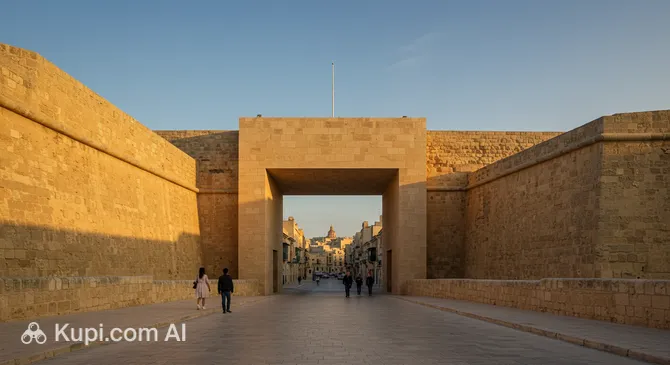
City Gate. Illustration.
Source: Kupi.com AI

Traveler photos:

Today, the City Gate is part of a large-scale reconstruction project that has transformed the entire entrance zone to the capital. The space around it has become a comfortable pedestrian zone with Freedom Square, the Parliament building, and an open-air theater. This is the starting point for exploring Valletta's main attractions: Republic Street starts here, leading to the heart of the city, its cathedrals, palaces, and gardens.

Contacts

The City Gate is a public architectural monument and the main entrance to the capital, so it has no specific contact details such as a phone number or email. It is open for passage 24/7 and serves as the starting point for most city tours. Reaching the gate is very easy, as it is located right by Valletta's main bus terminal, where routes arrive from all over the island.

How to contactContact
AddressRepublic St, Valletta, Malta

What to Do

Visiting the City Gate is not just a passage into the city, but an event in itself. First and foremost, it's an opportunity to appreciate a unique architectural ensemble where historical motifs harmoniously blend with modern design. After passing through the gate, you will immediately find yourself on the city's main artery — Republic Street. This is the perfect starting point for exploring Valletta: it's easy to begin a walking tour from here, as the main museums, palaces, shops, and cozy cafes are concentrated on this street.

Don't rush to dive into the city streets immediately. The space by the gate itself is a modern public area where you can rest after your journey, take impressive photos against the backdrop of the ancient fortifications, and enjoy views of the harbor. This plaza often becomes a stage for cultural events and open-air exhibitions, adding an element of pleasant surprise to your visit. Here, you can truly feel the vibrant rhythm of Malta's capital by watching the flow of tourists and locals merge.

Getting There

The City Gate is located in the very heart of Valletta, making it easily accessible for all visitors to the capital. If you are already exploring the historic part of the city, the best way to reach the gate is on foot. The narrow streets and ancient architecture create a wonderful atmosphere for a leisurely walk to the main entrance of the fortress city.

For those coming from other parts of Malta, the most convenient option is public transport. The island's well-developed bus network makes it easy to reach the capital from almost any resort or town. Most routes stop in the immediate vicinity of the gate, making it an ideal starting point for exploring Valletta.

If you are traveling by car, keep in mind that traffic restrictions apply in the city center, and finding a free parking spot can be challenging. It is recommended to leave your car in one of the parking lots located outside the historic center and walk to the City Gate. This walk won't take much time and will allow you to avoid parking difficulties.

Nearest city: Valletta

History & Facts

The history of the City Gate is inextricably linked with the founding of Valletta itself. The original gate, known as Porta San Giorgio, was erected in 1569 according to the design of the period's prominent architects — the Italian Francesco Laparelli and the Maltese Girolamo Cassar. Named after Saint George, it was built under the patronage of the city's founder, Grand Master Jean Parisot de la Valette. Initially, it was an austere, unadorned defensive structure, connected to the mainland by a wooden bridge across the ditch, which was later replaced by a stone one.

The gate not only protected the city but also changed its appearance along with it. As early as 1586, it was renamed Porta Reale ("Royal Gate"), and in 1633, it was significantly rebuilt by Tommaso Dingli, gaining a more grand and ceremonial look. An interesting fact: during the brief French occupation in 1798, it was renamed Porte Nationale ("National Gate"), but with the arrival of the British, its former name was restored. The gate was also unofficially called Porta di terra, meaning "land gate," as it was the only land entrance to the fortress city.

The modern appearance of the gate is its fifth version, resulting from a large-scale reconstruction between 2011 and 2014 under the direction of the world-renowned architect Renzo Piano. His project was a bold solution that caused much controversy but ultimately became a new symbol of the capital of Malta. Piano moved away from the idea of a traditional arch, creating a symbolic "breach" in the massive fortifications. This opening, framed by huge stone blocks and steel elements, symbolizes a dialogue between centuries-old history and modernity, opening the city to the future.

Time Needed

When planning a visit to the City Gate, keep in mind that the time spent exploring can vary significantly. For a quick look at the architectural ensemble and its immediate surroundings, 30 to 60 minutes is quite enough. During this time, you'll be able to appreciate the gate's modern design, take some striking photos against the monumental bastions and the nearby Triton Fountain, and see the new Parliament building.

However, the City Gate is primarily a starting point for exploring the entire capital of Malta. If you plan not just to see the entrance to the city but to walk along the famous Republic Street, browse the shops, and visit at least a couple of nearby attractions, you should set aside a few hours for such a walk. This will allow you to immerse yourself in the atmosphere of the historic center without rushing, enjoy its beauty, and discover the main treasures of Valletta.

Working Hours

You can visit the City Gate in Valletta at any time that is convenient for you. It is an open architectural structure that serves as the main entrance to the capital of Malta, so it is accessible 24 hours a day without any time restrictions. There are no ticket offices, and there is no need to buy tickets or book a visit in advance. You can freely pass through the gate both day and night, enjoying its monumental appearance in different lighting.

Since the gate is a public space rather than a museum, it is open to everyone year-round, regardless of the season. However, it's worth remembering that nearby sites, such as the Parliament building or museums, operate on their own schedules, which are best checked separately before your visit.

Open 24 hours

Nearby

Visiting the City Gate is just the beginning of your fascinating journey through Valletta. To truly feel the spirit of this amazing fortress city, it's worth taking the time to explore its immediate surroundings. Within walking distance of the main entrance to Malta's capital, you'll find iconic landmarks, charming gardens, and important historical sites that will help you gain a deeper understanding of the island's rich culture.

Exploring these places won't take much time, as Valletta is a very compact city where the most interesting sights are literally at your fingertips. A stroll around the City Gate area will allow you to form a complete impression of the capital and see how modern life harmoniously intertwines with a centuries-old heritage. Republic Street, the city's main thoroughfare and a guide to its key locations, starts right at the gate.

NameDistance
Sotto Pinsa Romana0.2 km
National Museum of Archaeology0.2 km
Saluting Battery0.3 km
Cafe Society0.3 km
Elephant Shoe0.3 km
Lascaris War Rooms0.3 km
St John's Co-Cathedral Museum0.4 km

Have you reached the end of the page?

So the route has been studied inside and out