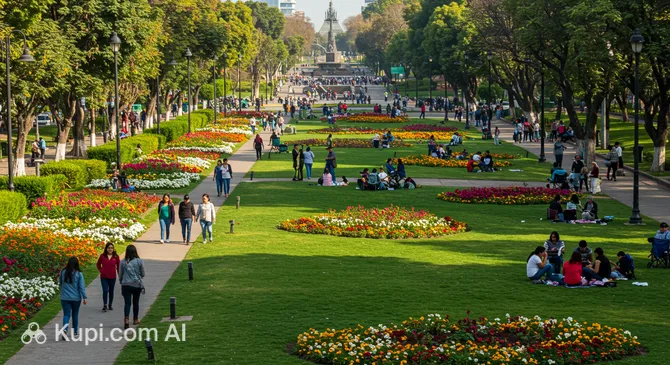
The history of Metropolitan Park in Guadalajara is a story of transforming disputed lands into one of the city's most beloved green spaces. The park was officially opened to visitors on February 14, 1997, marking a significant event in the life of the metropolis. This was preceded by a long process: legal expropriation procedures for the land began back in the 1980s but were delayed due to legal disputes. Ultimately, thanks to the persistence of the authorities and the citizens' desire for a large recreational area, the "green dream" became a reality, and today the park serves as the main "lungs" of Guadalajara.
An interesting fact is related to the park's name, which can cause confusion for tourists. The word "Metropolitano" in Mexico is often associated with the subway system. However, despite the similar name, the park is not directly related to the urban transport network. Furthermore, as already mentioned, the nearest metro stations are quite far away. This quirk highlights that the history of the park and the history of urban transport are two different, yet equally fascinating chapters in the city's life.
To provide further clarity, it is worth mentioning the history of the transport system, also referred to as "Metropolitan." The development of public transport in Guadalajara began as early as 1800 with mule-drawn trams. A significant step forward was taken in 1974 when entire streets were rebuilt to create a modern transport artery, and a tunnel for a trolleybus system was laid under Federalismo Avenue. The first line of the full-fledged subway (SITEUR) opened on September 1, 1989, and due to the city's growth, a second line was launched on July 1, 1994.
Thus, in Guadalajara, there are two iconic sites with similar names, each playing an important role. One—Metropolitan Park—serves as an oasis for relaxation and sports, while the other—the metro—is a key transport system ensuring the mobility of residents. Knowing this distinction will help travelers better navigate the city and appreciate the contribution of each of these "metropolitans" to urban life.