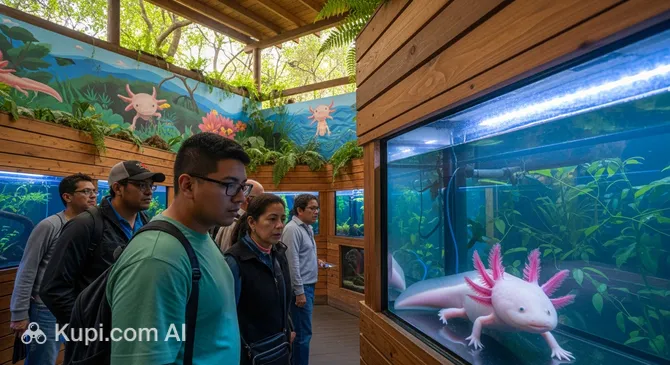
Have you ever wondered what it's like to meet a creature endowed by nature with the ability to stay forever young? In the heart of a metropolis like Mexico City, lies an amazing place — the Axolotl Museum (Museo del Axolote). This cozy and intimate space is entirely dedicated to the legendary Mexican salamander, a true symbol that Mexico has given to the world.
Axolotl Museum. Illustration.
Source: Kupi.com AI
Traveler photos:
This is not just an exhibition behind glass, but a full-fledged scientific and educational center. Here, the preservation of a rare species is intertwined with the deep study of biology and local culture. Visitors can not only see the live inhabitants of the Xochimilco canals but also learn why these creatures are so important to the region's ecosystem and how scientists are fighting for their survival.
The museum functions as a research institution where specialists breed axolotls in captivity, striving to maintain the genetic diversity of the population. Each individual here is a contribution to the future of the species, and the space itself serves as a bridge between science and society, inspiring guests to treat nature with care.
Contacts
To make your visit to the Axolotl Museum as convenient as possible, we recommend checking the contact information in advance. This small but important institution is always open to nature lovers and researchers.
Inside the museum, you'll find a meeting with the fascinating world of amphibians. In aquariums that mimic their natural habitat with aquatic plants and driftwood, you can observe the calm movements of axolotls of various ages and colors. Here, you'll find everything from rare dark wild-type individuals to the popular pink salamanders and golden-white albinos.
Of particular interest is the opportunity to peek into the work of a real scientific laboratory on the upper floor. There, you can see eggs and very young, almost transparent axolotls. This is a unique chance to observe the species conservation process in action, rather than just reading about it in textbooks.
The museum is perfect for families: interactive exhibits and engaging displays help children and adults better understand the biology of these creatures. Additionally, it’s a wonderful place for unusual photos, as seeing an axolotl this close in the wild is practically impossible.
Getting There
The museum is located in the Álvaro Obregón district in the southern part of the capital. The exact address is: Prol. 5 de Mayo 521, 2do Parque las Águilas. For the fastest and most comfortable trip from central areas of the city, it is best to use a taxi or Uber. For precise navigation, you can provide the driver with the coordinates: 19.3567086, -99.2196746.
If you plan to arrive by public transport, you can use the metro or bus lines heading towards the Las Águilas district. After getting off at the nearest stop, a short walk will be required to reach the museum entrance. Keep in mind that traffic in the capital can be heavy, so allow extra time for the journey.
Nearest city: Mexico City
History & Facts
The axolotl is not just an amphibian; it is a living symbol of the region's ancient history. These creatures live exclusively in the Xochimilco canals and have been part of local life for centuries. In pre-Hispanic times, the image of the axolotl adorned ancient codices, and the animal itself served as an important protein source for the residents of the chinampas — the floating islands of Mexico City.
A striking feature of the axolotl is neoteny: it remains an "eternally young" aquatic adolescent, retaining its gills and never transitioning into the adult terrestrial form of a salamander. This biological strategy developed due to the stable and cool aquatic environment of Xochimilco, where axolotls had no need to move onto land in search of food or safety.
Unfortunately, today this unique species is under serious threat of extinction. Rapid urbanization, the draining of wetlands, and the introduction of invasive fish species such as tilapia and carp are destroying their natural habitat. The museum plays a key role in preserving this national treasure, reminding us of the need to protect Mexico's biodiversity.
Time Needed
A full visit to the Axolotl Museum usually takes about 1 to 2 hours. The museum space is quite compact, allowing you to carefully observe all the inhabitants and study the information materials without spending the entire day.
If you plan to take a detailed look at the breeding laboratory's work or are visiting with children, who will likely want to spend more time watching these unusual creatures, it's worth allocating a bit more time. The museum's calm atmosphere is conducive to a thoughtful study of the biology of these rare amphibians.
Working Hours
The Axolotl Museum is open to visitors from Tuesday to Sunday. You can visit the exhibition from 09:00 to 16:00. Please note that Monday is an official day off — during this time, the center's staff focus exclusively on scientific research and caring for the inhabitants.
For a quieter and more detailed tour, it is recommended to plan your visit on weekdays or in the morning. Since operating hours may change on public holidays, it is advisable to check the latest information on the museum's official website before visiting.
Day
Working hours
Monday
Закрыто
Tuesday
09:00–16:00
Wednesday
09:00–16:00
Thursday
09:00–16:00
Friday
09:00–16:00
Saturday
09:00–16:00
Sunday
09:00–16:00
Nearby
A visit to the museum can be successfully combined with a stroll through other interesting spots in the southern and western parts of the city. Exploring the surroundings will allow you to dive deeper into the capital's atmosphere and find entertainment for all tastes, from extreme parks to educational farms.