Support

Amarapura

About

Amarapura is a true gem in the central part of the country, nestled comfortably on the banks of the majestic Irrawaddy River. This small town, located just a few kilometers south of Mandalay, attracts travelers with its amazing atmosphere of peace and harmony. For many, Myanmar reveals a new side here, where time seems to have slowed down, allowing you to savor the moment.

Despite its modest size and population of about 23,000 people, the town boasts a rich heritage. In the 18th and 19th centuries, it held the status of the capital of the Burmese kingdom. The ancient history of Amarapura can be felt in literally every corner: among the palace ruins, majestic monasteries, and ancient stupas, it is easy to imagine the lavish processions that once filled these streets. Today, the town has lost its capital luster but has gained a special magnetism, combining a traditional way of life with the spirit of bygone eras.
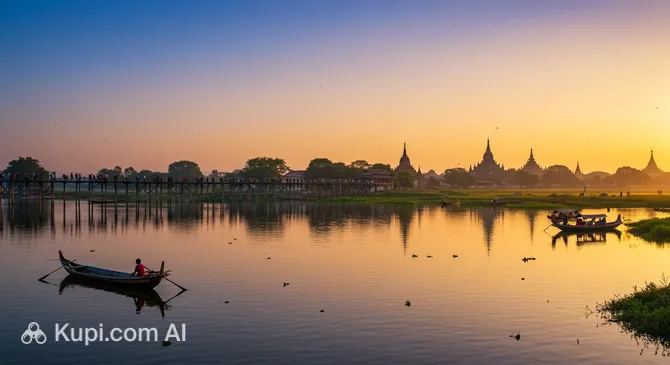
Amarapura. Illustration.
Source: Kupi.com AI

The main point of attraction for tourists is the legendary U Bein Bridge—the longest and oldest teak bridge in the world. This place is especially beautiful at sunset, when the soft sunlight paints the sky in golden hues, and the silhouettes of monks in saffron robes are reflected in the mirror-like surface of the water. Amarapura is famous for its photogenicity and the opportunity to observe the authentic life of local residents, whether it's fishing at dawn or leisurely strolls along the wooden planks of the bridge.

This town is perfect for those seeking inspiration and wishing to touch the living soul of the country. Amarapura gives a sense of serenity and leaves vivid images in the memory, making travelers return here again and again for its unique atmosphere of kindness and beauty.

Weather Overview

When planning a trip to this region, it's worth considering that the climate has pronounced seasonality. In general, the town is characterized by tropical weather: expect a hot spring with high temperatures and a humid rainy season in summer, which gives way to a dry and comfortable winter.

The most pleasant time to visit is considered to be the months from November to February. During this period, the average temperature fluctuates in a comfortable range from +21°C to +25°C, and nights can even be cool. January and February are the driest months of the year, when rain is practically non-existent, making it ideal for long walks around the sights.

With the arrival of March, the air begins to heat up rapidly. April is the hottest month: daytime temperatures often reach the +38°C mark. From May to October, the monsoon season lasts. If you are interested in detailed weather information for Amarapura before your trip, note that August and September are the rainiest months, when the number of days with precipitation can exceed 20 per month, although the air temperature remains high.

Average monthly temperature

Average monthly precipitation

Interesting Facts

Beyond its main attractions, Amarapura holds many fascinating secrets and traditions that make this town a truly unique place. Here are a few facts to help you better understand the spirit of the "City of Immortality":

  • A Telling Name. The city's name translates to "City of Immortality." Indeed, upon arriving here, travelers often note that time seems to have stood still: ancient customs, ritual dances, and the traditional way of life have been preserved almost in their original form, living up to the grand name.

  • The Bridge's Royal Past. The famous U Bein Bridge, the city's hallmark, has an unusual origin. It is the longest teak bridge in the world (over 1.2 km), and it was built using wooden beams taken from dismantled old royal palaces, which gives it special historical value.

  • A Center of Monastic Life. Amarapura is home to the Mahagandhayon Monastery—one of the most significant and largest in Myanmar. More than a thousand monks live and study here at any given time. Every day, tourists can witness an impressive ceremony where an endless line of monks stands in strict silence to receive their daily meal.

  • The Silk Capital. The town is famous for its silk-weaving traditions, which flourished here in the late 18th century when King Bodawpaya moved the capital here. Local masters still create exquisite fabrics by hand, and products from Amarapura are considered some of the best in the entire country.

How to Get There

Amarapura is located in close proximity to Mandalay, so the transport logistics are simple and convenient for travelers. Effectively, the town is part of a large metropolitan area, and getting here is easy. You can find out more details about how to get to Amarapura using various methods, but the primary gateway to the region is the international airport of the neighboring city.

The most optimal option is to fly into Mandalay International Airport (IATA: MDL). It is not in Amarapura itself but serves the city of Mandalay; however, it is located just 25 km from the center of Amarapura. It is a modern and large aviation hub receiving flights from various Asian countries. A taxi or transfer from the terminal to your hotel will take about 40–50 minutes, making this route the fastest and most comfortable.

If you are planning a complex journey around the country, you might consider flying into Nyaung-U Airport (IATA: NYU), which serves ancient Bagan. It is located in the town of Nyaung-U, about 141 km from Amarapura. This option is convenient for those wanting to combine a visit to the temples of Bagan and the ancient capitals of Mandalay. The journey by bus or car between the cities takes about 4 hours.

Also suitable for domestic flights is Heho Airport (IATA: HEH), located in the town of Heho, 150 km from Amarapura. This is the main air gateway to Inle Lake. From here, you will need to take a taxi or bus to Amarapura for about 4.5 hours, enjoying picturesque views along the way.

For convenience, here is a summary of the main airports:

AirportPassenger trafficDistance
Mandalay International Airport1.6 mln25 km
Nyaung U Airport450 000141 km
Heho Airport510 000149 km
Kalemyo Airport45 000250 km
Nay Pyi Taw Airport100 000253 km

As for rail connections, Amarapura itself does not have a major station geared toward tourist flows. Travelers usually use the railway station in neighboring Mandalay as their main hub. Arriving by train in Mandalay from Yangon or other regions, you can easily reach Amarapura by local transport: taxi, tuk-tuk, or pickup. The journey between the cities takes very little time, as they practically merge into one another.

Main Attractions

Despite its compact size, Amarapura offers travelers the chance to immerse themselves in the atmosphere of an ancient capital. It is home to unique architectural monuments and spiritual centers that allow for a better understanding of the culture and traditions of this amazing country.

The absolute symbol of the town is the U Bein Bridge. While it is often mentioned as the region's hallmark, it's worth noting that visiting this place is an adventure in itself. The 1.2-kilometer-long structure spans Lake Taungthaman. Experienced tourists recommend not just walking along the wooden planks but also renting a small boat. From the water, you get the best view of the hundreds of teak columns supporting the bridge, which is particularly impressive in the rays of the setting sun.

The spiritual heart of the town is the Mahagandhayon Monastery. This is not just a temple, but a massive educational center where thousands of monks study Buddhist scriptures. Visitors come here to witness the strict discipline and daily life of the novices. It is important to remember to maintain silence and respect: this is an active religious institution that plays a vital role in Myanmar.

Another significant attraction is the Pahtodawgyi Pagoda. Built in the early 19th century by King Bagyidaw, it stands out with its snow-white dome and majestic terraces. After climbing to the upper levels of the stupa, you can enjoy a panoramic view of the surroundings, including the Irrawaddy River and the neighboring temple spires. This place gives a sense of peace and allows for magnificent photos of the architecture of that era.

Near the bridge is the Kyauktawgyi Pagoda, built in 1847. It is famous not only for its large Buddha statue but also for the unique frescoes inside the temple. The wall paintings depict religious subjects, scenes from daily life, palaces, and astrological symbols, which is a rarity for religious buildings of that time and is of great interest to history and art lovers.

Local Cuisine

The culinary traditions of Amarapura are closely intertwined with its geographical location: its proximity to the Irrawaddy River and Lake Taungthaman defines the basis of the local menu. The main gastronomic treasure here is fresh fish. Travelers should definitely order fish fried in aromatic spices until golden brown or try the rich, spicy soups that are perfectly refreshing in the hot climate. Local salads are also popular, where the flavor of fresh vegetables is accented by the tanginess of lime and spicy herbs.

A true symbol of Myanmar cuisine, prepared with special love in Amarapura, is Mohinga. This thick fish soup with rice noodles is considered the ideal breakfast. Local cooks often add the crunchy core of a banana stem, lemongrass, and a generous portion of fresh herbs, giving the dish a unique aroma. You can try Mohinga in small roadside cafes as well as in morning markets, where life is in full swing from dawn.

Tea culture plays an important role in the daily life of the townspeople. Traditional tea houses are not just places for a snack but centers of social life where locals discuss the news. It is customary to order hot sweet tea with milk or classic green tea, which is often served for free with snacks of fried beans and sesame seeds. Those with a sweet tooth will enjoy desserts made from rice flour with coconut shavings and palm sugar, which are often sold right on the streets.

The town's gastronomic scene is affordable and authentic. There aren't many expensive restaurants, but street stalls and family-run open-air cafes abound. A stroll through the evening market will be a real adventure: the smells of fried snacks, fresh fruit, and sweet pastries create a unique atmosphere, allowing the tourist to feel the true taste of Amarapura.

Travel Tips

A trip to Amarapura is an immersion into the ancient history and deep spiritual culture of Myanmar. To make your journey to this amazing corner as comfortable and safe as possible, leaving only pleasant memories, we have prepared a list of useful recommendations based on the experience of seasoned travelers.

  1. Clothing and Footwear. The climate here is hot, so choose light clothing made of natural fabrics, but remember the strict dress code. Shoulders and knees must be covered when visiting any shrines. The most convenient footwear is flip-flops or sandals that are easy to take off and put on, as you will have to go barefoot very often when entering pagodas and monastery grounds.
  2. Transport. There is no public transport in the traditional sense in Amarapura. For getting around, it's most convenient to use taxis (the Grab app works great here if you're coming from Mandalay) or local tuk-tuks. Renting a car without a driver is difficult and unsafe for foreigners due to the specific traffic conditions, so the best option is to hire a car with a driver for the whole day.
  3. Finance. The official currency is the kyat. Bank cards are rarely accepted, mostly only in expensive hotels, so always have a supply of cash. If you are bringing dollars for exchange, the bills must be perfectly new: no folds, stamps, or wear, otherwise they may simply not be accepted or exchanged at a very low rate.
  4. Health and Safety. Amarapura is a quiet place, but basic precautions are necessary. Drink only bottled water and be cautious with ice in street drinks. Be sure to use sunscreen and repellents, especially during sunset walks near the water, to protect against mosquitoes.
  5. Communication and Language. English is understood by tourism industry workers, but with ordinary residents and monks, you often have to explain yourself with gestures. Learn the word "Mingalaba" (Hello)—this universal greeting endears you to the locals. It's best to buy a SIM card with internet immediately upon arrival at the airport, as Wi-Fi in cafes can be unstable.
  6. Local Etiquette. In Buddhist culture, the head is considered sacred, while the feet are the "unclean" part of the body. Never touch a local resident's head (even a child's) and be careful not to point your feet at people or Buddha statues when sitting. Women should not touch monks or hand them anything directly.
  7. What to Avoid. Refrain from public displays of affection—kissing and hugging are not customary here and may embarrass those around you. It is also strictly not recommended to visit restricted areas of monasteries without permission or to make noise during religious ceremonies, especially at the Mahagandhayon Monastery.
  8. A Unique Souvenir. Amarapura is historically famous for its weavers. Don't miss the chance to peek into local workshops where the rhythmic clatter of looms can be heard. Here you can buy authentic silk and cotton "longyis" (traditional skirts) of the highest quality directly from the masters, which will be the best reminder of your trip.

By following these simple tips, you can easily blend into the leisurely pace of life in Amarapura and avoid awkward situations. May your journey be filled with harmony, amazing discoveries, and warm encounters in this hospitable "City of Immortality."

Entertainment & Nightlife

The nightlife in Amarapura is drastically different from what tourists are used to in major Asian metropolises or beach resorts. Here, you won't find neon signs, noisy discos, or 24-hour clubs. Amarapura is a town that goes to sleep early, preserving its traditional way of life. Evening entertainment here is contemplative and gastronomic, perfectly suited for those who want to escape the hustle and bustle.

The center of attraction in the evening hours remains the Taungthaman Lake area. Life here is vibrant until about 8:00–9:00 PM. Immediately after sunset, when tourists leave U Bein Bridge, locals and remaining travelers move to the lakeside cafes. This is the best time and place to enjoy an open-air dinner. The atmosphere here is as relaxed as possible: plastic chairs, fresh river air, and delicious grilled fish.

If you're looking for an equivalent to bars, look out for the so-called "Beer Stations." This is a popular establishment format throughout Myanmar. They are simple open-air restaurants under awnings serving local draft beer and a variety of barbecue snacks. There is no dress code, prices are very affordable, and the crowd consists mainly of local men discussing the day's news. It’s a great way to immerse yourself in an authentic environment, though solo female travelers might feel slightly uncomfortable due to the increased attention.

For those craving a full-fledged nightlife with cocktails, music, and dancing, it's worth heading to neighboring Mandalay. Since the cities have virtually merged, a taxi ride takes only 20–30 minutes. In Mandalay (especially around the Royal Palace and 78th Street), you'll find modern rooftop bars and karaoke clubs (KTV) that stay open late into the night. This is where the local "golden youth" and expats gather.

Practical Tips and Safety:

  • Transport: After 8:00 PM, finding a tuk-tuk on the streets of Amarapura is difficult. If you plan a late dinner or a trip to Mandalay, be sure to arrange a pickup with a driver in advance or use a ride-hailing app.
  • Lighting: Street lighting in Amarapura is sparse, and sidewalks can be uneven. For night walks, be sure to carry a charged flashlight (or phone).
  • Safety: The area is considered safe, but because of the early bedtime, the streets empty quickly. Avoid walking alone in dark alleys due to the large number of stray dogs that gather in packs at night.

Speaking of entertainment in general, it's worth mentioning that daytime leisure in Amarapura is much richer than the nightlife. During daylight hours, besides the temples, it's worth visiting local weaving workshops. The town is famous for its silk, and watching masters work at ancient looms is a fascinating sight, comparable to visiting a living craft museum.

Parks & Museums

Amarapura is a fascinating town that is difficult to fit into the framework of a conventional travel guide with a clear division into parks and exhibition halls. There are no classic museum complexes with audio guides or fenced-off botanical gardens; however, the town itself is a massive open-air museum where nature harmoniously intertwines with ancient architecture and living traditions.

The main natural feature and a place for strolls is Lake Taungthaman. This is not just a body of water, but a center of social life and a picturesque recreation area. In the dry season, the lake's shores turn into green lawns where locals have picnics and farmers grow seasonal crops. A walk along the shore allows you to enjoy the silence and observe waterfowl. Special charm is added to the place by old trees whose roots are hidden under the water during the rainy season, creating a mystical landscape.

Although there is no official history museum in the town, its role is successfully fulfilled by the Kyauktawgyi Pagoda. This place is of great interest to art lovers due to its unique 19th-century frescoes. Unlike traditional religious paintings, the pictures here in the temple galleries depict secular scenes, palace life, Western ambassadors, and astrological charts. A visit to the pagoda replaces a trip to an art gallery, allowing you to see with your own eyes how people lived during the Konbaung dynasty era.

Another kind of "living museum" is the traditional silk weaving factories. Amarapura has held the status of a textile craft center for centuries. Visiting these workshops is an excursion into industrial history: there are no display cases with exhibits, but there are ancient wooden looms where masters manually create complex "acheik" patterns. Tourists can observe the entire process of creating fabric, from preparing the threads to the finished product, which provides much deeper immersion into the culture than dry descriptive stands.

Insider Tip: If you want to enjoy nature in solitude, rent a boat on Lake Taungthaman not at sunset, when there are hundreds of tourists, but early in the morning, right after dawn. At this time, the water is perfectly still, the air is fresh, and the mist rolling over the lake's surface creates incredibly atmospheric conditions for photography and meditation.

Getting Around

The public transport system in Amarapura differs significantly from the standard European or even capital-city Asian model. Here you won't find subways, trams, or large municipal buses with air conditioning and fixed schedules. City logistics are simple and chaotic, which adds a certain flavor to the trip but requires an understanding of local rules from the tourist.

The main form of "people's" transport is converted pickups, which locals call "line cars." Two benches for passengers are installed in the back, while the roof serves as additional space for cargo or the most daring travelers. These vehicles cruise along the main streets and connect Amarapura with the center of Mandalay. Stops here are informal: to get on, you just wave your hand to the driver, and to get off, you press a buzzer button on the ceiling or knock on the cab roof.

For more comfortable travel, tourists most often choose three-wheeled tuk-tuks (auto-rickshaws) or motorbike taxis. This is the most maneuverable and accessible way to get from one pagoda to another. Tuk-tuks are easy to find at the main attractions, for example, at the entrance to U Bein Bridge or near the Mahagandhayon Monastery. Drivers often offer their services to foreigners themselves upon seeing them on the street.

A special, "historical" type of transport is the sampan boats on Lake Taungthaman. Although they are used primarily as a tourist attraction for watching the sunset, locals sometimes use them to cross to the other side or transport goods. Horse-drawn carriages can also be found in tourist zones, but this is more of an amusement than a full-fledged means of transportation.

The payment system in Amarapura's public transport is exclusively cash. Transport cards, passes, or contactless payment through terminals do not work here. In pickups, money is handed to the driver or conductor (often a teenager hanging off the running board) at the end of the trip or upon boarding. The fare is fixed and very low for local routes.

When using tuk-tuks or motorbike taxis, the main rule applies: agree on the price in advance. There are no meters in such transport, and the cost of the trip depends on the distance and your ability to haggle. Always carry small bills with you, as drivers often don't have change for large banknotes.

A modern alternative to street haggling is the Grab app (similar to Uber). It works excellently in the Mandalay region and covers Amarapura. Calling a taxi or motorbike through the app eliminates the language barrier and guarantees a fixed price. This is the safest and recommended option for tourists, especially in the evening when street transport thins out.

If you prefer independence, you can rent a motorbike or bicycle, but it's better to do this in neighboring Mandalay, as there are virtually no rental agencies in Amarapura itself. Keep in mind that traffic can be chaotic, and roads are poorly lit after dark, so inexperienced drivers are better off using taxi services.

Accommodation

Choosing accommodation in Amarapura has its own peculiarities, shaped by the town's geography and history. Since Amarapura is effectively a suburb of Mandalay, it lacks the vast variety of hotels typical of major tourist centers. The typical range of accommodation consists of small, cozy guesthouses and mid-range hotels. You won't find luxury five-star resorts of global chains directly within the town limits; for premium service and a wide choice of amenities, travelers usually head to neighboring Mandalay, which is less than half an hour away.

Nevertheless, staying in Amarapura itself offers an undeniable advantage—a unique atmosphere. The most attractive area to stay is the vicinity of Taungthaman Lake. Hotels located within walking distance of the lake allow tourists to see the famous U Bein Bridge at dawn before the crowds of tour groups arrive, and to enjoy the silence of a provincial morning. This is an ideal choice for photographers and those who appreciate a quiet getaway.

The pricing policy in the town is very affordable. The cost of living varies from budget to mid-range. A night in a tidy guesthouse with basic amenities is inexpensive, attracting backpackers and independent travelers. In most places, guests are offered a clean room, air conditioning, and breakfast, but you shouldn't count on a swimming pool or spa center within Amarapura's hotels themselves.

Booking Tip: Due to the small number of accommodation options in Amarapura itself, rooms sell out very quickly, especially during the high season (November to February). If your goal is to stay within walking distance of U Bein Bridge, it is strongly recommended to book your accommodation in advance, 1–2 months before the trip. It's best to use major international online platforms for your search; however, be prepared for the fact that small family guesthouses may only take bookings by phone or through social networks, and payment on-site is often requested in cash kyats.

Nearby Cities

For those who want to explore the surrounding area, Amarapura serves as an excellent starting point for day trips to several interesting nearby locations:

Mandalay. Since Amarapura is effectively a suburb of this metropolis, a trip there is the most obvious choice. This is the cultural heart of the country, where the Royal Palace and many famous pagodas are preserved. It's worth climbing Mandalay Hill to see the city panorama and visiting the Kuthodaw Pagoda, which houses the "world's largest book" made of marble slabs.

Monywa. This city is located to the west and is perfect for a full-day trip. It is famous for its unusual temples, particularly the Thanboddhay Pagoda, whose interior is decorated with more than 500,000 images of Buddha. Also nearby is the Bodhi Tataung complex with giant statues of standing and reclining Buddhas that can be seen from afar.

Kyaukse. A quiet town south of Amarapura that will be of interest to those who love off-the-beaten-path routes. It is known for its annual dancing elephant festival (usually held in October) and a picturesque hilltop pagoda offering views of the green plains and rivers.

CityPopulationDistance
Mandalay1 319 4527 km
Sagaing69 9179 km
Myaydo72 00010 km
Kyaukse741 07134 km
Natogyi250 00067 km

These nearby destinations provide an insight into the region's diverse culture and landscapes.

Shopping & Souvenirs

Shopping in Amarapura is a fascinating immersion into the world of traditional crafts rather than a typical trip to brand boutiques. The town cannot boast modern shopping galleries, but it is famous throughout Myanmar as a center of textile art. The main goal for buyers here is unique handmade items created by local craftsmen using techniques unchanged for centuries. A visit to shopping outlets here is often combined with a tour: you can watch the process of creating the item you are about to buy.

The main trade is not concentrated on one specific street but is scattered throughout the town in the form of home workshops. Walking through residential neighborhoods, you will surely hear the rhythmic clatter of weaving looms. You can often enter such houses to buy fabrics directly from the producers without markups. In addition, a lively trade in souvenirs is conducted at the approaches to the main attractions, especially in the U Bein Bridge area and at the entrance to the Mahagandhayon Monastery, where numerous stalls with goods for tourists are set up.

There are no large shopping centers or malls in Amarapura itself. For shopping in the modern sense—with air conditioning, supermarkets, and electronics stores—you will have to go to neighboring Mandalay. The nearest large complexes, such as Diamond Plaza or Ocean Supercenter, are just a 20–30 minute taxi ride away. In Amarapura, small family shops and street stalls prevail.

As for markets, they are divided into two types here: for locals and for tourists. Morning food markets open at dawn and offer fresh fruits, vegetables, and local fast food; it is a colorful sight, but it's hard to buy anything durable there. Tourist interest is focused on the shopping rows along the shore of Lake Taungthaman. Here you can find a wide range of handicrafts, from clothing to jewelry, and this is where it is customary to haggle.

The main souvenir worth bringing back from Amarapura is, undoubtedly, silk. The town is famous for the complex "acheik" weaving technique (luntaya acheik), where more than a hundred shuttles are used to create a pattern. Luxurious silk longyis (traditional skirts), scarves, and fabric cuts are considered the best in the country. Also look out for cotton products, wooden marionettes, bronze figurines, and lacquerware, which this region is rich in.

Shops and workshops usually operate during daylight hours, roughly from 09:00 AM to 05:00 PM or until sunset. In souvenir shops near the bridge, trade may continue a bit longer. The main method of payment is cash kyats. Bank cards are accepted very rarely, only in the largest and most expensive factory shops, so always carry a supply of small bills.

The Tax Free system does not operate in Amarapura. Most purchases are made from private craftsmen or in markets where receipts for VAT refunds are not issued. Prices initially include all taxes, but the final cost often depends on your ability to haggle politely.

Reached the end of the page?

That means the route is fully explored