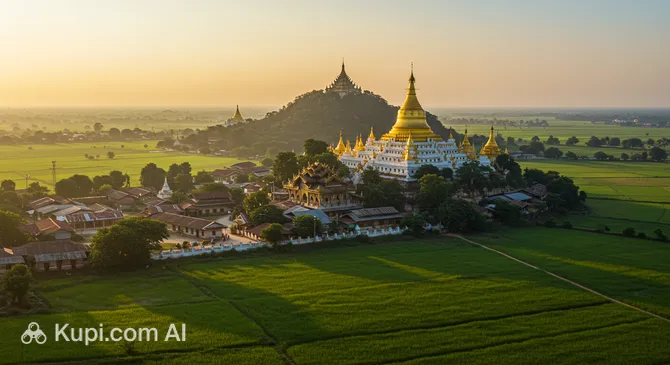
Kyaukse is a charming provincial center located in the heart of Myanmar, in the arid zone of the Mandalay Region. The city is nestled in the valley of the Zawgyi and Panlaung rivers, which historically made this region one of the cradles of Burmese civilization. Although the city's population is around 50,480 people, it retains an atmosphere of authentic life, untouched by mass tourism, where ancestral traditions harmoniously intertwine with the bustle of everyday life.
Kyaukse. Illustration.
Source: Kupi.com AI
For the traveler, Kyaukse reveals itself as a quiet corner with a steady rhythm. Its historical heritage is closely linked to the development of agriculture and the construction of ancient pagodas, which today remain the main landmarks of the city skyline. There is no chaotic development of megacities here, and the central districts are filled with the aromas of local cuisine and the noise of traditional markets.
Among the city's features, its status as an educational center is worth highlighting—the presence of its own university gives Kyaukse a special energy. Visitors are drawn to unique Buddhist shrines, such as the Jade Pagoda, and the sincere hospitality of the local residents. If you are looking for an authentic atmosphere of central Myanmar and want to see the country's life without embellishment, this city will be a wonderful discovery on your itinerary.
Weather Overview
The climate in Kyaukse is typical of the central regions of Myanmar and is characterized as tropical monsoon. The city is located in the so-called "dry zone," which means less rainfall compared to coastal areas, but also more pronounced heat. There are three main seasons: hot (March to May), rainy (June to October), and cool dry (November to February).
The most comfortable time for a visit is considered to be the period from November to February, when the average air temperature stays around 21–25°C. At this time, the weather in the city is ideal for long walks. Conversely, in April, the air can heat up to an extreme 38–40°C, which, combined with the dust of the dry season, requires tourists to be particularly cautious and stay hydrated.
During the monsoon period, especially in August and September, rains become frequent and heavy, bringing long-awaited coolness and reviving the greenery in the valley. If you want more detailed data, study the current city climate before your trip. Overall, Kyaukse is welcoming year-round if you choose the right gear and time to visit the sights.
Average monthly temperature
Average monthly precipitation
Interesting Facts
This small city in the central part of the country hides many wonders for the discerning traveler.
Cradle of civilization: The valley where Kyaukse is located is considered one of Myanmar's oldest agricultural regions; it was here that the economic foundations of ancient Burmese states were laid.
University town: Despite its provincial status, the city is an important educational hub thanks to the presence of Kyaukse University.
River system: The city's geography is unique in that it is intersected by two significant rivers—the Zawgyi and the Panlaung—which have nourished local rice fields for centuries.
Jade wonder: In the surrounding area is one of the world's few pagodas completely clad in jade, highlighting the region's wealth of this stone.
Exact coordinates: Geographically, the city is located in Myanmar's so-called "dry zone," at approximately 21°36' north latitude.
How to Get There
Getting to the city of Kyaukse is easy if you are already in the central part of Myanmar. The city is located in close proximity to the region's largest transport hub, Mandalay, just 25–30 kilometers south of it. For tourists, this makes the city an ideal destination for a day trip or a convenient stop when traveling deeper into the country.
The city does not have its own airport, so the main flow of travelers arrives via Mandalay International Airport. This is a modern hub serving both domestic and some international flights. From there, Kyaukse can be reached by taxi or rented car in about an hour, depending on traffic.
Railway connections also link Kyaukse with the country's key cities. The local station receives trains traveling along the main line, allowing for budget-friendly and colorful travel between regions. Although train travel times in Myanmar can be unpredictable, it is a great way to see the picturesque rural landscapes of the valley.
Station
Passenger traffic
Distance
Mandalay Central Railway Station
6
41 km
Naypyitaw Central Railway Station
3
195 km
The most popular and fastest way to get around remains buses and shared pickup trucks, which run from Mandalay almost every half hour. Details about routes and schedules can always be checked on the page about how to get to this region. Remember that during peak hours, traffic in the valley can be quite heavy.
Main Attractions
Although Kyaukse is not a major tourist hub, the city hides several authentic architectural and cultural gems. One of the most impressive shrines is the Werawsana Jade Pagoda. It stands out from others due to its unique cladding of natural jade, making it a rare and extremely valuable site for the Buddhist world. The shimmer of the stone under the tropical sun creates a truly mystical atmosphere.
Also deserving of attention are the Lay Myat Nar and Maha Shwe Thein Taw pagodas. These spiritual centers are a point of attraction for local residents and allow tourists to touch the living traditions of Burmese Buddhism. Unlike the overcrowded temples of major cities, here you can enjoy the exquisite carvings and the calm majesty of ancient walls in silence.
For those interested in modern city life and engineering structures, it will be curious to take a look at the Zeedaw Dam. This is an important hydraulic structure in the valley of the Zawgyi and Panlaung rivers, which ensures the prosperity of local agriculture. Another point of attraction for locals is the local stadium and the university grounds, where you can observe the daily activity of Kyaukse's youth.
Local Cuisine
A gastronomic journey to Kyaukse is an introduction to the honest and hearty cuisine of central Myanmar. The basis of the diet is rice, which is grown here in abundance. Be sure to try mohinga—a traditional rice noodle and fish soup that is considered the national breakfast. Local shops prepare it according to old recipes with the addition of aromatic herbs and spices.
A special place on the menu is held by various curries and the famous fermented tea leaf salad—laphet thoke. This unique delicacy combines salty, sour, and spicy notes, creating a distinct taste. As a beverage, locals prefer green tea or coffee from local plantations, served in cozy tea houses scattered throughout the city.
Food culture here is concentrated in markets and small family cafes. The most authentic dishes can be found near pagodas and in the university district, where there are always many young people. Street food in Kyaukse is safe if you choose stalls popular with the locals. This is a wonderful opportunity to try real home-cooked food for very little money.
Travel Tips
A trip to Kyaukse will be a pleasant and comfortable experience if you consider a few practical features of this original region in advance.
Clothing and Dress Code: Choose light clothing made from natural fabrics, as it can be very hot in the valley. When visiting pagodas, be sure to cover your shoulders and knees, and be prepared to remove shoes and socks before entering temples.
Transport Within the City: The best way to get around is by motor rickshaws or on foot. The city is compact, and many interesting places are within walking distance of each other.
Finances and Cards: Carry a sufficient supply of cash (Kyats). ATMs are rare in the city, and international cards are accepted in only a few places.
Health and Sun: Always carry water with you and use sunscreen. The dry climate and active sun can be treacherous for an unaccustomed tourist.
Communication: English is not very widely spoken, so learn a few basic phrases in Burmese. Local residents are very friendly and will always try to help, even using sign language.
Local Etiquette: Politeness is the key to success. Greet people with a smile and avoid touching the heads of locals, as this is considered offensive in Buddhist culture.
What to Avoid: Do not point at people or objects with your foot—this is extremely rude. Also, you should not show intense emotions or raise your voice in public places.
Connectivity: Buy a local SIM card in Mandalay before your trip—it is harder to find sales points in Kyaukse, and Wi-Fi in guesthouses can be unstable.
This city will reward you with its sincerity and tranquility if you show it respect and openness. Have a pleasant trip to the heart of the ancient valley!
Entertainment & Nightlife
Entertainment in Kyaukse is of a calm and traditional nature. You won't find noisy nightclubs or neon bars here—the city falls asleep quite early, following the rhythms of an agrarian region. The evening life of locals is centered around family dinners and strolls near pagodas. Major cultural events and festivals are often tied to the Buddhist calendar and take place on the grounds of temple complexes.
The main hub of activity in the evening is sometimes the area around the local stadium, where sporting events or local fairs are held. For those who miss the city drive and modern cinemas, the bustling city of Mandalay is just a 45-minute drive away, where residents often head for entertainment on weekends.
During the day, leisure time can be diversified by visiting colorful markets where life hums from early morning. A walk through the local university campus will also allow you to feel the modern rhythm of the city. Kyaukse is ideal for those who appreciate the beauty of simple joys: watching the sunset over the river or having a leisurely conversation over a cup of tea in a local shop.
Parks & Museums
The green zones of Kyaukse are, first and foremost, picturesque agricultural landscapes and riverbanks. In the city itself, there are few organized parks in the European sense; however, the area around the university and the stadium serves as a place for walking and active recreation. The surrounding rice fields, especially during the rainy season, turn into an endless emerald sea, creating beautiful conditions for photo sessions and nature contemplation.
The role of museums in the city is fulfilled by its numerous pagodas. It is here that the main cultural and historical artifacts of the region are concentrated. Each major shrine is a kind of open-air gallery where you can study traditional architecture, stone and wood carvings, and religious painting. The atmosphere of these places allows one to understand the uniqueness of Burmese culture better than any museum.
For those looking for more classical museum exhibits, a visit to nearby Mandalay is recommended. In Kyaukse itself, the value lies precisely in the living history preserved within the walls of active monasteries and temples. A walk through the historical center of the city will give you a much greater insight into the region's past than formal exhibitions.
Getting Around
The transport system in Kyaukse is simple and efficient for a small city. The main means of transport for locals and tourists are motor rickshaws and pickup taxis. They cruise the main streets and can easily take you to any point in the city or to the surrounding pagodas. The fare is usually fixed or negotiable, and it is very affordable.
For moving between districts and trips to neighboring villages, local buses are often used. They can be overcrowded in the morning and evening hours when people are going to the market or work, but this is the cheapest way to get around. In the very center of the city, distances are compact, so many people prefer walking or renting a bicycle—this is the best way to see the details of local architecture without rushing.
Unlike large megacities, there are no problems with traffic jams in Kyaukse, and the movement of transport is more steady. Taxis can be called through a hotel administrator or simply hailed on the street. If you are planning a long trip, for example to Mandalay, it is most convenient to book an individual transfer. Remember that public transport finishes work quite early, so evening trips should be planned in advance.
Accommodation
Accommodation options directly in Kyaukse are quite limited, as the city is primarily oriented toward domestic needs and students. For travelers, mostly modest guesthouses and apartments with basic amenities are available here. This is a great option for those who want to immerse themselves as much as possible in the local environment and are not looking for luxury.
Most tourists prefer to stay in hotels in Mandalay, which offers a wide range of options—from budget hostels to high-end resorts. Due to the proximity of the cities (only about 30 km), taking day trips to Kyaukse is very convenient. If you still decide to spend the night in the city, we recommend booking accommodation in advance, especially during festivals or the start of the academic year at the university.
Accommodation prices here remain very affordable. Payment is most often made in cash in the local currency, although some modern establishments are starting to accept international cards. In any case, staying in Kyaukse will give you a rare experience of peace and quiet unavailable in major tourist centers.
Nearby Cities
The city of Kyaukse serves as an excellent starting point for exploring the cultural treasures of central Myanmar. Due to its favorable location in the valley, it is easy to reach several historical capitals from here, each of which has a unique character and architectural heritage.
Just 39 kilometers to the north is Mandalay—the cultural heart of the country with its massive royal palace and numerous monasteries. It is also worth visiting Amarapura, famous for its iconic U Bein teak bridge, and picturesque Sagaing, whose hills are dotted with snow-white and golden pagodas. These cities are ideal for day trips.
Exploring the surroundings of Kyaukse will allow you to see the contrast between quiet provincial life and the grandeur of ancient imperial cities. Each of these directions will give you plenty of impressions and allow you to deeper understand the history and soul of this amazing region.
Shopping & Souvenirs
Shopping in Kyaukse is primarily about visiting colorful local markets. You won't find huge shopping malls with global brands here, but you will be able to purchase authentic goods. The main objects of interest for tourists are jade products, as the region is famous for the mining of this stone, and traditional Burmese textiles. The markets offer a huge selection of handmade fabrics used to make the famous longyi.
At the base of major pagodas, there are often shops with Buddhist-themed souvenirs: exquisite figurines, prayer beads, and ritual objects. It is also worth paying attention to the work of local wood craftsmen and ceramics. Visiting food markets is a pleasure in itself, where you can buy fresh tropical fruits and the famous Myanmar tea.
Shops usually operate from early morning until sunset. Payment is mainly made in cash in the local currency (Kyats), so it is worth taking care of currency exchange in advance. Bargaining at markets is appropriate and even welcomed, but remember to be polite and smile—in Kyaukse, this is the key to a successful purchase and pleasant interaction.