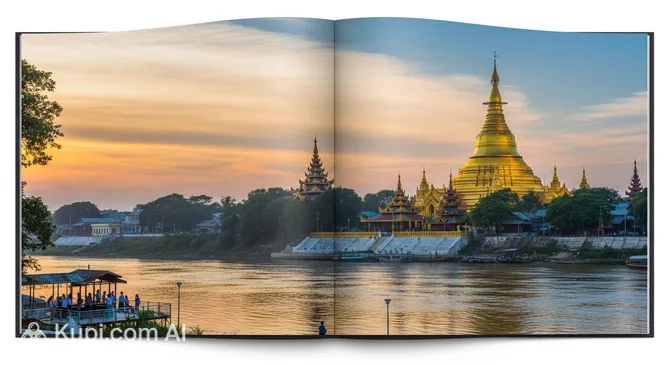
Magway is a dynamic administrative center of the region of the same name, stretching along the left bank of the majestic Irrawaddy River in the heart of Myanmar. The city has the unique atmosphere of a vital transportation crossroads, where the country's key highways intersect, connecting the north with the south and the west with the east. Life here flows to the rhythm of bustling trade and a busy river port, making it an interesting stop for those who want to see the real, non-touristy life of the region.
Magway. Illustration.
Source: Kupi.com AI
The city's geographical position defines its significance: it is located approximately 120 kilometers from the country's capital, Naypyidaw. According to modern estimates, the population of Magway reaches 289,000 people. Despite its status as a transit hub, the city maintains a provincial tranquility. The history of this region is closely linked to the development of river shipping and agriculture in the country's central dry zone.
Among the key features that draw travelers' attention is the famous Myathalun Pagoda, whose golden domes rise above the banks of the Irrawaddy. The city also serves as a convenient base for exploring nearby forts and archaeological zones. We invite you to visit Magway to experience the authentic flavor of the central part of the country and enjoy the sunsets over the great river.
Weather Overview
The climate in Magway is typical of Myanmar’s central dry zone. A tropical weather pattern prevails here, characterized by a hot dry season and a monsoon rainy period. The hottest month is April, when the average maximum reaches an impressive 39-40°C, and the air remains dry. Winter in the city is very mild and pleasant: in January, the average temperature is about 22°C, making this period the most comfortable for visiting.
The rainy season usually starts in May and lasts until October. The peak of precipitation occurs in September, when up to 200 mm of moisture falls. During this time, humidity increases significantly, and the proximity of the Irrawaddy River creates a special microclimate. If you plan a trip during this time, be sure to bring a light raincoat, although showers are often short-lived and followed by bright sunshine.
Overall, the weather in Magway is conducive to travel most of the year, though the intense heat in the spring months should be considered. The ideal time for walking around the city and sightseeing is from November to February, when dry and moderately warm weather sets in, allowing you to fully enjoy the beauty of the riverbank.
Average monthly temperature
Average monthly precipitation
Interesting Facts
Magway holds a strategic position as a key transportation hub at the intersection of Myanmar's major highways, connecting all four cardinal directions.
The city is located on the left bank of the Irrawaddy River at an elevation of only 49 meters above sea level, making it an important river port for the region.
The city has its own airport nearby, which, despite its small size, plays an important role in connecting the central part of the country with major cities.
The city's population is showing rapid growth: while about 55,000 people lived here in 1983, today estimates of the number of residents are approaching 290,000.
The city serves not only as a transport hub but also as the important administrative center of the Magway Region, coordinating life in a vast agricultural area.
How to Get There
Magway is a vital transport hub in the central part of the country, ensuring good accessibility for travelers. Thanks to its location at the intersection of key roads, the city is conveniently connected by bus service to Yangon and Mandalay. A trip from Yangon can take between 10 to 12 hours, and this route allows you to see diverse rural landscapes, though road conditions during the rainy season should be taken into account.
For those who prefer air travel, Magway Airport (MWQ) operates in the city. Although the regularity of flights may vary, it periodically handles domestic flights from the country's largest cities. A flight from Yangon or Mandalay takes just over an hour, which significantly saves travel time.
Railway connections also link Magway with the capital, Naypyidaw, and other regions. Traveling by train is a great way to experience local color; the journey from the capital usually takes about 4-6 hours. More detailed information on routes and travel times can be found in the section on how to get to the city.
Station
Passenger traffic
Distance
Naypyitaw Central Railway Station
3
135 km
Mandalay Central Railway Station
6
234 km
Main Attractions
While Magway is primarily known as an administrative and transit center, the inquisitive traveler will find several noteworthy sites here. The main spiritual landmark of the city is the Myathalun Pagoda. This magnificent religious structure, located on the banks of the Irrawaddy River, is particularly beautiful in the rays of the setting sun, when the gold of its spires is reflected in the river's surface.
For fans of military history, the nearby Min Hla Fort is of great interest. This historic fortress was built to defend against British forces during the Anglo-Burmese Wars and is a rare example of European fortification architecture in the region. Visiting the fort allows for a deeper understanding of the local people's heroic past.
In the vicinity of Magway, you can also find the ancient archaeological site of Beikthano. This is one of the oldest city-states of the Pyu people and is included in the UNESCO World Heritage list. Strolling through the central markets by the river can also be an attraction in itself, offering tourists a chance to immerse themselves in the everyday hustle and color of local trade.
Local Cuisine
The culinary scene in Magway is a quintessence of the flavors of central Myanmar, where rice always takes center stage, accompanied by a variety of curries. Due to its proximity to the Irrawaddy River, you should definitely try fresh river fish dishes, which local chefs prepare with aromatic herbs and spices. The cuisine here is simple, hearty, and reflects the agricultural nature of the region.
Among the signature dishes every guest should try is mohinga—a traditional fish soup with thin rice noodles, considered a national treasure. Also, do not miss the opportunity to taste lahpet thoke (the famous tea leaf salad), where fermented tea leaves are mixed with fried nuts, garlic, and vegetables, creating a unique flavor.
The food culture in the city centers around bustling markets and tea houses. In these establishments, locals spend hours enjoying strong Burmese tea with condensed milk. Street food in Magway is safe and diverse, ranging from steamed buns to fried snacks. Restaurants along the riverbank offer not only a delicious dinner but also a beautiful view of passing boats, making the meal particularly atmospheric.
Travel Tips
A visit to Magway will give you a unique experience of getting to know the authentic Myanmar. To make your trip as comfortable as possible, we have prepared several practical recommendations.
Clothing and Dress Code: Choose light clothing made from natural fabrics, as it can get very hot in the region. When visiting pagodas and monasteries, be sure to cover your shoulders and knees, and be prepared to remove your shoes and socks before entering a temple.
Finances: International cards are practically not accepted in the city, so always carry a sufficient supply of cash Kyat. It is better to exchange currency in advance in large cities or at local bank branches.
Transport: Motor-rickshaws are the best way to get around the city. Agree on the price of the trip before getting into the vehicle.
Connectivity: Buy a local SIM card (e.g., MPT or Telenor) immediately upon arrival in the country—this will provide you with a stable mobile internet connection, as Wi-Fi in hotels can be slow.
Health: Drink only bottled water and use sunscreen. Pharmacies can be found on central streets, but it is better to bring specific medications with you.
Etiquette: The Burmese are very polite people. Greet people with a slight bow or a smile. Do not touch the heads of local residents and do not point at objects or people with your feet.
What to Avoid: Do not engage in discussions on political topics and avoid photographing military or administrative facilities to prevent any misunderstandings.
Specific Tip: Try to be at the Myathalun Pagoda during sunset—this is the most magical time in Magway.
May your stay in this river city be filled with interesting discoveries and warm encounters!
Entertainment & Nightlife
The entertainment industry in Magway is primarily geared toward locals, so it is difficult to find noisy nightclubs or Western-style bars here. The main evening pastime for residents is visiting traditional tea houses and cozy street cafes, where the latest news is discussed over a cup of strong Burmese tea. A special atmosphere prevails on the Irrawaddy embankment, where food stalls open as the air cools and local families come out for a walk.
For those seeking cultural leisure during the day, visiting local markets and squares, which are the epicenter of urban activity, can be interesting. Here, you can observe the life of the river port and the work of local artisans. The evening lighting of the pagodas also creates a wonderful, almost mystical atmosphere, perfect for quiet walks.
If you crave more active nightlife or modern entertainment, it is worth planning a trip to the capital, Naypyidaw, located a couple of hours away. In Magway itself, life quiets down quite early, so for safety and convenience, it is recommended to arrange for a taxi or motor-rickshaw driver in advance for returning to the hotel in the evening. The central areas of the city near the river remain safe and welcoming until late in the evening.
Parks & Museums
Park architecture in Magway is predominantly utilitarian or religious in nature. The city does not yet have extensive botanical gardens; however, the territory around the main shrine—the Myathalun Pagoda—serves as a kind of green zone and a place of rest for the citizens. A walk along the banks of the Irrawaddy River also serves as a park for locals: the fresh river breeze and open spaces make the embankment a popular place for a promenade.
Regarding museums, the city is more focused on preserving living traditions than on archival storage. While there are few classical museums in the European sense in Magway, the unique history of the region can be studied through the architecture of local monasteries. These often house ancient manuscripts and religious artifacts of great cultural value.
For those looking for larger-scale exhibitions, it is recommended to visit neighboring archaeological zones such as Beikthano, where the earth itself serves as an open-air museum. In the city itself, attention should be paid to the central squares and small parks near administrative buildings, which reflect the modern stage of development of this important regional center.
Getting Around
The transport system within Magway is simple and functional, fully meeting the needs of a provincial center. The main means of transportation for tourists are taxis and motor-rickshaws (tuk-tuks). They are available everywhere, especially near markets and hotels. It is advisable to agree on the price of the trip in advance, as meters in local taxis are a rarity.
City buses connect outlying areas with the center, but they can be crowded during peak hours, and the routes are not always intuitive for a foreigner. Many locals prefer bicycles and light scooters, which allow them to maneuver through narrow streets and bypass trucks on transit highways. For tourists, renting a bicycle can be an excellent way to explore the city at a leisurely pace.
Due to its status as a major transportation hub, transit cargo vehicles are often seen on the central roads of Magway. This should be taken into account when planning walks, especially near the bridge over the Irrawaddy. Overall, the city is quite compact, and many interesting places in the center can be explored on foot, enjoying the daily life of this river port.
Accommodation
Hotel infrastructure in Magway is primarily oriented toward transit travelers, pilgrims, and business people. One should not expect an abundance of luxury five-star hotels here, but the choice of quality mid-range accommodation is quite wide. Most popular hotels are concentrated near transport hubs—the airport and the railway station—which is convenient for those making a short stop in the city.
Budget travelers can find cozy guesthouses and small private hotels offering basic amenities at very affordable prices. For those who value comfort, there are 3-star hotels with air conditioning and included breakfast. Service in such establishments is usually friendly, and the staff is ready to help with organizing further travel routes.
During peak periods, such as religious festivals at the Myathalun Pagoda, demand for accommodation increases, so it is recommended to book rooms in advance. Major online booking systems cover the city's largest hotels, but smaller guesthouses may require direct contact. The price range in the city remains very affordable compared to tourist centers like Bagan or Inle Lake.
Nearby Cities
Thanks to its central location, Magway is an ideal starting point for exploring the lesser-known but charming towns of the region. Just a few kilometers across the river lies the town of Minbu, known for its unusual mud volcanoes and sacred sites. You can get there via the bridge or by ferry, which is an adventure in itself.
Another interesting destination for a day trip is Yenangyaung, located about 34 kilometers away. This town has significant historical importance as an oil industry center and offers beautiful views of river landscapes. You might also consider a trip to Taungdwingyi, where you can get acquainted with the traditional way of life in the central dry zone.
City
Population
Distance
Minbu
22 962
8 km
Yenangyaung
110 553
34 km
Taungdwingyi
145 909
65 km
Chauk
90 870
84 km
Aunglan
57 897
92 km
Exploring the surroundings of Magway allows travelers to see Myanmar without embellishment, enjoy the hospitality of the locals, and discover unique natural and cultural monuments hidden from the mass tourist. Each of these directions will add depth to your journey through the region.
Shopping & Souvenirs
Shopping in Magway is primarily about immersing yourself in the atmosphere of traditional Burmese bazaars. The city's main shopping areas are concentrated near the banks of the Irrawaddy and in the central part of the district. You won't find huge, glittering shopping malls here, but you can purchase goods for which this agricultural region is famous: premium rice, legumes, and various types of vegetable oils.
In local markets, pay attention to handcrafted items. Traditional Burmese fabrics and handmade scarves, known for their durability and bright ethnic patterns, make excellent souvenirs. You can also find high-quality ceramics and woodwork produced in the surrounding villages in Magway.
Shops and markets usually start operating early in the morning and close at dusk. Payments are primarily made in cash in the local currency (Kyat); cards are only accepted in very large hotels or rare specialized shops. Bargaining in markets is appropriate and even welcomed; it is a great way to interact with locals and get a pleasant discount on a memento.