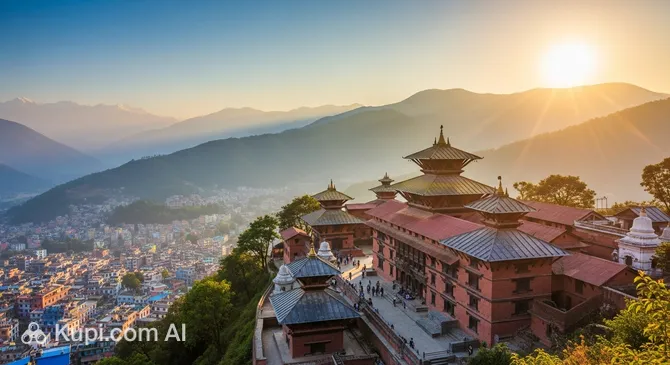
Gorkha is a town that itself resembles a huge open-air museum surrounded by majestic nature. It's hard to find the usual European parks with alleys and fountains here; however, the town's green zones represent something more: they are sacred forests, steep hillsides, and ancient gardens where the history of Nepal intertwines with the wild beauty of the Himalayan foothills.
Although there isn't a great variety of botanical gardens in the town, the natural areas are breathtaking in their authenticity:
The Sacred Forest around Gorkha Durbar
Ascending to the main palace via the famous stone steps (there are over a thousand), you essentially pass through a dense green zone protected by the state and local traditions. This forest area on the hillside serves as a natural park where you can encounter centuries-old trees offering cool shade even on a hot day. A walk here is not just physical exercise, but an opportunity to enjoy the silence, birdsong, and the scent of subtropical vegetation before the panorama of snowy peaks opens before you.
Upallokot Viewpoint
This site is located above the palace complex and is a natural viewpoint at an altitude exceeding that of the palace itself. While it is not a park in the traditional sense, it is the best green area for a picnic and contemplation. From here, perhaps the most impressive view of the Manaslu massif and the valley below opens up. The terrain is covered with grass and shrubs, and local residents can often be found here enjoying the sunset.
The town's cultural heritage is carefully preserved in its key museum complex:
Gorkha Museum (Lower Palace / Tallo Durbar)
This is the town's main and most significant museum, located in the Lower Palace building, built in 1835. The structure itself is a masterpiece of Newar architecture with rich wood carvings on windows and doors. Inside the museum is an extensive exhibition dedicated to the history of the Shah dynasty and the unification of Nepalese lands. Tourists can see a collection of antique weapons, musical instruments, coins, manuscripts, and everyday items from the 18th–19th centuries. Of particular interest is the museum's inner courtyard—a well-kept garden where you can rest in the silence of historical walls.
In the category of historical and architectural monuments, the town has no equal in the region:
Gorkha Durbar Complex
This architectural ensemble crowning the hilltop is the symbol of the town. It combines the functions of a fortress, palace, and temple. The building, erected in the 16th century, is striking for its impregnability and the elegance of its wooden craftsmanship. For tourists, it is an opportunity to touch the origins of Nepalese statehood. The temple of the goddess Kali is also located here, which is an important spiritual center. The architecture of the complex is perfectly integrated into the landscape, creating the feeling that the palace grew out of the rock.
Insider Tip: If you want to feel the true magic of this place, head to the Gorakhnath Temple (next to the upper palace) at dawn. At this time, there are the fewest tourists, and the morning mist rising from the valley creates a mystical atmosphere. Pay attention to the small cave near the temple—according to legend, it was here that Saint Gorakhnath meditated, and his footprints carved in stone are preserved there.