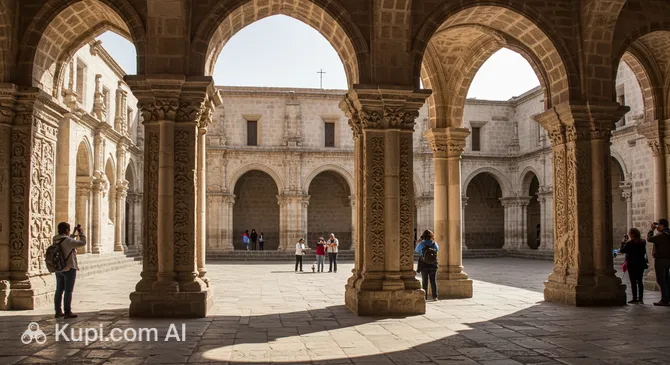
In the very heart of the "White City" of Arequipa, lies an architectural treasure — the Cloisters of La Compañía. This ensemble is an integral part of the ancient Jesuit complex and represents a magnificent example of colonial Baroque. The defining feature of this site is the use of sillar, the white volcanic stone that gives the city's buildings their iconic and unique appearance.
Cloisters of La Compañía. Illustration.
Source: Kupi.com AI
Traveler photos:
The cloisters consist of spacious and bright inner courtyards framed by elegant arcades. Strolling through the vaulted galleries, one can spend hours admiring the intricate stone carvings that adorn the massive columns. Originally intended for the seclusion and spiritual practices of monks, the site still retains a uniquely tranquil atmosphere.
Today, the Cloisters of La Compañía are not just a historical monument in Peru, but a vibrant cultural center. The site is a must-visit for anyone wishing to experience the history of South American colonization and see how European traditions intertwined with the mastery of local stonemasons.
Contacts
For more details regarding your visit or information about special events, you can use the following contact details:
A visit to the Cloisters of La Compañía offers guests a rare opportunity to enjoy silence in the heart of a bustling city. The primary activity here is contemplation. Examining the facades and column capitals, you will discover stunning details: images of angels, tropical plants, and intricate geometric patterns carved into the pliable volcanic stone.
For lovers of aesthetics, this place is a true photography paradise. The play of light and shadow within the arcades, combined with the contrast of white stone against Arequipa's bright blue sky, allows for unique shots. Additionally, the former monks' cells now often house small art galleries and exhibitions by local artisans, where you can purchase high-quality alpaca wool items or silver jewelry.
Your walk through the galleries can conclude at one of the cozy cafes located right within the complex. Sitting at a table in the courtyard, you can feel the rhythm of history while listening to guides tell stories about the role the Jesuits played in the region's cultural development. It is the perfect place to slow down and recharge before continuing your exploration of the city.
Getting There
The site is located at Gral. Morán 118, making it extremely accessible for any traveler. The cloisters are situated in the very heart of the historical district, just a few dozen yards from the main square, the Plaza de Armas. If you are staying in the center, a leisurely walk to the location will be a pleasant addition to your exploration of the city's streets.
For those arriving in the city via the airport (located approximately 8 km away) or the intercity bus terminal, the most convenient and safest way to reach the historic center is by taxi. The ride takes about 20-30 minutes, depending on traffic conditions.
Public transport also runs towards the center; however, tourists with luggage are advised to use official taxi services. Once you are in central Arequipa, look for the spires of the Cathedral — the La Compañía complex is located right next to it.
Nearest city: Arequipa
History & Facts
The history of this magnificent architectural ensemble began in 1598. It was then that construction of the Jesuit church complex commenced, based on the designs of Spanish architect Francisco Becerra. The building process was long and thorough: over several decades, multiple structures were created, each striving to surpass the previous one in elegance and scale.
The cloisters reached their current, completed form by 1668. A whole constellation of talented masters contributed to their creation, including Juan Rodríguez de Rivera, Juan de Cárdenas, and Miguel Gutiérrez Sencio. Their labor transformed ordinary monastery courtyards into a masterpiece of colonial Baroque.
For centuries, the Cloisters of La Compañía served not only as a place for prayer and seclusion for Jesuit monks but also as an important educational and cultural hub for the region. The architectural style of the complex is unique because it harmoniously blends strict European traditions with decorative elements characteristic of South American indigenous craftsmanship.
Time Needed
To leisurely examine the architectural details, take photographs, and soak in the peaceful atmosphere, most visitors need between 30 and 90 minutes. This is ample time to walk through all the galleries and browse the souvenir shops.
If you plan to visit one of the temporary art exhibitions or decide to relax in a local cafe with a cup of Peruvian coffee, it is worth setting aside a bit more time — about two hours. In any case, the site's compact nature makes it easy to fit into a walking tour of the city center.
Working Hours
The Cloisters of La Compañía hospitably open their doors to visitors every day. Thanks to the convenient schedule, you can explore the landmark either early in the morning or in the evening, when architectural lighting gives the stone a special charm.
Opening Hours:
Monday — Sunday: 06:00 to 21:00.
Such a wide time range makes it easy to plan a visit even with a very tight travel itinerary.
6:00 – 21:00
Nearby
Arequipa's center is packed with interesting locations, and exploring the cloisters is just the beginning of your introduction to this amazing region. A stroll through the surrounding blocks will allow you to feel the spirit of the "White City" more deeply and find entertainment for every taste.
In the relative vicinity of the historical center, there are several parks and recreation areas suitable for the whole family: