Support

St. Michael the Archangel Cathedral, Piura

About

In the very heart of the historical center of Piura stands the Cathedral of Saint Michael the Archangel—a majestic symbol of faith and the main Catholic temple of the region. Founded as far back as 1588, this architectural masterpiece is a living testament to the colonial past of Peru, harmoniously combining Neo-Renaissance austerity with the elegance of historical details.
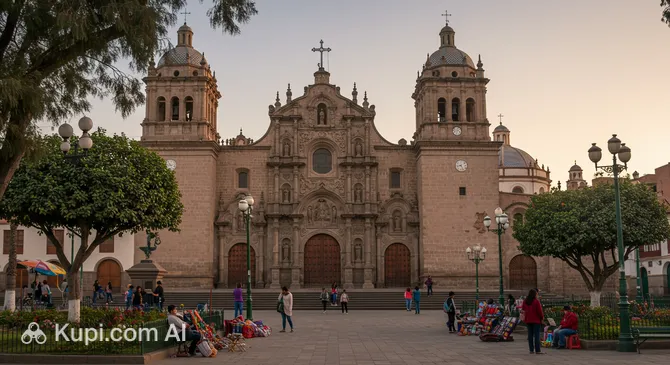
St. Michael the Archangel Cathedral
St. Michael the Archangel Cathedral. Иллюстрация. Источник: Kupi.com AI

The cathedral's facade immediately catches the eye with its cheerful yellow color, which contrasts beautifully with the white and gray decorative elements. Two symmetrical twin towers, one of which features a clock, give the building a solemn and finished look, while its location directly opposite the central Plaza de Armas makes it the primary landmark for all visitors to the city.

Inside, visitors are greeted by a solemn space divided by 20 Doric columns. The main treasure of the interior is the monumental altar, crafted in the Plateresque style and completely covered in gold leaf. This temple is not just a religious site, but a true open-air museum where every element—from the Stations of the Cross to ancient icons—tells the story of the spiritual development of the country's northern region.

Contacts

To check current information about mass times or special events, you can contact the cathedral administration directly. As the cathedral is the active center of the archdiocese, the staff is always ready to assist parishioners and visitors.

How to contactContact
AddressJr. Huancavelica 362, Piura 20001, Peru
Phone+51 73 327112
Websitearzobispadodepiura.org

What to Do

A visit to the cathedral is, first and foremost, an opportunity to experience fine art. First, pay attention to the main altar, created by the Spanish master Julián Alagna. Its golden brilliance and delicate Plateresque-style wood carvings are truly mesmerizing, while the central niches featuring images of the Virgin of the Assumption and St. Michael the Archangel represent the pinnacle of religious sculpture craftsmanship.

Be sure to walk along the side aisles, which house unique Baroque altars from the 17th and 18th centuries. Of particular interest is the Altar of the Lord of the Captive with expressive figures of the Sorrowful Mother, as well as the Altar of the Infant Jesus of Prague, decorated with characteristic Churrigueresque columns. Each of these structures is a valuable example of colonial carving that preserves the spirit of Old Spain.

Don't forget to examine the ancient 17th-century pulpit, decorated with a relief of the Immaculate Conception, and the Altar of Our Lady of Fatima, skillfully carved from precious Nicaraguan cedar. An observant visitor will also notice high reliefs depicting biblical scenes: the Annunciation, the Holy Family, and the Crucifixion, which allow one to trace the evolution of religious art in this region.

Getting There

Finding the city's main sanctuary is easy, as it is located at Jr. Huancavelica 362, right in the historical heart of the city, opposite the central Plaza de Armas. Thanks to this central location, the cathedral is within easy walking distance of most hotels and tourist spots in the downtown area.

If you are arriving from Capitán FAP Guillermo Concha Ibérico International Airport (PIU), the trip will take very little time. The airport is located about 5 kilometers from the center. A ride by taxi or the local mototaxi (a popular choice in these parts) takes about 15–20 minutes. You can also use public transport that regularly runs toward the main square.

For getting around Piura itself, tourists most often choose walking or taxis, as the historical zone is quite compact. If you are in more distant areas of the city, simply ask the driver to take you to the "Catedral de Piura" — every local knows this landmark.

Ближайший город: Piura

History & Facts

The history of this majestic building dates back to the era of the conquistadors. It is believed that the cathedral was founded in 1588, replacing the very first Catholic church in Peru, which was built by the Spaniards in 1539 in the settlement of San Miguel de Piura. Since its foundation, the temple has been under the heavenly patronage of the Virgin Mary of the Assumption and St. Michael the Archangel.

Over the centuries, the appearance of the cathedral has undergone significant changes, largely due to natural disasters. For example, the devastating earthquake of 1912 caused serious damage to the structure, which was followed by a large-scale reconstruction. In the 1940s, under Piura's first bishop, Monsignor Fortunato Chirichigno, the church towers were rebuilt in the Neo-Renaissance style, acquiring their current three-tiered appearance.

The status of the temple also grew alongside the city's development. In 1940, Pope Pius XII proclaimed it a cathedral, and in 1966, Pope Paul VI elevated its status to an arch-cathedral. The sanctuary received special state recognition on December 18, 1942, when it was officially declared a National Colonial Historical Monument.

Interestingly, although the original Baroque altar was lost during historical upheavals, the modern interior of the temple is considered one of the most beautiful in the region. Masters managed to recreate the atmosphere of the colonial era by combining old traditions and 20th-century art into a single harmonious ensemble.

Time Needed

To leisurely explore the cathedral's interiors, study the details of its many altars, and feel the atmosphere of this holy place, most travelers need 1 to 2 hours. This is quite enough for a peaceful visual introduction to the temple's architectural features and religious art.

If you plan to visit the cathedral during a service or want to spend more time studying the detailed wood carvings and ancient reliefs, your stay may be longer. It is recommended to plan your visit in the morning or evening hours, when the soft light best highlights the gold leaf of the main altar.

Working Hours

The cathedral doors are open to parishioners and tourists throughout the week, though the schedule is divided into morning and evening hours. This is important to consider when planning a walk through the city center:

From Monday to Friday, the temple is open from 9:00 AM to 1:30 PM and from 4:30 PM to 6:30 PM. On Saturday, the cathedral is open only in the morning—from 9:00 AM to 1:00 PM. Sunday is a special day when the temple is available for visits all day, allowing believers and visitors to come at any convenient time for prayer or to view the sanctuary.

DayWorking hours
Понедельник9:00 – 13:30, 4:30 – 18:30
Вторник9:00 – 13:30, 4:30 – 18:30
Среда9:00 – 13:30, 4:30 – 18:30
Четверг9:00 – 13:30, 4:30 – 18:30
Пятница9:00 – 13:30, 4:30 – 18:30
Суббота9:00 – 13:00
ВоскресеньеКруглосуточно

Nearby

The cathedral's location in the heart of the historic center makes it an ideal starting point for further exploration of the city. A stroll through the surrounding streets will allow you to immerse yourself deeper into the atmosphere of northern Peru and see how the modern pace of life intertwines with colonial heritage.

Within walking distance of the temple, you will find cozy parks, monuments dedicated to national heroes, and entertainment centers that will interest both adults and children. Below is a list of interesting places located nearby:

NameDistance
Plaza Mayor of Piura0.1 km
Admiral Grau House Museum0.2 km
San Sebastian Church0.3 km
Grau Oval0.4 km
Vicús Municipal Museum0.6 km
Club Grau0.6 km
Festa Restobar1.5 km

Reached the end of the page?

That means the route is fully explored