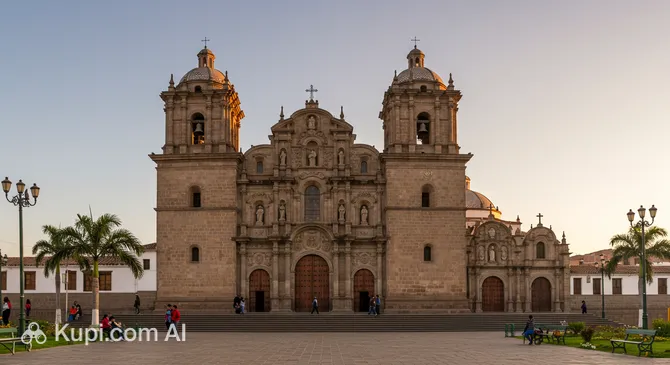
In the heart of bustling Chiclayo stands the elegant Basilica of Saint Anthony of Padua—a striking example of neocolonial architecture in Peru. This Catholic church, built in 1949, is not only an important spiritual center for locals but also a significant landmark that draws tourists with its austere beauty and tranquility.
Basilica of Saint Anthony of Padua. Illustration.
Source: Kupi.com AI
Traveler photos:
The building is notable for its solemn facade, crowned by two symmetrical bell towers. Inside, the basilica features a spacious hall divided into three naves by majestic Corinthian columns. Thanks to its high vaults and well-designed lighting, the interior feels light and airy despite the massive brick walls, which are one and a half meters thick.
Visitors are particularly drawn to the altar area, which is adorned with a wooden sculpture of Christ. The combination of noble materials—oak and cypress in the ceiling finishes and stone in the base—creates a unique atmosphere of peace, making the basilica an ideal place to discover the region's sacred heritage.
Contacts
The basilica is located in the central part of the city, making it easy to find during a walking tour. Below are the current contact details for navigation and inquiries.
A visit to the basilica is primarily an opportunity to enjoy the harmony of neocolonial style and peaceful silence. Begin your visit at the spacious atrium, where you can appreciate the facade's symmetry and take excellent panoramic photos. Inside the church, take note of the graceful Corinthian columns and the rich decor of the vaults, which create a sense of grandeur.
For connoisseurs of religious art, the main point of interest will be the wooden sculpture of Christ on the altar. The church is also an excellent place for prayer or quiet contemplation, offering a peaceful refuge from the city noise. If you are interested in Franciscan traditions, attending a mass will allow you to feel the living history of this place more deeply.
Due to its convenient location, a visit to the basilica can be made part of a fascinating walk through the historic center. Tourists often recommend stopping by in the morning or evening hours to find the church open and fully appreciate the play of light in its high naves.
Getting There
The church is located in the very heart of the city at Av. Luis Gonzales 455. It is easy to find: the building is within walking distance of the main city square (Plaza de Armas) and the Cathedral of Santa Maria. If you are staying in the historic center, the walk to the basilica entrance will take no more than 10–15 minutes.
When traveling from outlying districts or the Gran Terminal de Chiclayo bus station, it is most convenient to use a taxi or a mototaxi, which is traditional in Peru and very affordable. From the Colonel Faustino Zapata Ruiz International Airport, the drive takes about 20–30 minutes depending on traffic.
Public transport in the city consists of numerous buses and minibuses (combis) that run along the main avenues. Look for stops near the central squares, from where the basilica is just a short walk away.
Nearest city: Chiclayo
History & Facts
The history of the Basilica of Saint Anthony of Padua is closely intertwined with the work of the Franciscan Order in the Lambayeque region. Although the current building was erected in 1949, the spiritual presence of the Franciscans in these lands dates back to the 16th century. It was they who laid the foundations of the settlement that eventually grew into the modern city.
Interestingly, Chiclayo did not develop as a typical Spanish colonial city, but rather as an indigenous settlement, which left its mark on the local culture and architecture. The construction of the basilica in the mid-20th century marked a period of architectural revival, where ornate Baroque gave way to more restrained yet majestic neocolonial forms.
The building's construction is impressively sturdy: the foundation is made of massive stone, and the brick walls, held together with lime mortar, reach an imposing thickness of 1.5 meters. This has allowed the temple to successfully withstand the test of time. The basilica has become an important symbol of the city, harmoniously complementing the ensemble of Elias Aguirre Square and highlighting the region's deep Catholic heritage.
Time Needed
For a quick look at the facade's architecture and a tour of the interior, 30–45 minutes is usually sufficient. This is enough time to appreciate the scale of the naves, examine the altar details, and take souvenir photos in the atrium.
If you plan to attend a service or wish to spend time in quiet meditation, it is worth setting aside about an hour. Thanks to its central location, a visit to the basilica is easily combined with a stroll through the historic center without overloading your travel schedule.
Working Hours
The basilica doors are usually open to visitors from Monday to Friday in two blocks: from 09:00 to 12:30 and from 16:00 to 19:00. On Saturday, the schedule is shortened—from 09:00 to 11:00—and on Sunday, the church is generally closed for tourist sightseeing.
Please note that access to the basilica may be restricted during masses or special ceremonies. To avoid arriving when the doors are closed, it is recommended to check the current schedule on-site or on the official website of the religious community before planning your visit.
Day
Working hours
Monday
09:00–12:30, 16:00–19:00
Tuesday
09:00–12:30, 16:00–19:00
Wednesday
09:00–12:30, 16:00–19:00
Thursday
09:00–12:30, 16:00–19:00
Friday
09:00–12:30, 16:00–19:00
Saturday
09:00–11:00
Sunday
Закрыто
Nearby
Exploring the area around the basilica will help you get a deeper feel for the city's atmosphere and its modern life. Within walking distance or a short drive from the church, you will find interesting parks, historic buildings, and entertainment venues.