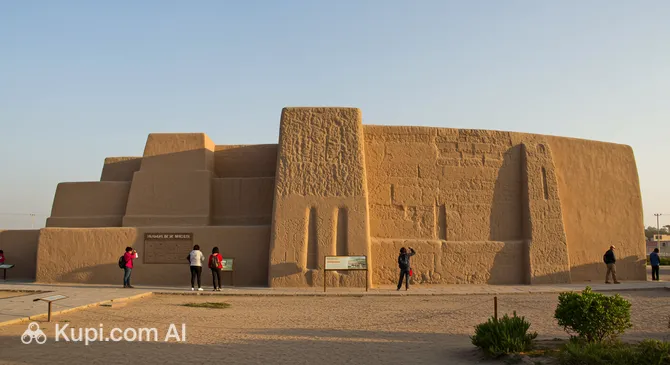
The mysterious past of ancient civilizations comes to life in the city of Trujillo, home to one of South America's most significant archaeological sites. The Huacas de Moche Museum is a unique complex combining the ruins of majestic temples with a rich museum exhibition dedicated to the Moche culture, which flourished in Peru between the 1st and 8th centuries.
The central features of the complex are two grand adobe pyramids: Huaca del Sol (Pyramid of the Sun) and Huaca de la Luna (Pyramid of the Moon). These structures are considered the largest buildings of their time in the region, with Huaca de la Luna being particularly famous for its multi-colored wall murals, which have remained remarkably well-preserved to this day.
Huacas de Moche Museum. Illustration.
Source: Kupi.com AI
Traveler photos:
Today, the site serves as a vital scientific and tourist center, allowing guests to catch a glimpse into the world of one of the most advanced pre-Inca civilizations. Visitors can not only witness large-scale archaeological excavations but also get acquainted with exquisite works of art, including the famous Moche ceramics, which are rightfully considered a pinnacle of pre-Columbian craftsmanship.
Contacts
To ensure your journey to the ancient pyramids is as comfortable as possible, we recommend checking the official details of the archaeological complex in advance. Having up-to-date contact information will help you clarify access details and plan your visit without unnecessary delays.
Below is the essential information for contacting the museum administration and its exact location:
The main activity for every visitor here is exploring the archaeological zones of Huaca de la Luna. Walking along specially equipped walkways, you can get a close look at the unique murals depicting the god Ai Apaec and various ritual scenes. The bright colors, preserved after fifteen hundred years, leave a lasting impression and allow you to appreciate the skill of ancient artists.
Inside the museum building itself, it's worth dedicating time to the collection of artifacts, which features the finest examples of Moche culture ceramics. These vessels, crafted in the form of human heads, animals, and mythical creatures, served as a kind of chronicle for the Moche people. Researchers call them "clay books" because they convey the emotions and details of daily life from that era in great detail.
Often, a visit is complemented by a vibrant cultural experience — a Peruvian Paso horse show. These graceful animals with their unique gait are the pride of the region. The combination of the raw beauty of ancient ruins and the living tradition of horsemanship makes a visit to Huacas de Moche truly rich and multi-faceted.
Getting There
The archaeological complex is located in the picturesque countryside of Campiña de Moche, just a few kilometers from the historic center of Trujillo. The most convenient way to reach the museum is by taxi or via mobile apps. The trip from the main city square takes about 15–20 minutes along a direct road.
If you prefer more structured travel, organized tour groups depart from many hotels in Trujillo. This is an excellent option, as the price usually includes a transfer right to the complex entrance. Public transport in this direction is not very regular, so car-based travel is most frequently recommended for tourists.
For independent travelers using rented transport, use the following address as a landmark: Carr. Campiña de Moche. Precise geographic coordinates (latitude -8.1417, longitude -78.9921) will allow you to easily set a route in your navigator and find the entrance to the site without any trouble.
Nearest city: Trujillo
History & Facts
The origins of this monumental center date back to the period of the Moche culture (or Mochica), which flourished on the northern coast of Peru from the 1st to the 8th century AD. These ancient inhabitants were outstanding hydraulic engineers who managed to create blooming oases in the desert thanks to a complex network of irrigation canals. The center of their powerful civilization was located for a long time in the very valley where the pyramids stand today.
The main structures of the complex, Huaca del Sol and Huaca de la Luna, are recognized as some of the most grandiose buildings made of unfired brick (adobe) in the history of pre-Columbian America. Although the Moche did not have a classical writing system, they left behind incredible "ceramic writing." The depictions on vessels and temple walls are so detailed that modern scientists have been able to reconstruct the daily life, religious rituals, and even the social hierarchy of this mysterious civilization.
One of the most sensational discoveries in the study of Moche culture occurred in 2006. In an untouched tomb, the mummy of a high-ranking woman was found, who was given the name Lady of Cao. The presence of weapons and ritual items in her grave, along with characteristic tattoos on her body, completely changed historians' perceptions of the role of women in the upper echelons of ancient Peru's society.
Time Needed
Most visitors need 2 to 3 hours for a full tour of the complex grounds and the museum exhibition. This is quite enough time to leisurely explore the main pyramid, study the ancient murals, and visit the halls with archaeological finds. If you plan your visit with a guide, the time may increase slightly due to detailed stories about the architectural features of the site.
Those who want to dive deeper into the ancient atmosphere or plan to attend additional events, such as traditional shows, should set aside half a day for the trip. It is best to arrive in the morning when the sun is not yet too strong and the tourist flow is minimal, allowing for great photos without the extra bustle.
Working Hours
When planning your journey to the roots of Moche culture, it's important to consider the specific operating schedule of the complex. Unlike many other museums, it has short working hours, and entry is only possible in the first half of the day, so an early departure from the hotel is the best solution.
According to official data, the museum and archaeological zone operate on the following schedule:
Monday: Closed
Tuesday: 09:00 – 15:00
Wednesday: 09:00 – 15:00
Thursday: 09:00 – 15:00
Friday: 09:00 – 15:00
Saturday: 09:00 – 15:00
Sunday: Closed
Please note that on Mondays and Sundays, the site is completely closed to the public. We recommend checking the information before your visit if your trip falls on a public holiday.
Day
Working hours
Monday
Closed
Tuesday
9:00 – 15:00
Wednesday
9:00 – 15:00
Thursday
9:00 – 15:00
Friday
9:00 – 15:00
Saturday
9:00 – 15:00
Sunday
Closed
Nearby
Exploring the surroundings of the Huacas de Moche Museum can significantly enrich your experience of visiting this region. The Moche River valley and the city of Trujillo itself hide many architectural treasures and family leisure spots just a few minutes' drive away.
In addition to exploring the main pyramids, it is worth spending time in the colonial city center, where old squares and parks create a unique atmosphere. The table below lists interesting sites located near the museum: