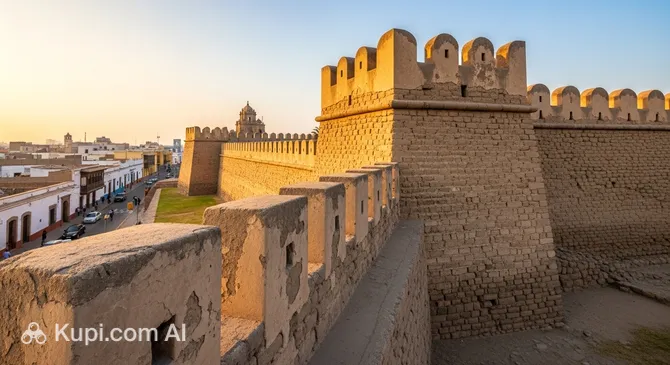
The Trujillo City Walls, also known as Muralla La Cumbre, are a majestic monument of ancient engineering located near the city of Trujillo. This grand structure was built by the Chimú culture about a thousand years ago and once stretched for nearly 10 kilometers across the arid lands of Peru.
Trujillo City Walls. Illustration.
Source: Kupi.com AI
Traveler photos:
The site is a historical location of exceptional importance, where fragments of ancient walls up to 10 meters high cross dry riverbeds. Today, only mysterious traces remain on the landscape of what were once powerful fortifications, continuing to spark the imagination of researchers and tourists alike.
This is not just a defensive line, but a unique testament to the struggle of an ancient people against the elements. A visit to the walls allows you to feel the scale of pre-Columbian civilizations and see how the engineering of the past was woven into the harsh natural landscape of the northern coast.
Contacts
If you are planning to visit this historical site in the city of Trujillo, located in Peru, you will find these current contact details useful. This site is located outdoors, so the provided address serves as a primary reference for navigation and finding the location on a map.
Visiting the La Cumbre Walls offers tourists a rare opportunity to walk through a real open-air archaeological zone. Here, you can witness the traces of the colossal labor of ancient builders and imagine how this area looked a millennium ago, when the wall towered over the desert as high as a three-story building.
Photography enthusiasts will appreciate the contrasting landscapes: the geometrically precise lines of the ancient structure look striking against the backdrop of endless sands and dry riverbeds. It is a great place to capture atmospheric photos that convey the spirit of ancient Peru.
Beyond visual exploration, a walk along the wall invites quiet reflection on history and the climatic challenges faced by the Chimú. This place is ideal for those who want to take a break from the hustle and bustle of popular tourist locations and enjoy the silence surrounded by the mysteries of the distant past.
Getting There
The La Cumbre Wall is located on the outskirts of the city, and the address Jirón Francisco Pizarro, Trujillo 13001 is often used as a primary reference point. The most convenient way to reach this archaeological monument is by taxi or a rental car. The trip from the center of Trujillo takes approximately 20-30 minutes along roads passing through arid desert regions.
For a deeper immersion into the context and proper orientation, it is recommended to book a guided tour, for example, as part of the Huanchaco Archaeological Project. A professional guide will help you find the most interesting sections of the structure that might not be obvious during an independent visit.
Public transport toward this site is very rare, so a taxi remains the priority option for tourists. Since the walk will be in an open area, be sure to bring a supply of water, a hat, and wear comfortable shoes suitable for rocky ground.
Nearest city: Trujillo
History & Facts
The construction of the monumental La Cumbre wall began around 1100 AD. It was built by the Chimú culture—a powerful civilization that flourished on the northern coast long before the expansion of the Inca Empire. For a long time, archaeologists considered this structure to be purely a defensive barrier against external enemies.
However, a more detailed analysis revealed a surprise: the wall turned out to be a brilliant engineering solution for dealing with climate threats. Researchers discovered traces of heavy flood deposits only on the eastern side of the structure. This proves that the wall's primary function was to protect agricultural lands from catastrophic floods.
Such floods were caused by the El Niño phenomenon, which even in ancient times brought devastating rains to this typically arid region. Thus, the Trujillo city walls are one of the most significant monuments of ancient hydraulic engineering, demonstrating the high level of adaptation of the Chimú people to their harsh environment.
Time Needed
It usually takes 1 to 2 hours to explore the preserved sections of the wall and take a short walk around the surrounding area. The site is compact enough for visual inspection, and this time is quite sufficient to appreciate the scale of the ancient construction and take memorable photos.
A trip to the La Cumbre walls is often planned as part of a half-day excursion, combining it with visits to other archaeological complexes such as Chan Chan or the Temples of the Sun and Moon. The best time to visit is in the morning or before sunset, when the soft light highlights the texture of the ancient structures against the desert backdrop.
Working Hours
Since the Trujillo city walls are located in an open area and are not a closed museum complex, they are accessible for viewing 24 hours a day, seven days a week. You can visit this archaeological site on any day of the week, including holidays.
However, visitors are recommended to plan their visit for daylight hours, as there is no artificial lighting on-site. For the most up-to-date information on trail conditions or organized tours, it is worth consulting official city tourist centers or checking specialized archaeological resources.
Open 24 hours
Nearby
A journey to the ancient walls in Peru is a wonderful opportunity to discover other unique monuments of the region. Exploring the surroundings of Trujillo will help you form a complete picture of the development of South American civilizations and enjoy the charm of colonial architecture.
Cozy squares and modern entertainment centers sit alongside archaeological zones, making a visit to this area rich and interesting for tourists of all ages.