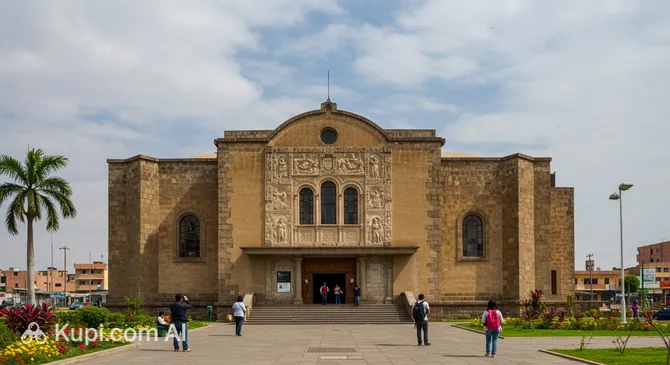
Immerse yourself in the mysterious world of ancient civilizations by visiting the Archaeology Museum of the National University of Trujillo. This is the leading scientific and cultural institution in Trujillo, serving as a window into the rich past of Peru's northern coast. Named after the prominent archaeologist Rafael Larco Herrera, the museum is rightfully considered a must-visit for anyone wishing to understand the origins of Peruvian culture.
Archaeological Museum of the National University of Trujillo. Illustration.
Source: Kupi.com AI
Traveler photos:
The museum halls showcase a grand collection spanning from the first settlers to the Inca era. It houses thousands of artifacts: from the finest textiles and gold jewelry to everyday items. Special attention is given to the Moche culture, whose artisans became world-famous for their realistic ceramics and complex symbolism.
The "crown jewel" of the exhibition is a unique find — the remains of an ancient priestess with hair of incredible length, exceeding two and a half meters. Such exhibits make a visit not just educational, but truly impressive, allowing you to literally touch the secrets hidden by the sands of the Peruvian deserts for millennia.
Contacts
For the most up-to-date information before your visit, you can use the official contact details of the institution. The museum is part of the university's educational structure, so its staff are always ready to assist researchers and curious tourists.
Below is the primary contact information to reach them and find the location on the map:
Within the museum walls, a fascinating journey through time awaits you. Start your tour in the halls dedicated to the Moche and Chimu cultures: here, you can examine in detail the famous anthropomorphic ceramics, exquisite gold pieces, and ancient weapons. Don't miss the opportunity to see models of great temples, such as the Temple of the Rainbow (El Dragón), which help to better visualize the scale of ancient Peruvian architectural achievements.
Anthropology enthusiasts will find the collection of mummies and ritual objects especially interesting. A particular highlight for visitors is the priestess's skull with its preserved braids — this exhibit is one of the most photographed in Trujillo. Interactive burial reconstructions clearly show how complex funeral rites were performed in pre-Hispanic times.
A visit to the museum perfectly complements excursions to nearby ruins like Huaca de la Luna, allowing you to connect the walls seen at excavations with the real objects that once filled them. You can use an audio guide or join an organized group to hear captivating legends about the gods and rulers of the ancient North.
Getting There
Getting to this cultural center is easy, as it is located in the heart of the historical district of Trujillo. The museum is situated at Jr. Junin 682, just a few blocks from the main square, Plaza de Armas, so it is a 5–10 minute walk from most central hotels.
If you are coming from more distant areas or the airport, it is most convenient to use a taxi — the trip will take about 15–20 minutes. Local minibuses called "combis" also run through the central streets and stop near the museum. Keep in mind that parking in this area is limited, so walking through the colonial streets is the best solution.
Nearest city: Trujillo
History & Facts
The founding of this unique institution in Trujillo is inextricably linked with the name of Rafael Larco Herrera, a distinguished researcher whose passion for history laid the foundation for the study of Peru's northern coast. His personal collections and excavation findings became the core of the exhibition, allowing visitors to trace the development of the region's civilizations over millennia.
The study of the Moche culture, which flourished between the 1st and 8th centuries AD, holds a special place in the museum's history. This civilization left behind an incredible legacy of sophisticated irrigation systems and ceramics, considered some of the most skillful in pre-Columbian America. The museum exhibits clearly demonstrate how ancient masters transformed ordinary household items into true works of art.
One of the most striking pieces of historical evidence kept here is the skull of a priestess dating back to the 2nd century BC. The discovery of a woman aged around 50 with braids 2.8 meters long overturned scholars' understanding of women's roles in ancient societies. This fact confirms that in pre-Hispanic cultures, women could hold high social and religious positions, serving as spiritual leaders.
Time Needed
To thoughtfully explore the rich collection of artifacts and read the information stands, a typical visitor will need between 1.5 and 2.5 hours. This time is quite sufficient to walk through all the halls without rushing and pay attention to the rarest exhibits, such as ancient mummies and jewelry.
If you are a professional history enthusiast or plan to study Moche and Chimu ceramics in detail, your visit may last longer. Photography lovers should also set aside an extra half hour to capture the unique details of architectural models and anthropological finds.
Working Hours
When planning your visit to the museum, please note its operating schedule. The institution is open to visitors from Monday to Saturday. On Monday, the museum operates on a shorter schedule — from 09:00 to 13:30, and from Tuesday to Saturday, the doors are open until 17:00. Sunday is a day off.
As the schedule may change during holidays or due to university events, it is recommended to check the current opening hours on the official resource or with local tour operators just before your trip.
Day
Working hours
Monday
09:00–13:30
Tuesday
09:00–17:00
Wednesday
09:00–17:00
Thursday
09:00–17:00
Friday
09:00–17:00
Saturday
09:00–17:00
Sunday
Закрыто
Nearby
The museum's location in the historical center makes it easy to combine your visit with other iconic sites. A stroll through the surroundings will reveal the charm of colonial architecture and the rhythm of life in a modern Peruvian city.
The following sites are within walking distance or a short distance away: