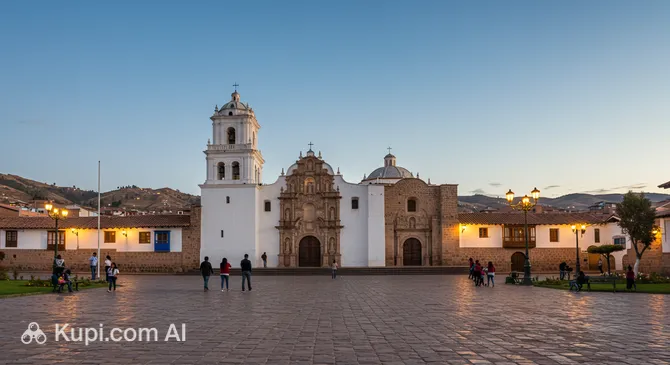
Imagine a cozy corner where time stands still: Belén Square (Plazuela Belén) is a picturesque space in the historic center of Cajamarca. It is part of the famous El Conjunto Monumental de Belén, which is considered one of the most striking examples of colonial architecture in Peru.
Belén Square. Illustration.
Source: Kupi.com AI
Traveler photos:
The central element of the ensemble is a magnificent 17th-century church built of light volcanic stone. Its Baroque facade is rightfully called one of the most elegant in the region. Nearby is the building of a former hospital, which today houses the Ethnographic Museum, showcasing the rich cultural heritage of the northern Andes.
Unique details give the square a special charm: the museum's facade is decorated with frescoes depicting angels and birds, as well as rare sculptures of women symbolizing fertility. It is an ideal place for those who want to feel the spirit of history and enjoy the silence among ancient walls at an altitude of more than 2,600 meters above sea level.
Contacts
For your convenience in planning your itinerary, the official contact details for Belén Square are provided below. Its location in the heart of the historic center makes it easily accessible for all visitors to the city.
A visit to Belén Square is, above all, an aesthetic pleasure. Begin by examining the church's facade: its detailed stone carvings are breathtaking. Stepping inside through the right door, you will find yourself in a cozy courtyard and see a golden altar and a unique dome supported by eight angels. Be sure to look for the painting of "Tired Jesus" (Jesús Cansado)—a rare and very moving iconographic subject.
After the temple, head to the Ethnographic Museum. Here, you can not only learn about the daily life of local peoples but also examine the unusual sculptures on the facade. For photography enthusiasts, this place offers many interesting angles: the play of light on the pale stone and the colonial balconies around the square create perfect backdrops for shots.
If you prefer an active holiday, Belén Square often serves as a starting point for historical quests and walking tours. A stroll through the adjacent alleys will allow you to dive deeper into the atmosphere of a city where Inca heritage is closely intertwined with Spanish traditions. It is a great place to slow down, enjoy the cool mountain air, and watch the locals go about their day.
Getting There
Belén Square is located at Jirón Silva Santisteban 144, just a few blocks from the city's main square, the Plaza de Armas. Thanks to its central location, it is easily reachable on foot, strolling through narrow colonial streets with their famous carved balconies.
If you are arriving in Cajamarca from afar, the nearest airport—Mayor General FAP Armando Revilla Rivas (CJA)—receives flights from Lima. The journey from the airport to the city center by taxi or local bus takes about 20–30 minutes. There is also an excellent bus service connecting to cities such as Trujillo and Chimbote via reliable carriers like Cruz del Sur.
Within the city itself, it is most convenient to get around on foot, as the main attractions are concentrated in the historical zone. However, you can always use the affordable local taxis to quickly reach the complex from more distant neighborhoods.
Nearest city: Cajamarca
History & Facts
The history of this site is inextricably linked to the region's colonial past. El Conjunto Monumental de Belén was erected in the 17th century and was originally intended as a large-scale complex combining a hospital and a church. The buildings are constructed from light volcanic stone, which gives the architecture a special, noble appearance characteristic of the northern Andes.
Cajamarca itself is a city with deep roots dating back more than three millennia. Before the arrival of the Spanish, the Cajamarca culture flourished here, and in the 15th century, the territory was annexed to the Inca Empire by the great Pachacuti. Belén Square has become an important testament to the synthesis of Inca building traditions and Spanish Baroque.
In the past, the complex played not only a religious but also an important social role. For example, the building that now houses the Ethnographic Museum used to be a women's hospital. This highlights the uniqueness of the site as a monument not only to architecture but also to colonial-era medicine, where care for the soul and body went hand in hand.
Time Needed
To leisurely explore Belén Square, step inside the church, and see the Ethnographic Museum's collection, 1–2 hours is sufficient for most travelers. This time is enough to enjoy the architectural details and take memorable photographs.
If you plan to include a visit to the square in a larger walking tour of central Cajamarca, allow a little more time to relax in the square itself. The peaceful atmosphere of this place invites you to simply sit on a bench and watch the slow-paced city life at an altitude of 2,650 meters.
Working Hours
Belén Square is accessible at any time, as the public space itself is open 24/7. You can walk here in the early morning or by the light of evening lamps, which give the ancient buildings a special air of mystery.
Please note that the internal facilities of the complex, such as the church and the museum, have their own operating schedules, which usually coincide with standard daytime hours. Nevertheless, the square itself is always open to tourists from Monday to Sunday.
Open 24 hours
Nearby
Exploring the surroundings of Belén Square allows you to fully experience the atmosphere of ancient Cajamarca. The city's historic center is literally saturated with architectural monuments, cozy passages, and museums, all within walking distance of each other.
A stroll through the nearby streets will reveal modern cultural spaces and monuments dedicated to national heroes. This is a perfect opportunity to combine a tour of colonial churches with a visit to local markets or natural parks located slightly further from the center.